Prop Firm Rules
How to read a prop firm rulebook before you buy: the 10 lines to find
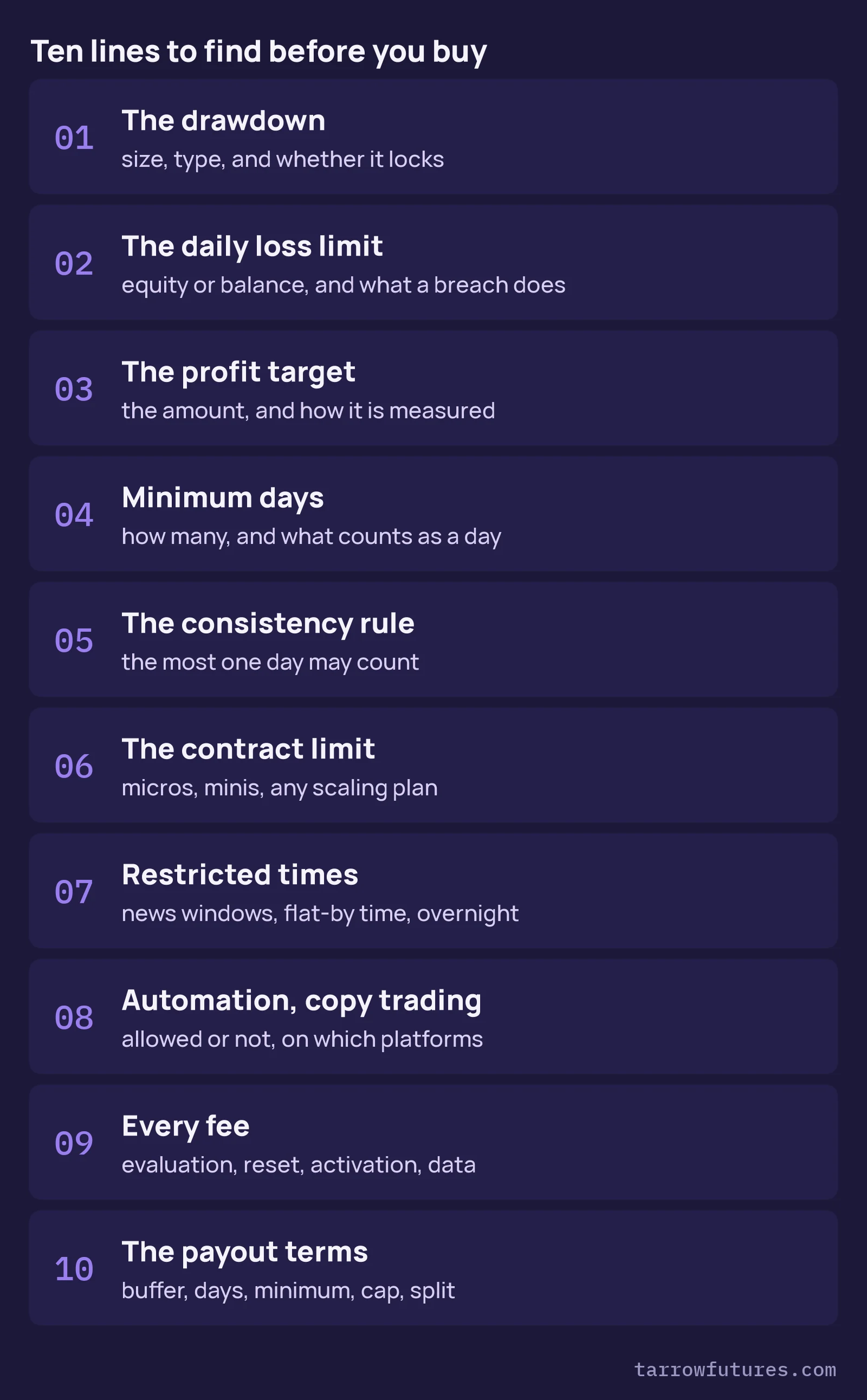
Before you buy a prop firm evaluation, find ten lines in its rulebook: the drawdown, the daily loss limit, the profit target, the minimum trading days, the consistency rule, the contract limit, restricted times, automation and copy trading, the fees and the payout terms. Then turn the dollar figures into units of your own risk per trade, so you can see what the plan asks of the way you trade.
Any one of these lines can end an evaluation or change what it costs, and every one is on a page you can read before paying. This post goes through the ten lines, what to look for in each, and works them on one example plan. The figures are examples for a hypothetical plan that explain the method; they are not any firm's rules and not results. Your plan's current rulebook decides.
Free printable · free with your email
The Floor Sheet
Every account's floor, room and max loss for the day on one page. Up to 8 accounts.
✓ It's yours. The link is on its way to your inbox.
Check your inbox in the next few minutes.
Where the lines are
A plan's rules are often spread across three places: a rulebook or help centre, an FAQ, and the terms of service. Read all three for the exact plan and account type you would buy, because evaluation and funded accounts often have different rules. Note the date each page was last updated, and save a copy on the day you buy.
The ten lines
1. The drawdown. Its size, its type and whether it stops moving. Intraday trailing follows open profit up during a trade; end-of-day trailing moves only on the closing balance; static never moves. Many trailing floors stop rising at a set level, called a lock. How a trailing drawdown works and static vs trailing cover the types.
2. The daily loss limit. The most you may lose in one session, whether it counts open trades (equity) or only closed ones (balance), and what a breach does: fail the account, or stop trading for the day. How it interacts with the drawdown.
3. The profit target. The amount, and whether it is measured on the closing balance or at any moment.
4. The minimum trading days. How many, and what counts as a day: any day with a trade, a day with a minimum profit, or a calendar day. What counts as a day.
5. The consistency rule. The most one day may count toward the target or a payout, as a percentage, and whether it applies to the evaluation, the funded account or both. The consistency rule, worked.
6. The contract limit. The most contracts at once, how micros count against it, and any scaling plan that lowers it while the account is new. Size from the stop and the limits.
7. Restricted times. News windows (which releases, how many minutes, what the rule stops), the time the account must be flat by, and whether holding overnight is allowed. News rules are the most common.
8. Automation and copy trading. Whether bots, trade copiers and running several accounts at once are allowed, and on which platforms. Copy trading across accounts shows what a copied stop costs.
9. Every fee. The evaluation fee, one-time or monthly, the reset fee, any activation fee after a pass, data and platform fees. The real cost of an evaluation adds them up.
10. The payout terms. The buffer, waiting days, the minimum and maximum payout, the profit split and processing time. Payout rules explained.
One example plan, read line by line
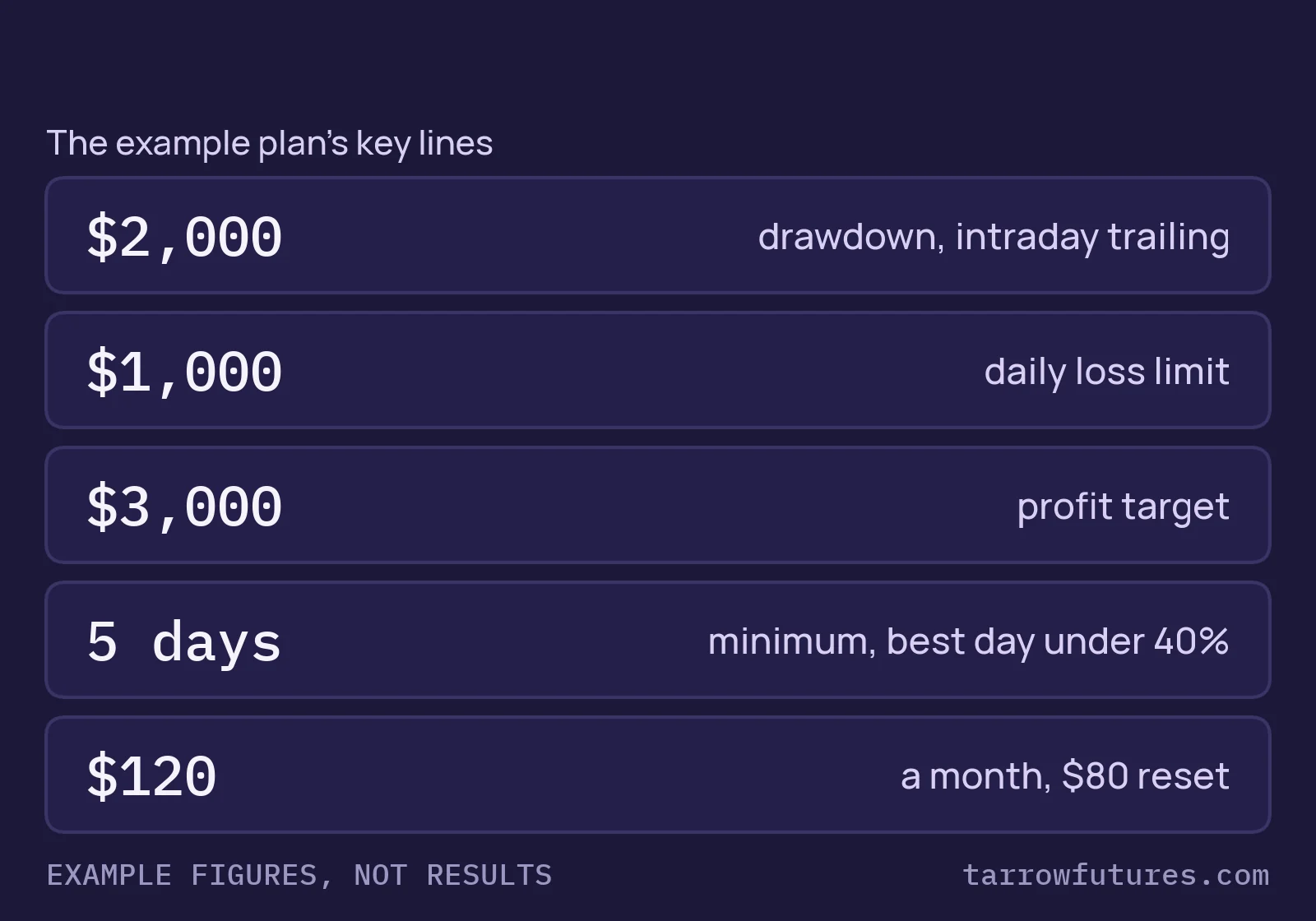
The example plan's rulebook, filled in (example figures, not results):
| Line | Example plan |
|---|---|
| Drawdown | $2,000, intraday trailing, locks at the $50,000 start |
| Daily loss limit | $1,000, counts open trades, a breach fails the account |
| Profit target | $3,000 on a $50,000 account |
| Minimum days | 5 trading days |
| Consistency | best day under 40% of the profit |
| Contract limit | 5 minis or 50 micros |
| Restricted times | 2 minutes either side of listed releases; flat by 3:10 p.m. CT |
| Automation, copy trading | stated in the rulebook (example: both allowed) |
| Fees | $120 a month, $80 reset |
| Payouts | $2,000 buffer, 80% split |
Turn the lines into your numbers
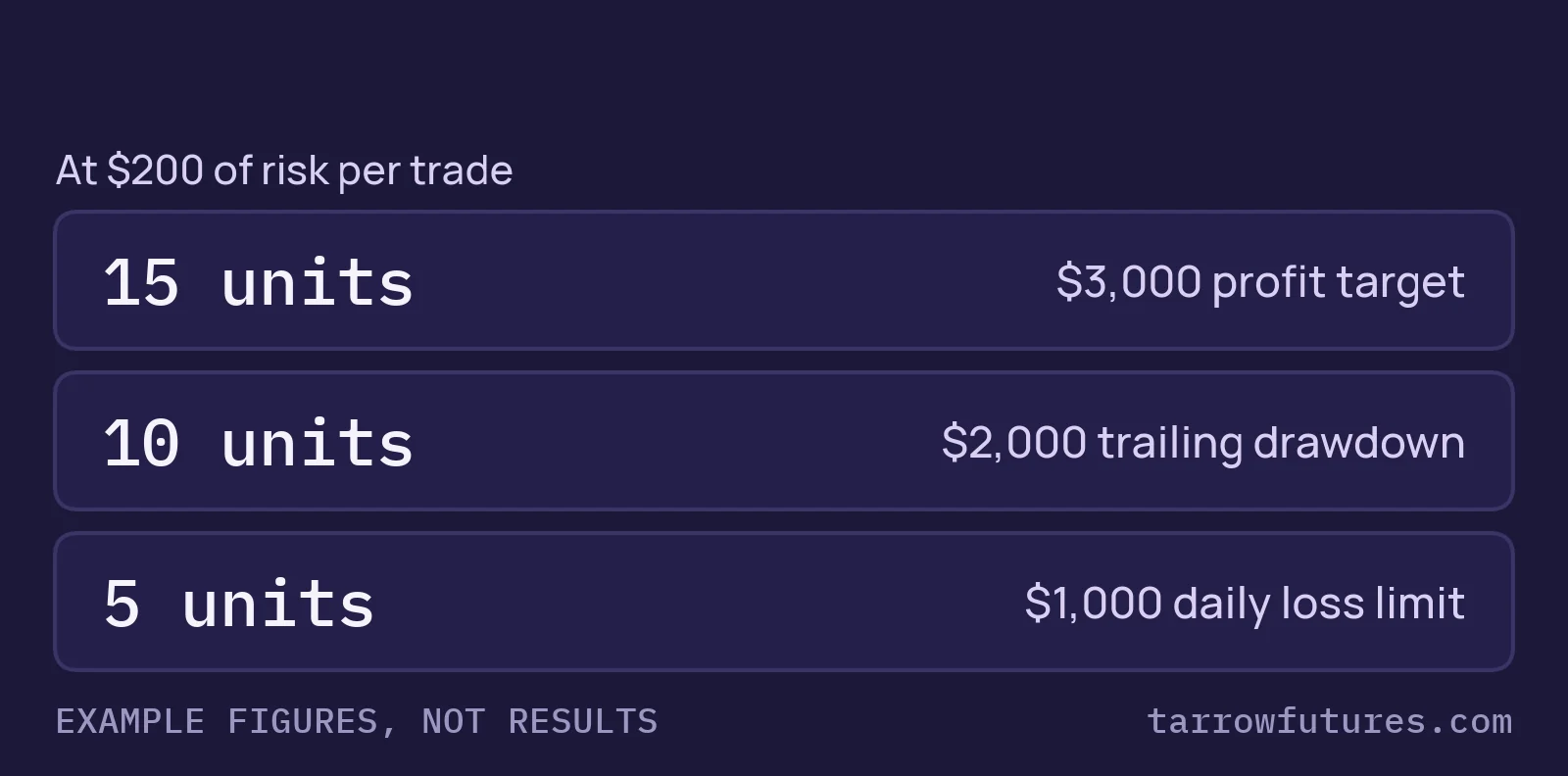
The dollar figures look large until they are measured in your own risk. With $200 of risk per trade (example figure):
| Line | Dollars | In risk units |
|---|---|---|
| Profit target | $3,000 |
$3,000 ÷ $200 = 15 |
| Trailing drawdown | $2,000 |
$2,000 ÷ $200 = 10 |
| Daily loss limit | $1,000 |
$1,000 ÷ $200 = 5 |
So the plan asks for 15 units of profit, allows 10 units of loss from the high, and 5 in a day. Two more numbers come straight from the lines:
- The fewest days. The larger of the
5-day minimum and1 ÷ 0.40 = 2.5, rounded up to3. So5days, however fast the target comes (why). - The cost by month.
$120for each month the evaluation runs:$360if it takes3months, before any reset.
When a line is missing or vague
If you cannot find a line, or can't state it in one sentence, ask the firm in writing before you buy. Quote the line, ask the question, and keep the reply with the copy of the rulebook you saved. A limit with no number, such as "no excessive risk", is a rule you cannot plan around until it has one.
Ask the same way about a pass rate if a firm quotes one: the period it covers, how it counts an attempt, and which plans it includes. A figure without those three is not one you can check.
Five steps before you pay
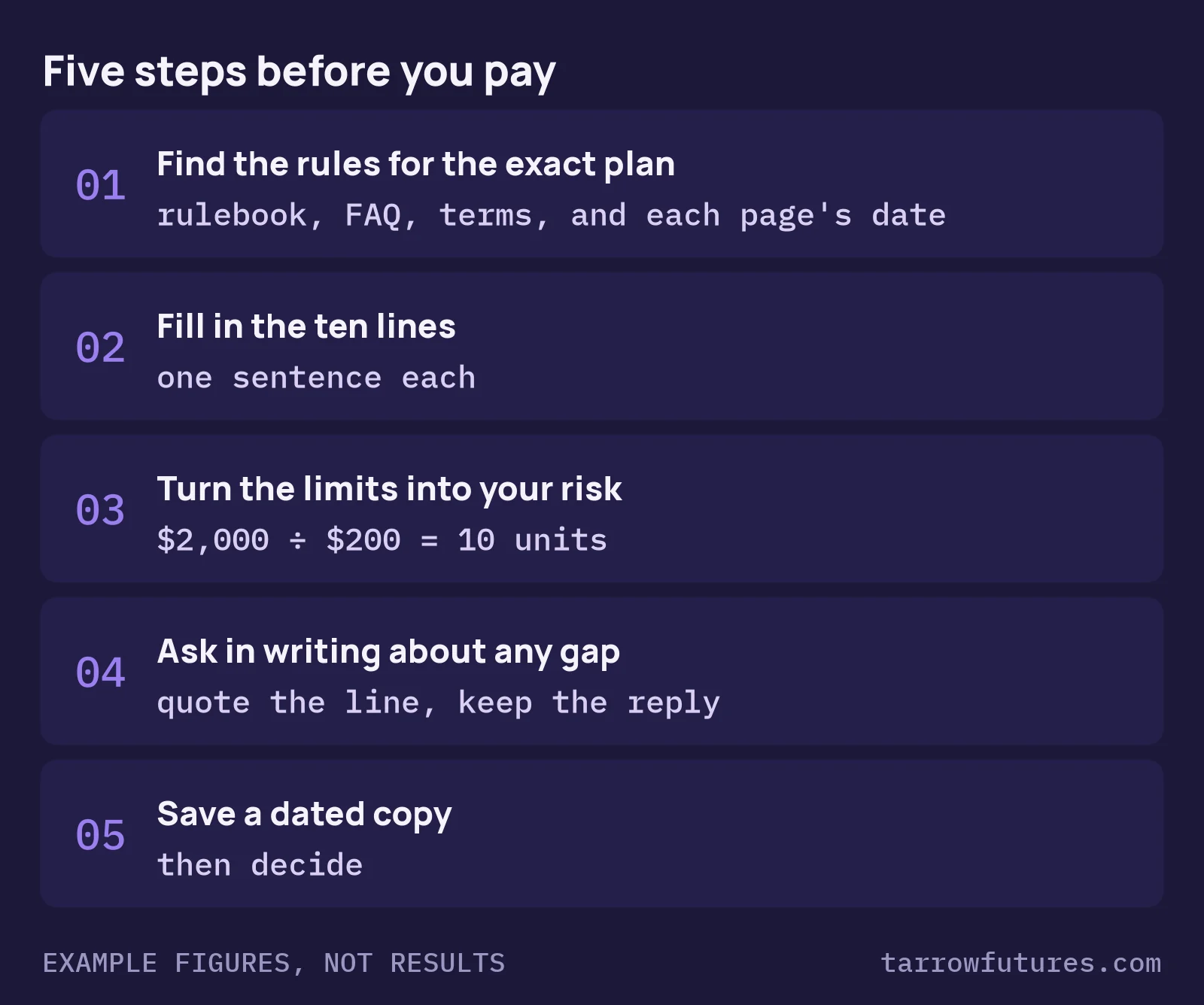
- Find the rulebook, FAQ and terms for the exact plan, and note each page's date.
- Fill in the ten lines.
- Turn the limits into units of your risk per trade.
- Ask in writing about any line that is missing or unclear.
- Save a dated copy of the rules, and only then decide.
Common mistakes
- Reading the account size, not the drawdown. A
$50,000account with a$2,000drawdown has10units of room at$200a trade, not250. - Reading the drawdown size, not its type. The same
$2,000behaves differently intraday, end of day and static. - Reading the evaluation rules only. The funded account can have a different drawdown, consistency rule and contract limit.
- Reading the FAQ only. The rulebook and the terms can add lines the FAQ leaves out.
- Reading last month's rules. Rules change. The version in force on the day of the trade decides.
Keep the ten lines next to every account
The free Floor Sheet is a printable page for up to eight accounts: each account's drawdown type, floor, room, daily limit and max loss for the day, with a 10-point pre-trade checklist of the rules traders breach without noticing. It is free with your email, below.
Only buy an evaluation with money you can afford to lose in full. The fee is spent whether the evaluation passes or not.
Diagrams are illustrations drawn by Tarrow Futures, not market data. Worked examples use example figures for a hypothetical plan, not any firm's rules and not results. Educational only, not financial advice. Trading futures involves substantial risk of loss.
Free printable · free with your email
The Floor Sheet
Every account's floor, room and max loss for the day on one page. Up to 8 accounts. We email you the link, so it is one tap away next time.
✓ It's yours. The link is on its way to your inbox.
Check your inbox in the next few minutes.
Questions
What should I check in a prop firm's rules before buying?
Ten lines. The drawdown type and size, the daily loss limit, the profit target, the minimum trading days, the consistency rule, the contract limit, restricted times such as news windows and the flat-by time, whether automation and copy trading are allowed, every fee, and the payout terms. Each one can end an account or change what it costs, and each plan sets its own.
Where do I find a prop firm's rules?
Usually in a rulebook or help centre, an FAQ, and the terms of service, sometimes spread across all three. Read the version for the exact plan and account type you would buy, note the date each page was last updated, and save a copy on the day you buy.
What if the rules are unclear or two pages disagree?
Ask the firm in writing before you buy, quote the two lines, and keep the answer. A rule you cannot state in one sentence, such as an undefined limit on risk, is a rule you cannot plan around.
Which prop firm rule matters most?
The drawdown, because it decides where the account fails, and its type matters more than its size. An intraday trailing drawdown follows open profit up during the trade; an end-of-day drawdown moves only on the closing balance; a static one never moves. The same $2,000 behaves very differently under each.
How do I compare the rules to my own trading?
Divide each dollar limit by your risk per trade. With $200 of risk per trade on an example plan, a $3,000 target is 15 units, a $2,000 drawdown 10 units and a $1,000 daily limit 5 units. Those three numbers say more about the plan than the account size does.
Do prop firm rules change?
They can. Rulebooks are updated, and the version in force on the day of a trade or a payout request is the one that applies. Save a dated copy when you buy and check the rules page again before any request.
Educational material only. Not financial, investment or trading advice, and not a recommendation to trade any contract or size. Prop firm rules differ and change; the current rulebook of the firm you use decides. Worked examples use example figures, not results. Futures trading involves substantial risk of loss. Evaluations are paid tests and most people who take one do not pass.