Prop Firm Rules
Prop firm payout rules explained: buffers, caps, splits and waiting days
Prop firm payout rules decide when a funded account can request a withdrawal and how much of it reaches you. The buffer sets how much of the balance can be withdrawn, a minimum and a cap set the size of each request, the profit split sets your share, and waiting days set how often you can ask.
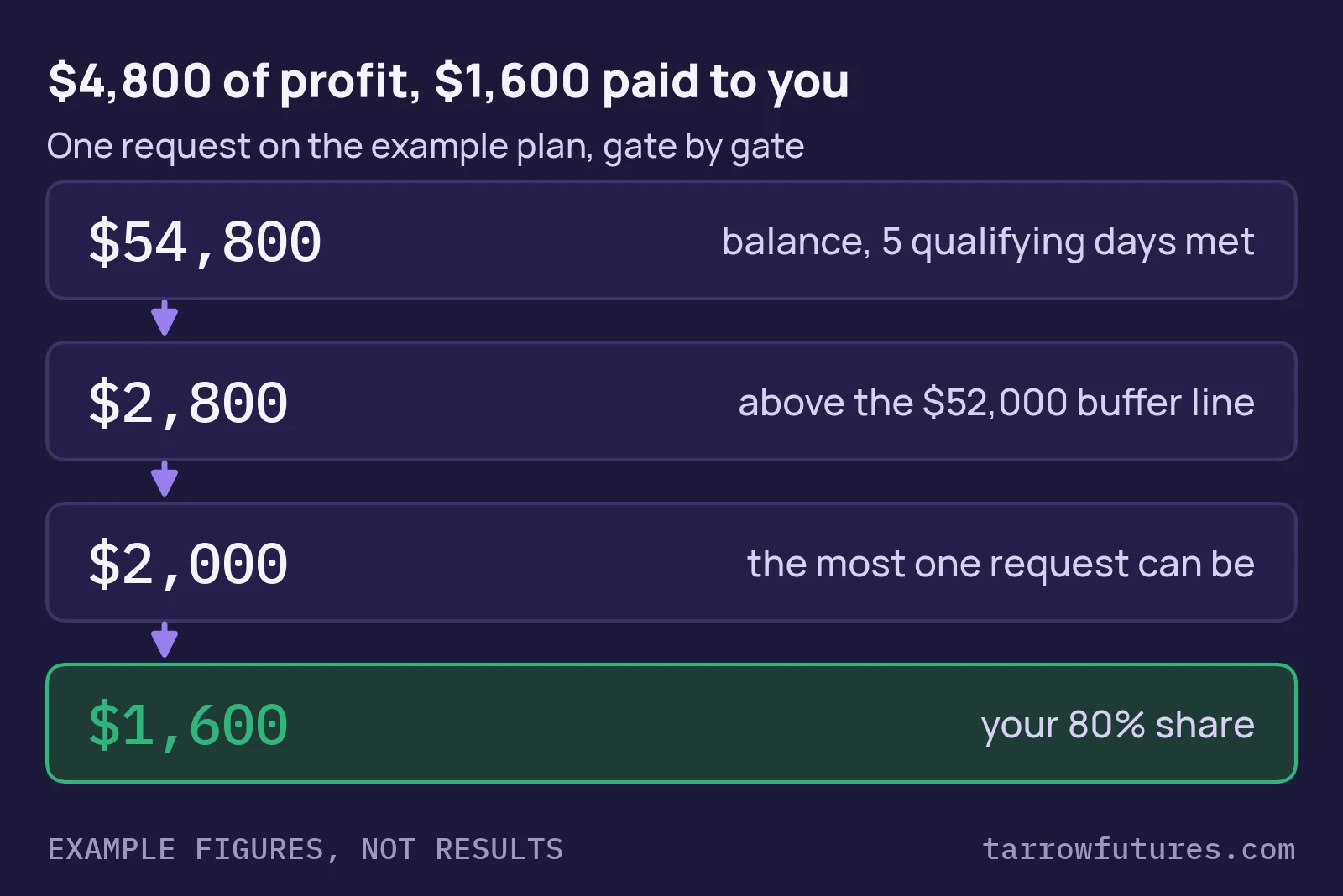
Each one is a separate gate, and a request has to pass all of them. This post defines each rule, then works one request through them on an example plan: a $54,800 balance becomes a $2,000 request and $1,600 paid to you. The figures are examples for a hypothetical plan that explain the mechanism, not any firm's rules and not results. Your plan's current rulebook decides what applies.
Free tool · free with your email
Prop account tracker
Every account's most-you-can-lose today, room to the floor and target, on one screen.
✓ It's yours. The link is on its way to your inbox. Open the prop account tracker now
See what the prop account tracker does firstThe example plan
Used through this post (example figures, not results):
- Starting balance
$50,000, floor locked at$50,000 - Buffer
$2,000above the floor, so the buffer line is$52,000 5qualifying days before each request, a qualifying day being one that makes at least$150- Minimum payout
$500, maximum$2,000per request - Profit split
80%to you, no withdrawal fee
The rules, one definition each
Buffer. A line above the floor. Only the balance above it can be withdrawn. The buffer post works through it in full; on the example plan the line is $50,000 + $2,000 = $52,000.
Waiting days. The days that have to pass before the first request, and again between requests. Plans count them as trading days, as qualifying days with a profit threshold, or as calendar days. What counts as a day is set by the plan, and the definitions differ more than the numbers do.
Minimum payout. The smallest request allowed. Below it, nothing can be requested.
Payout cap. The largest single request allowed. Some plans cap only the first few payouts; others cap every one. Anything above the cap stays in the account.
Profit split. The share of each payout that is paid to you. At 80%, $1 requested pays you $0.80. Some plans change the split after a number of payouts or above a set amount.
Consistency at payout. Some plans apply a consistency rule to the profit since the last payout, not only to the evaluation. A best day above the cap can hold a request back until more days are traded.
Processing time. How long an approved request takes to be reviewed and paid, usually stated in business days. It is not the same as waiting days: waiting days come before the request, processing comes after it.
Fees and method. Withdrawal or payment-method fees, and which payment methods the plan uses. They come out of your share, so they belong in the cost of the evaluation too.
One request, worked through every gate
The account has 5 qualifying days since it was funded and a balance of $54,800.
| Gate | Working | Result |
|---|---|---|
| Waiting days | 5 qualifying days of 5 needed |
met |
| Buffer | $54,800 − $52,000 |
$2,800 withdrawable |
Minimum $500 |
$2,800 is above it |
met |
Cap $2,000 |
the smaller of $2,800 and $2,000 |
$2,000 requested |
Split 80% |
$2,000 × 0.80 |
$1,600 paid to you |
The account is $4,800 in profit, and $1,600 of it reaches you from this request. The other gates explain the gap: $2,000 of the profit is the buffer, $800 is above the cap and stays in the account, and $400 is the plan's 20% share of the request.
When the minimum blocks a request
Same plan, a balance of $52,400 after 5 qualifying days. The account is $2,400 in profit, but only $52,400 − $52,000 = $400 sits above the buffer line. That is below the $500 minimum, so no request can be made. It needs at least $100 more above the line, and a losing day takes it further away.
After the payout
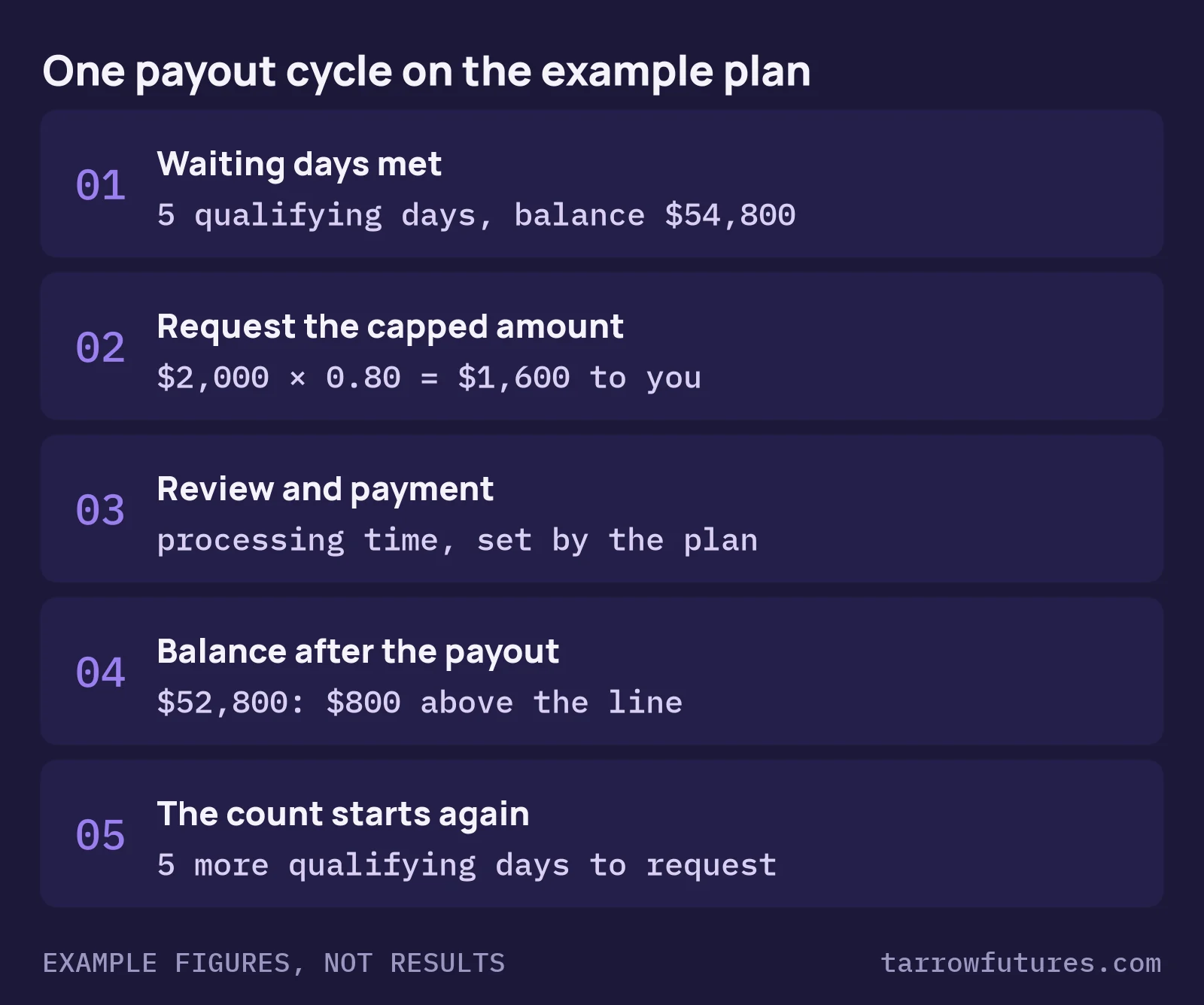
On the example plan the $2,000 request comes off the balance in full. The balance goes from $54,800 to $52,800, and the floor stays at $50,000:
| Before | After | |
|---|---|---|
| Balance | $54,800 |
$52,800 |
| Room to the floor | $4,800 |
$2,800 |
| Above the buffer line | $2,800 |
$800 |
The $800 left above the line is not paid and not saved. It is part of the balance, and a losing day comes out of it first. The waiting-day count also starts again: on the example plan, the next request needs 5 more qualifying days counted from this one. Whether the count restarts, and whether the buffer or cap change after the first payout, is plan-specific. Does a trailing drawdown reset after a payout? covers what the withdrawal does to the floor.
What payout rules do not tell you
They say when a request is allowed and how big it can be. They do not say that an account will reach a payout, how often one will be requested or what it will add up to over time. None of the figures here is a forecast.
Eight lines to find in the payout section
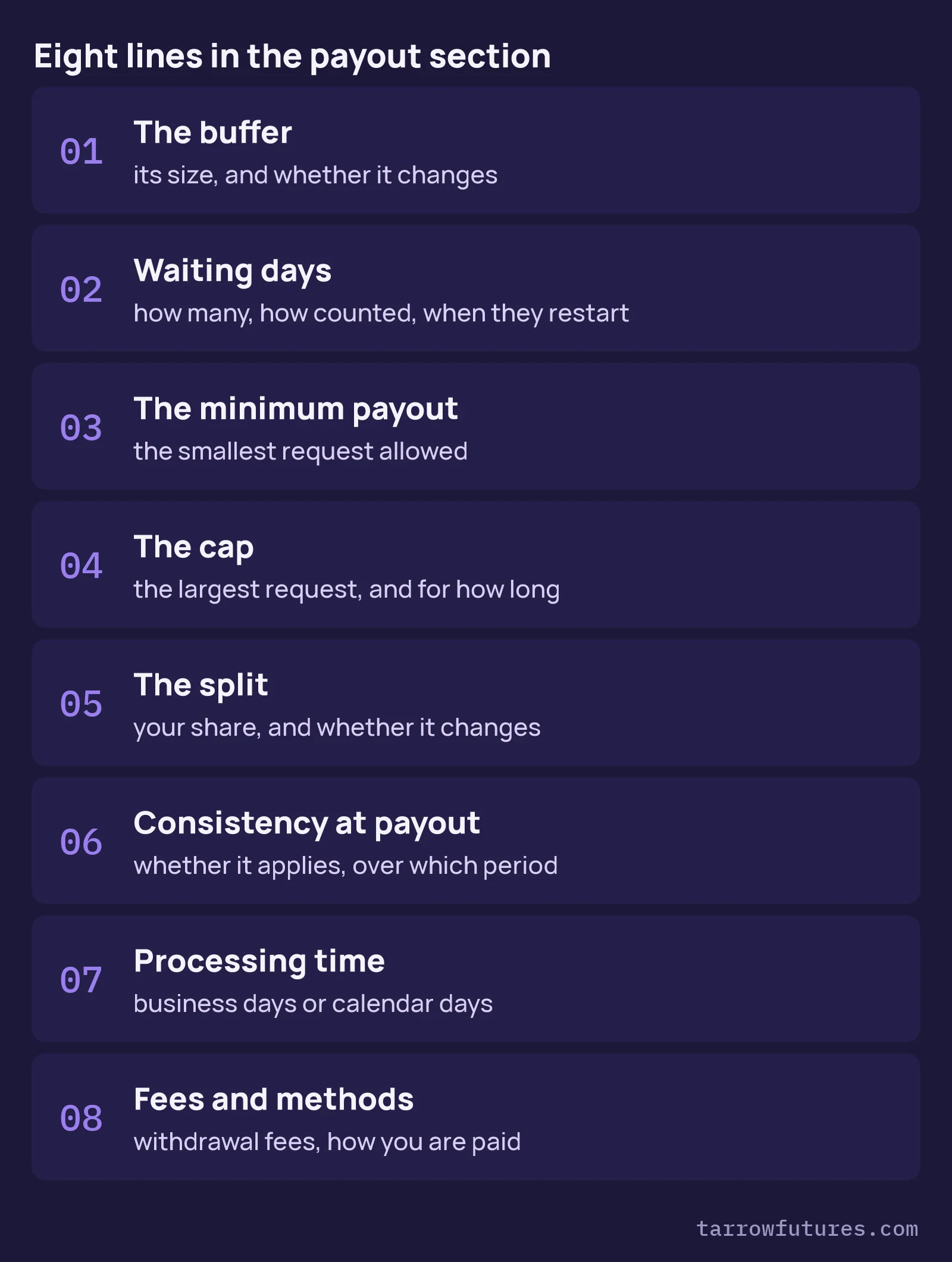
- The buffer. Its size, what it is measured from, and whether it changes after a payout.
- Waiting days. How many, how a day is counted, and whether the count restarts after each payout.
- The minimum payout. The smallest request allowed.
- The cap. The largest request, and whether it applies to every payout or only the first few.
- The split. Your share, and whether it changes over time.
- Consistency at payout. Whether a consistency rule applies to payouts, and over which period.
- Processing time. How long a request takes, in business days or calendar days.
- Fees and methods. Withdrawal and payment-method fees, and how you are paid.
Common mistakes
- Treating profit as withdrawable.
$4,800of profit was a$2,000request on the example plan, after the buffer and the cap. - Forgetting the split. The request and the amount paid to you are different numbers:
$2,000and$1,600. - Mixing up waiting days and processing time. One comes before the request, the other after it.
- Counting what is above the cap as banked. The
$800left over is still balance, still exposed to the next losing day. - Reading last month's rules. Payout terms change. The current rulebook on the day of the request decides.
Keep each account's numbers in one place
The free prop account tracker keeps each account's balance, floor, room to the floor and trading days on one screen, so you can check an account against its own payout rules before you request. It is free with your email, below.
Only buy an evaluation with money you can afford to lose in full. The fee is spent whether or not an account ever reaches a payout.
Diagrams are illustrations drawn by Tarrow Futures, not market data. Worked examples use example figures for a hypothetical plan, not any firm's rules and not results. Educational only, not financial advice. Trading futures involves substantial risk of loss.
Free tool · free with your email
Prop account tracker
Every account's most-you-can-lose today, room to the floor and target, on one screen. We email you the link, so it is one tap away next time.
✓ It's yours. The link is on its way to your inbox. Open the prop account tracker now
See what the prop account tracker does firstQuestions
What are prop firm payout rules?
The rules that decide when a funded account can request a withdrawal and how much of it is paid to you. The usual ones are a buffer, a minimum number of days before each request, a minimum and a maximum payout amount, the profit split and the processing time. Each plan sets its own, in the payout section of its rulebook.
What is a payout cap?
The most a single payout request can be. Anything above the cap stays in the account, where it can still be lost, and can only be requested in a later payout. On an example plan with a $2,000 cap, $2,800 above the buffer line allows a $2,000 request and leaves $800 in the account.
What is a minimum payout?
The smallest amount a request can be. If the withdrawable amount is below it, nothing can be requested yet. With a $500 minimum and a buffer line at $52,000, a $52,400 balance has $400 above the line, so no request is possible (example figures).
How does a profit split work on a payout?
The split is the share of each payout paid to you. On the example plan the request comes off the account balance in full and the split decides your share of it, so a $2,000 request at an 80% split pays you $1,600, before any withdrawal or payment-method fee. Some plans change the split over time; the terms say how.
What are waiting days in a prop firm?
The days that have to pass before the first payout, or between payouts. Plans count them in different ways, as trading days, as qualifying days that each make a minimum profit, or as calendar days. They are separate from processing time, which is how long an approved request takes to be paid.
Does a payout reduce my drawdown room?
Yes. A payout comes off the balance, and the floor does not move down with it. On the example plan, a $2,000 payout from $54,800 leaves $52,800, which is $2,800 above a $50,000 floor instead of $4,800. The buffer exists so some room always stays after a payout.
Educational material only. Not financial, investment or trading advice, and not a recommendation to trade any contract or size. Prop firm rules differ and change; the current rulebook of the firm you use decides. Worked examples use example figures, not results. Futures trading involves substantial risk of loss. Evaluations are paid tests and most people who take one do not pass.