Prop Firm Rules
What does minimum trading days mean in a prop firm? What counts as a day
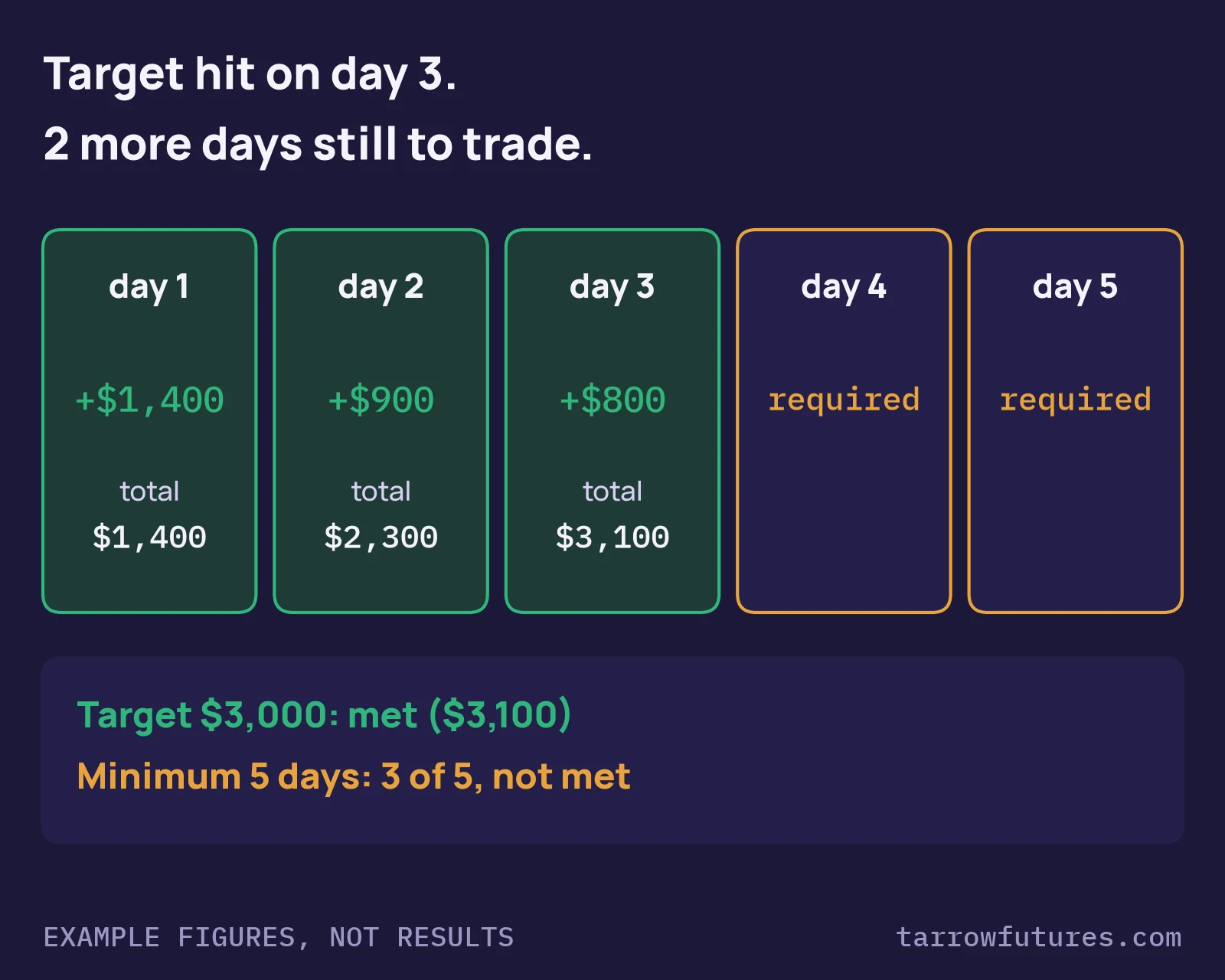
Minimum trading days is the number of separate days you must trade before a prop firm evaluation can pass, or before a payout can be requested. Reaching the profit target sooner does not end it: with a 5-day minimum and the target reached on day 3, the evaluation still needs 2 more trading days, and every rule keeps applying on them.
What counts as a day is set by each plan, and the definitions differ more than the number does. This post covers the three common definitions, what the extra days do to an account that has already hit its target, qualifying days with a profit threshold, and the lines to find in your rulebook. The figures are examples for a hypothetical plan that explain the mechanism; your rulebook decides the rest.
Free tool · free with your email
Prop account tracker
Every account's most-you-can-lose today, room to the floor and target, on one screen.
✓ It's yours. The link is on its way to your inbox. Open the prop account tracker now
See what the prop account tracker does firstWhat the rule says
The example evaluation used through this post (example figures, not results):
- Starting balance
$50,000, profit target$3,000, trailing drawdown$2,000 - Minimum
5trading days before the evaluation can pass
Three days of trading: +$1,400, +$900, +$800. The account is at $1,400 + $900 + $800 = $3,100 of profit, over the $3,000 target, after 3 days.
The evaluation has not passed. It has 3 of 5 days, so it needs 5 − 3 = 2 more, and it passes only when the target and the day count are both met.
What counts as a day
Plans use one of three definitions, sometimes with extra conditions:
- Any day with a trade. Place at least one trade in the session and the day counts, win or lose. This is the simplest version.
- A qualifying day. The day counts only if it meets a condition, usually a minimum profit. More common in payout rules than in evaluations.
- A calendar day. A few rules count days on the calendar, not days traded: a waiting period before a payout, for example. That is a different rule with a similar name, and trading does not shorten it.
When a day starts and ends matters too. Futures trade overnight. CME Globex equity index futures (MNQ, NQ, MES, ES and others) trade from Sunday 5:00 p.m. to Friday 4:00 p.m. CT, with a daily break from 4:00 to 5:00 p.m. CT (CME Group contract specifications, checked 2026-10-06). A plan that dates days by that session counts a trade at 6:30 p.m. CT on Monday toward Tuesday's session, and a Sunday evening trade toward Monday. A plan that uses the calendar date counts the same trade as Monday. Your rulebook says which; if it does not, ask before you rely on it.
The days after the target
On the example, the account reaches $3,100 of profit on day 3 with 2 days still to go. Those two days carry every rule the first three did: the daily loss limit, the trailing drawdown, any consistency rule.
A $200 loss on day 4 takes profit to $3,100 − $200 = $2,900. The account now has 4 of 5 days, but it is $3,000 − $2,900 = $100 under the target, so day 5 has to make at least $100 for the evaluation to pass on day 5.
So the minimum day count affects how traders plan the last days of an evaluation. Some trade smaller once the target is met, some keep the same plan. That is a planning decision; the rulebook only sets the count and the other rules.
When a consistency rule applies as well
Minimum days and a consistency rule often sit on the same plan, and they interact. A consistency rule caps the share of total profit that one day can make up (how the formula works).
On the example, the best day is $1,400 of $3,100: $1,400 ÷ $3,100 = 45.2%.
- Under a
50%cap,45.2%is inside it. The only thing missing is the 2 days. - Under a
40%cap, the account needs total profit of at least$1,400 ÷ 0.40 = $3,500, so the remaining days have to add$3,500 − $3,100 = $400as well.
Spreading profit over more days lowers the best day's share. On plans with both rules, the extra days required by the minimum are often the days that bring the share under the cap.
Free toolSkip the arithmetic: the prop account tracker does this for your own numbers.Get it ↓Qualifying days and a profit threshold
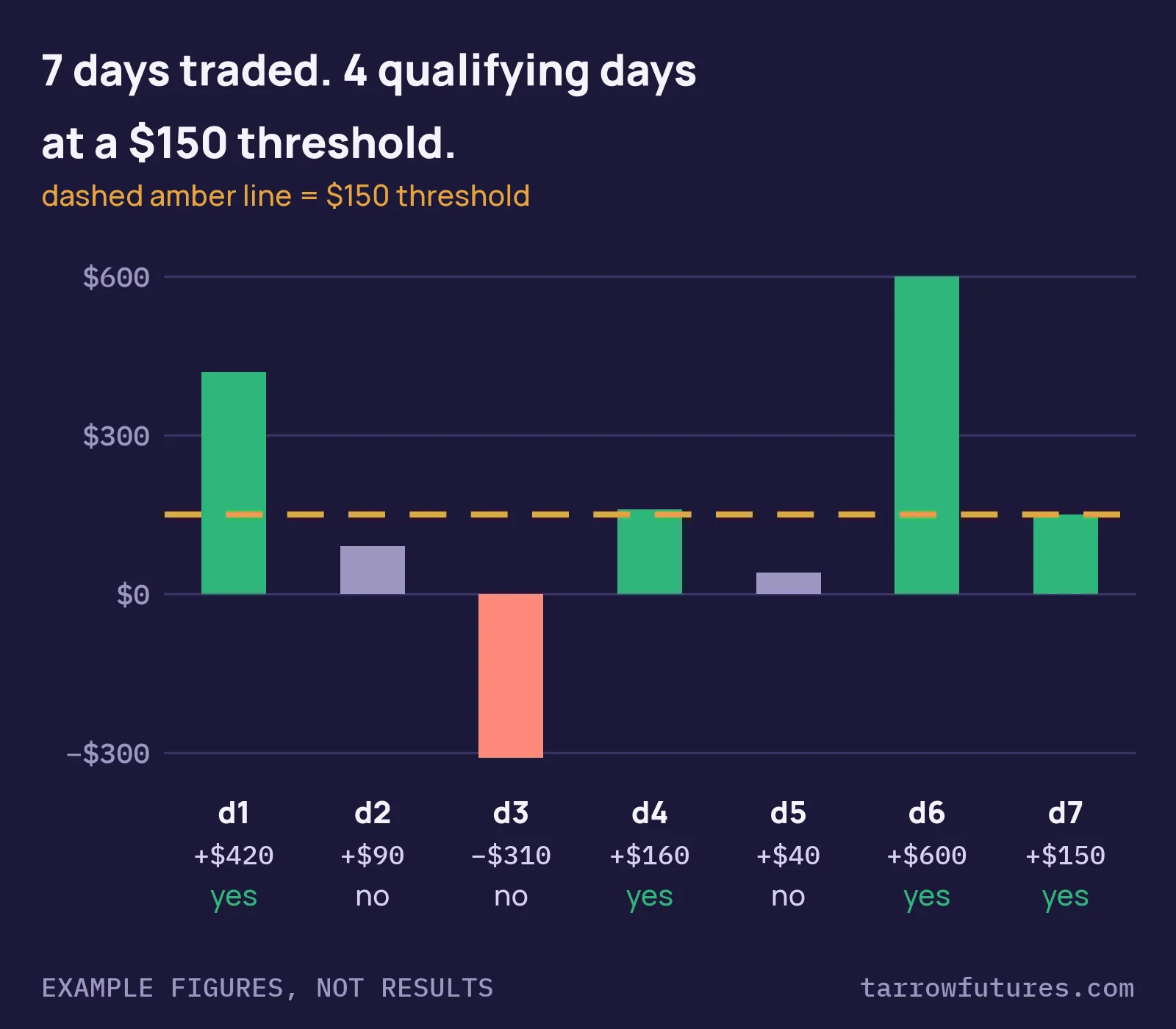
A payout rule might say: "at least 5 qualifying days, each with $150 or more of profit" (example figures). Seven days of trading:
| Day | P&L | Counts? |
|---|---|---|
| 1 | +$420 |
yes |
| 2 | +$90 |
no, under $150 |
| 3 | −$310 |
no, a losing day |
| 4 | +$160 |
yes |
| 5 | +$40 |
no, under $150 |
| 6 | +$600 |
yes |
| 7 | +$150 |
yes, if the rule says "or more" |
Seven days traded, 4 qualifying days. The account needs 5 − 4 = 1 more day of at least $150 before it can request the payout. Under a plain minimum of trading days, the same seven days would already be 7 of 5. Only the wording differs, and on day 7 it comes down to "at least" versus "more than".
Five lines to find in the rulebook
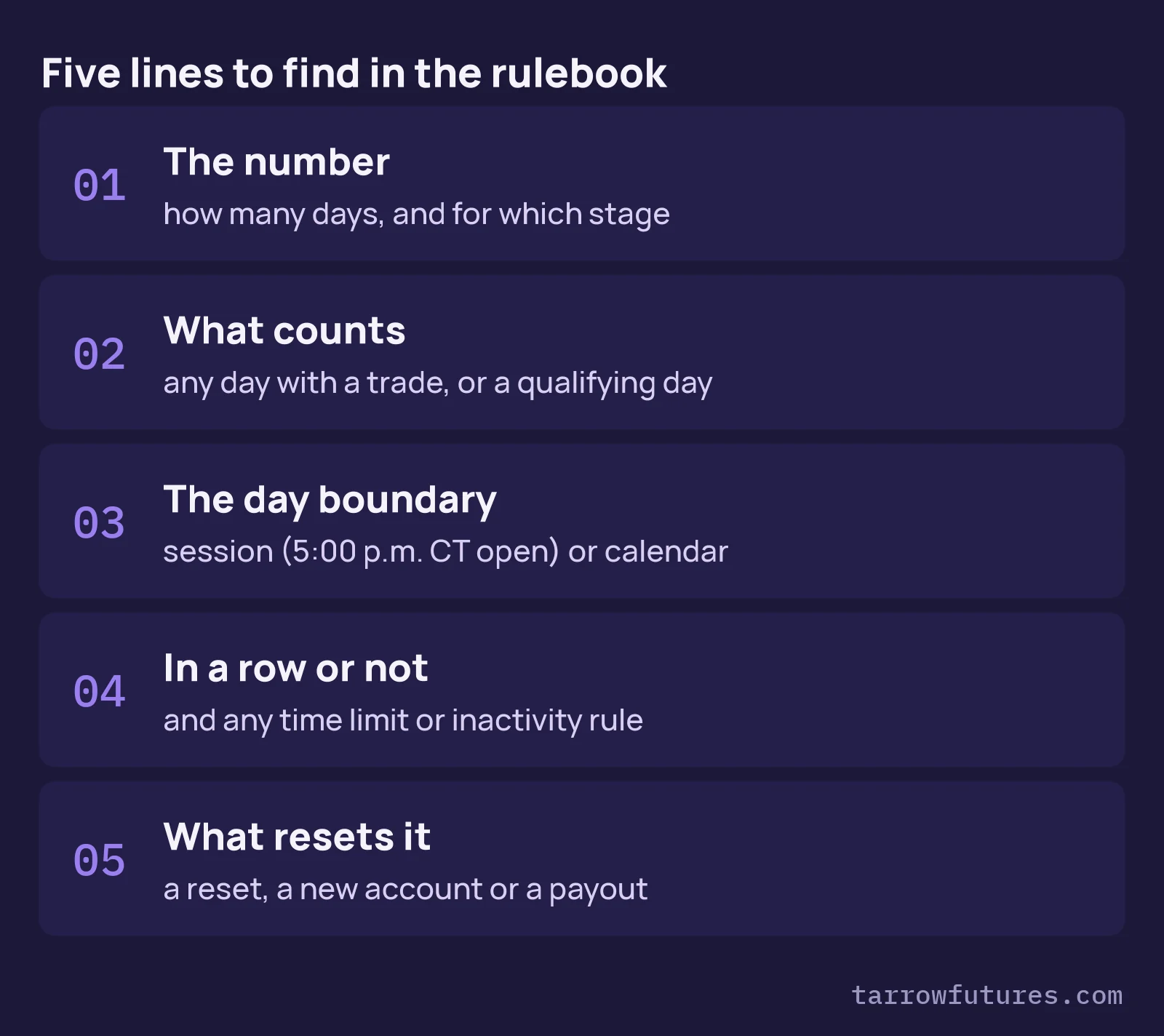
- The number. How many days, and for which stage: the evaluation, the payout, or both.
- What counts. Any day with a trade, or a qualifying day. If qualifying, the condition, in dollars.
- The day boundary. Session dating (from the 5:00 p.m. CT open) or the calendar date, and in which time zone.
- In a row or not. Whether the days must be consecutive, and whether there is a time limit or inactivity rule alongside.
- What resets it. Whether a reset, a new account or a payout starts the count again.
Then write each answer on your plan in one line, so the day count you track is the one the rule counts.
Common mistakes
- Treating the target as the finish line. On the example,
$3,100on day 3 is not a pass;2more days are. - Counting days the rule does not count. A
+$90day is a trading day, but not a qualifying day at a$150threshold. - Using the calendar date when the plan uses the session. A Monday evening trade can be Tuesday's day.
- Mixing up two rules. A minimum of trading days and a calendar waiting period can both appear in the payout section.
- Reading the rule once. Rules change. Read the current version before you plan the last days of an evaluation or a payout.
Count the days next to the floor
The free prop account tracker has a field for your plan's minimum trading days and shows "trading days 3 of 5" next to the account's balance, floor and room. It counts each session you log, so on a qualifying-day rule, check each day against the threshold before you count it. Free with your email, below. For the other gate on payouts, read what is a prop firm buffer?.
Diagrams are illustrations drawn by Tarrow Futures, not market data. Worked examples use example figures for a hypothetical plan, not any firm's rules and not results. Educational only, not financial advice. Trading futures involves substantial risk of loss.
Free tool · free with your email
Prop account tracker
Every account's most-you-can-lose today, room to the floor and target, on one screen. We email you the link, so it is one tap away next time.
✓ It's yours. The link is on its way to your inbox. Open the prop account tracker now
See what the prop account tracker does firstQuestions
What does minimum trading days mean in a prop firm?
It is the number of separate days you must trade before an evaluation can pass, or before a payout can be requested. Reaching the profit target sooner does not end the evaluation early. With a 5-day minimum and the target reached on day 3, two more trading days are still needed (example figures).
What counts as a trading day?
Usually a session in which you place at least one trade. Some plans count a day only if it makes a minimum profit, often called a qualifying day. Many plans date a day by the futures session, which for CME equity index futures runs from 5:00 p.m. to 4:00 p.m. CT the next day, so a Monday evening trade can count toward Tuesday. Your rulebook defines it.
Do minimum trading days have to be in a row?
On most plans they do not; any separate days count. Some plans add a time limit or an inactivity rule, which is a separate rule. Check whether yours has either.
Do I have to keep trading after I hit the profit target?
If you have not reached the minimum number of days, yes. Every other rule still applies on those days, so a losing day can take the balance back below the target or toward the floor. How much to trade on them is a planning decision; the rulebook only sets the count.
What is a qualifying day?
A trading day that meets a condition set by the plan, usually a minimum profit. With a $150 threshold, a +$160 day counts and a +$90 day does not, and losing days never count. Payout rules use qualifying days more often than evaluations do.
Does a losing day count as a trading day?
Toward a plain minimum of trading days, usually yes, because you traded. Toward a minimum of qualifying days with a profit threshold, no. The wording of the rule decides which one you have.
Educational material only. Not financial, investment or trading advice, and not a recommendation to trade any contract or size. Prop firm rules differ and change; the current rulebook of the firm you use decides. Worked examples use example figures, not results. Futures trading involves substantial risk of loss. Evaluations are paid tests and most people who take one do not pass.