Prop Firm Rules
What is a prop firm buffer? The balance you keep before a payout
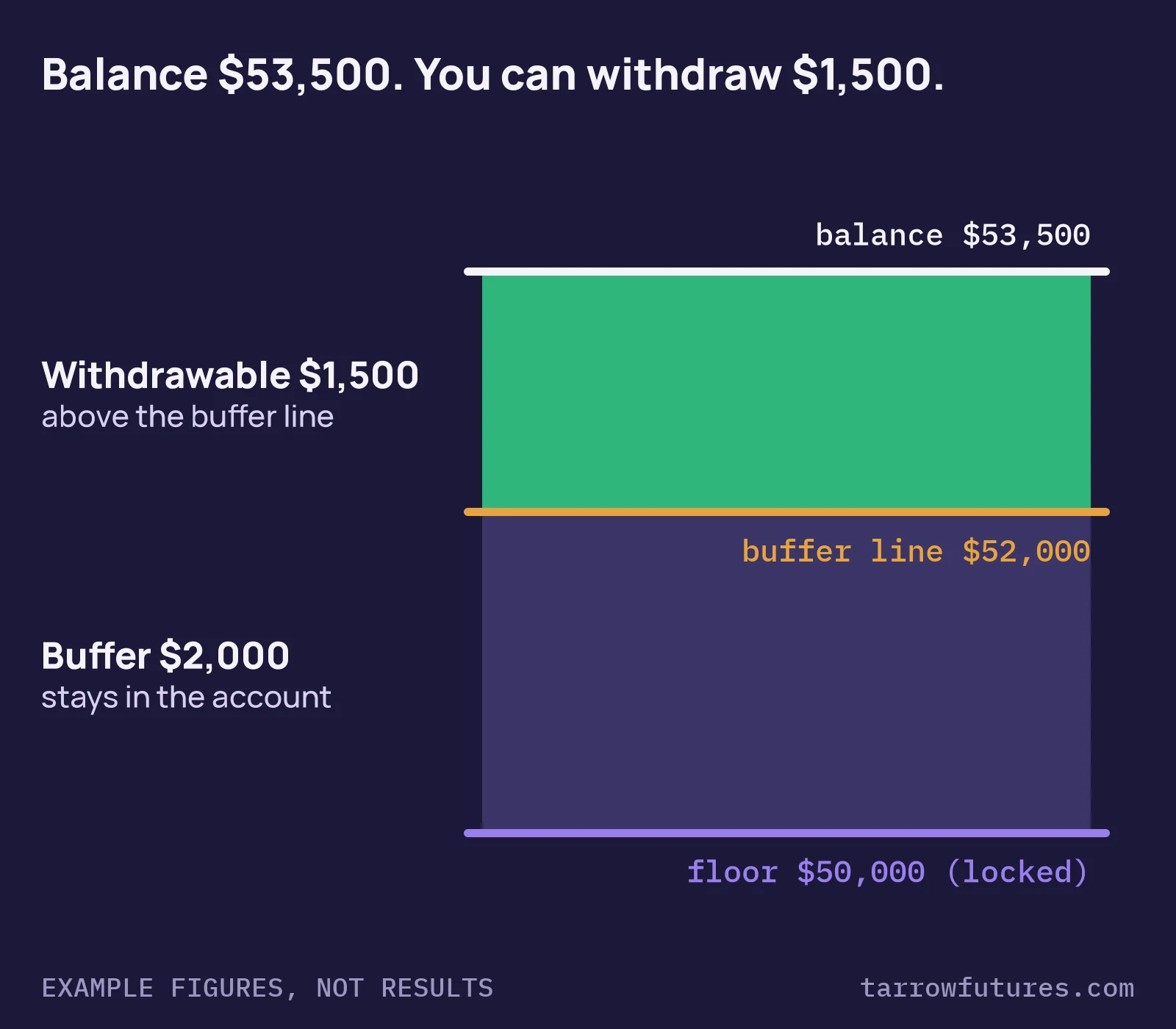
A prop firm buffer is an amount of profit that has to stay in a funded account, above the drawdown floor, when you take a payout. Only the balance above the buffer line can be withdrawn: with a floor at $50,000 and a $2,000 buffer, the line is $52,000, so a $53,500 balance leaves $1,500 to withdraw.
That is why a trader can look at $2,400 of profit and find only $400 available. This post covers what a buffer is measured from, what it does to the amount you can withdraw, how it differs from the drawdown, and the lines to find in your rulebook before you plan a payout. Plans differ on every detail, so the figures here are examples that explain the mechanism; your rulebook decides the rest.
Free tool · free with your email
Prop account tracker
Every account's most-you-can-lose today, room to the floor and target, on one screen.
✓ It's yours. The link is on its way to your inbox. Open the prop account tracker now
See what the prop account tracker does firstWhat a buffer is
Every funded account has a floor: the balance at which it fails. A buffer is a second line above the floor. Profit between the floor and that line has to stay in the account. Profit above it can be requested as a payout, subject to the plan's other payout rules.
The example account used through this post (example figures, not results):
- Starting balance
$50,000, trailing drawdown$2,000 - The floor locks at
$50,000once the peak balance reaches$52,000(how a lock works) - Buffer
$2,000above the locked floor, so the buffer line is$50,000 + $2,000 = $52,000
At a balance of $53,500, the account holds $3,500 above the floor. The first $2,000 of it is the buffer. The $1,500 above $52,000 is what can be withdrawn: $53,500 − $52,000 = $1,500.
Why plans set one
Take the same account without a buffer. If a payout could take the balance down to $50,500, the account would be left with $50,500 − $50,000 = $500 of room. A single losing trade could end it the next morning.
With the buffer, the most the same payout can take is $1,500, and the account keeps $52,000 − $50,000 = $2,000 of room after it. The buffer is room the rules make you keep. Whether it is there to protect the account, the firm's capital or both, the arithmetic for you is the same: that money is not available to withdraw.
Profit is not the same as withdrawable
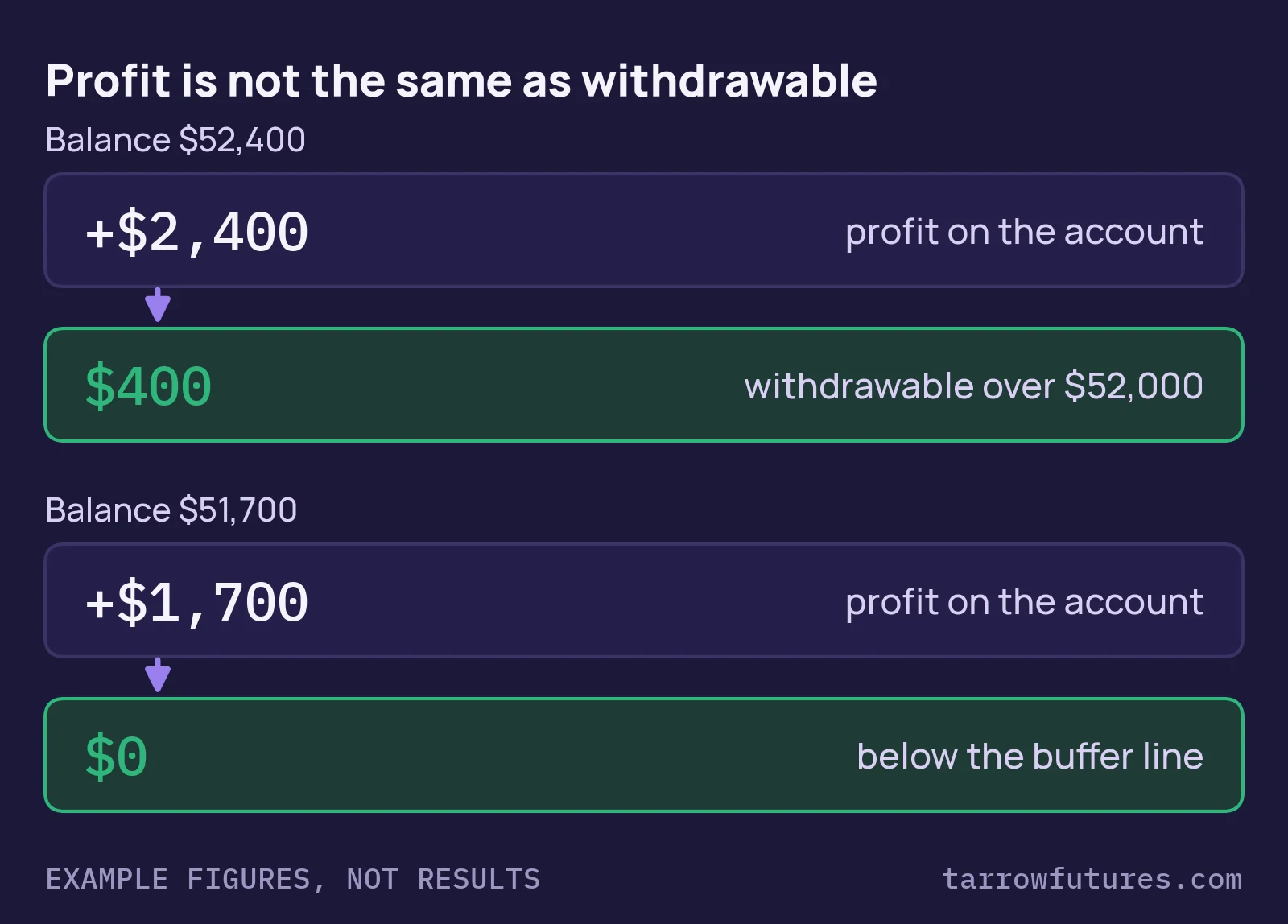
Two balances on the example plan:
| Balance | Profit on the account | Above the $52,000 line |
Withdrawable |
|---|---|---|---|
$52,400 |
$2,400 |
$400 |
$400 |
$51,700 |
$1,700 |
below it | $0 |
At $51,700 the account is $1,700 in profit and still has $1,700 of room to the floor, so it is in good standing. Nothing can be withdrawn until the balance is back over $52,000. Other payout rules (minimum days, a consistency rule, a minimum payout amount, a cap) can lower the withdrawable figure further; the buffer is one of several gates, and the table shows only that one.
A losing day after you reach the line
The buffer is part of your balance, not money set aside. Losses come out of it the same way as any other balance.
On the example plan, a balance of $52,300 has $300 above the line. A $500 losing day takes it to $51,800. The account has lost $500 of room (from $2,300 to $1,800), and the withdrawable amount has gone from $300 to $0. The account needs $200 of profit to be back at the line, and more than that before there is anything above it.
This is why some traders keep a personal margin above the buffer line before they request a payout, rather than requesting the moment the balance crosses it. How much margin, if any, is a planning decision; the rulebook only sets the line.
Free toolSkip the arithmetic: the prop account tracker does this for your own numbers.Get it ↓Buffer vs drawdown
The two are easy to mix up, because on some plans the buffer equals the drawdown amount, as it does in the example.
| Drawdown floor | Buffer line | |
|---|---|---|
| What it decides | Whether the account survives | How much can be withdrawn |
| Crossing it | Ends the account | Blocks withdrawals until you are back above |
| Moves with a trailing drawdown | Yes, until a lock, if the plan has one | Set by the plan: fixed, or measured from the floor |
| Example | $50,000 (locked) |
$52,000 |
If your plan's floor is still trailing, check how the buffer is measured. A line measured from the floor rises with it; a line set as a fixed balance does not. The difference changes how much you can withdraw before the lock. Static vs trailing drawdown covers how each floor moves.
How plans write a buffer rule
Rulebooks describe buffers in a few different ways. The same idea can appear as:
- A minimum balance to keep after a payout: "the balance may not fall below
$52,000as a result of a withdrawal" - A threshold to reach before the first payout can be requested: "the account must reach
$52,000" - An amount above the floor or the starting balance: "
$2,000above the starting balance"
A threshold and a minimum balance can both exist on the same plan, and they may not be the same number. Read the wording, and turn every version into one dollar figure for your account: the balance below which nothing can be withdrawn.
Five lines to find in the payout rules
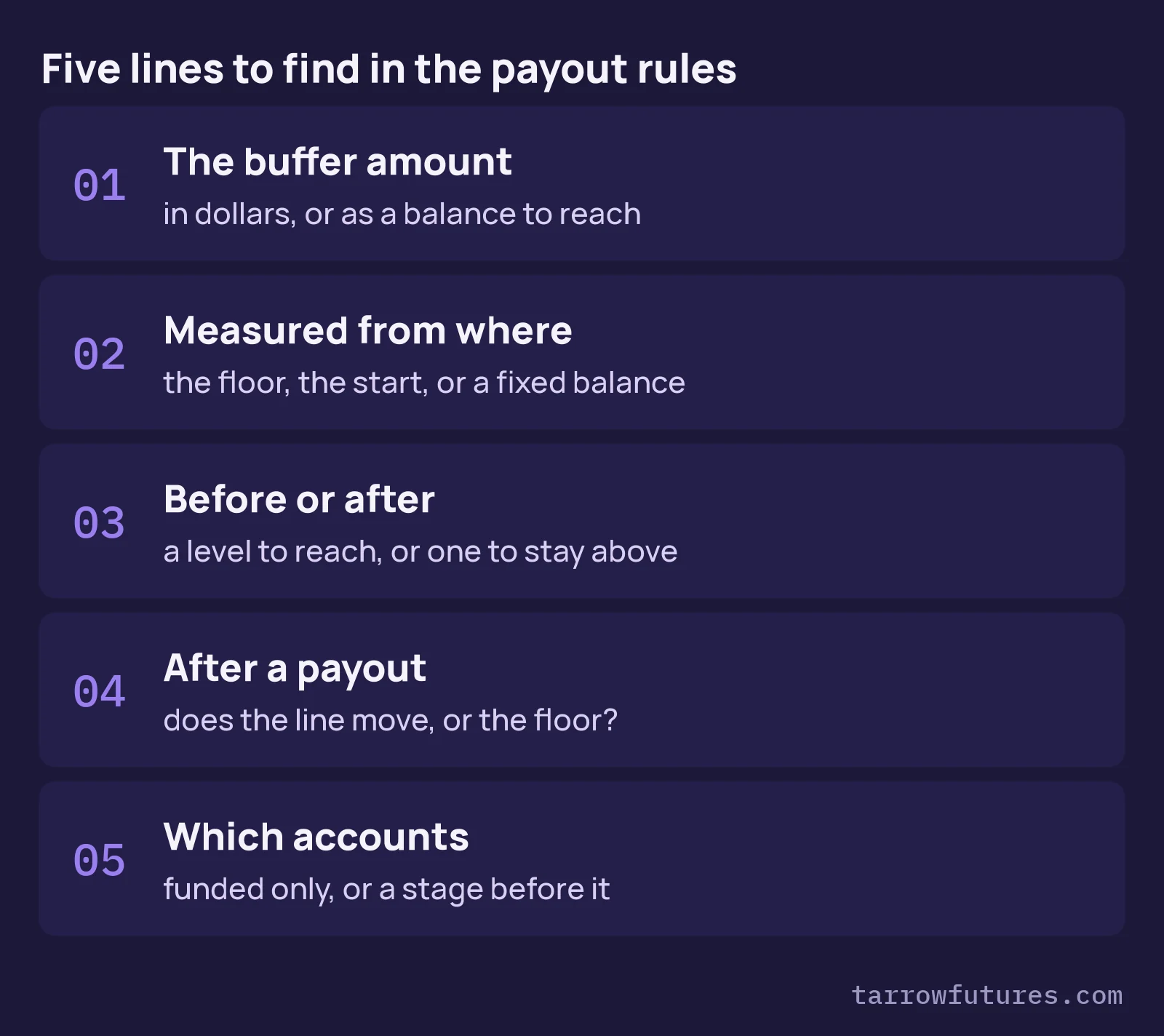
- The amount. In dollars, or stated as a balance to reach.
- What it is measured from. The floor, the starting balance, or a fixed balance.
- Before or after. A level to reach before you can request a payout, a level the balance must stay above after it, or both.
- What a payout changes. Whether the line, the floor or any other rule moves after the first withdrawal.
- Which accounts. Whether it applies to the funded account only, or to a stage before it.
Then write the line on your plan next to the floor, as one dollar figure each.
Common mistakes
- Counting profit as withdrawable. On the example plan,
$2,400of profit is$400you can request. - Treating the buffer as protected. It is balance. A losing day comes out of it, and drops the withdrawable amount first.
- Mixing up the two lines. Falling below the buffer line blocks a payout; falling to the floor ends the account.
- Reading the rule once. Payout rules change. Read the current version in the week you plan a withdrawal.
- Forgetting the other gates. Minimum days, consistency, payout minimums and caps apply on top of the buffer. See the consistency rule.
Keep the lines in one place
The free prop account tracker keeps each account's balance, floor and room to the floor on one screen, so the distance to a buffer line is one subtraction away before you plan a payout. It is free with your email, below. For what a withdrawal does to your room, read does a trailing drawdown reset?.
Diagrams are illustrations drawn by Tarrow Futures, not market data. Worked examples use example figures for a hypothetical plan, not any firm's rules and not results. Educational only, not financial advice. Trading futures involves substantial risk of loss.
Free tool · free with your email
Prop account tracker
Every account's most-you-can-lose today, room to the floor and target, on one screen. We email you the link, so it is one tap away next time.
✓ It's yours. The link is on its way to your inbox. Open the prop account tracker now
See what the prop account tracker does firstQuestions
What is a buffer in a prop firm?
A buffer is an amount of profit that has to stay in the account, above the drawdown floor, when you take a payout. Only the balance above the buffer line can be withdrawn. With a floor at $50,000 and a $2,000 buffer, the line is $52,000, so a $53,500 balance leaves $1,500 to withdraw (example figures).
Why do prop firms have a buffer?
Without one, a payout could take the balance down to just above the floor, and the account would have almost no room left for the next trade. The buffer keeps a set amount of room in the account after each withdrawal. Whether a plan has one, and how large it is, is set in its payout rules.
Is the buffer the same as the drawdown?
No. The drawdown sets the floor, the level at which the account fails. The buffer is a second line above the floor that decides how much can be withdrawn. On some plans the buffer equals the drawdown amount, which is why the two get mixed up, but they are separate rules.
Can you lose the buffer?
Yes. The buffer is part of your balance, not money set aside. Losing trades come out of it like any other balance, and if the balance falls below the buffer line, nothing can be withdrawn until it is back above. Only the floor ends the account.
Does a buffer apply during the evaluation?
Buffers belong to payout rules, so they matter on an account that can request a payout. Some plans also set a balance to reach before the first payout. Your rulebook says which account types and which payouts the buffer applies to.
Does the buffer change after a payout?
It depends on the plan. On some plans the buffer line stays where it is and every later payout is measured from it; on others the rules change after the first payout. The payout section of your plan's current rulebook decides.
Educational material only. Not financial, investment or trading advice, and not a recommendation to trade any contract or size. Prop firm rules differ and change; the current rulebook of the firm you use decides. Worked examples use example figures, not results. Futures trading involves substantial risk of loss. Evaluations are paid tests and most people who take one do not pass.