Risk & Drawdown
Static vs trailing drawdown: same trades, different floor
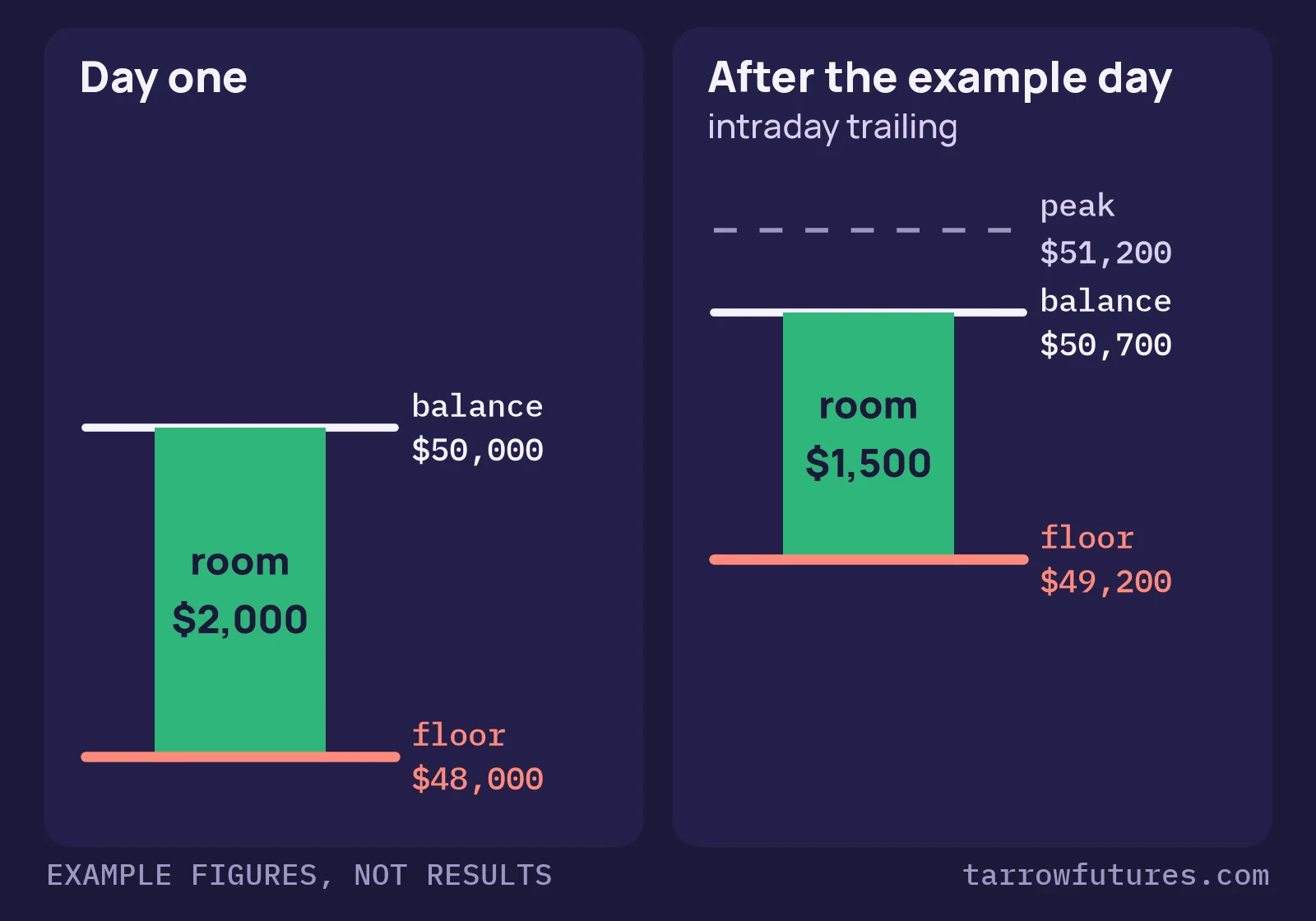
A static drawdown floor is set once, at your starting balance minus the drawdown, and never moves. A trailing drawdown floor rises with your peak and never comes back down. So on a static plan every dollar of profit adds a dollar of room, and on a trailing plan a new peak adds no room at all until the floor stops rising.
The rest of this post runs the same trades through both, with the $50,000 account and $2,000 drawdown used across this blog. If the word "floor" is new, start with What is a trailing drawdown?. Plans differ in the details, so your firm's current rulebook decides how yours works.
Free tool · free with your email
Drawdown room calculator
See where your floor sits right now and how many stops your room can take.
✓ It's yours. The link is on its way to your inbox. Open the drawdown room calculator now
See what the drawdown room calculator does firstThe two rules side by side
| Static | Trailing | |
|---|---|---|
| Floor on day one | $50,000 − $2,000 = $48,000 |
$50,000 − $2,000 = $48,000 |
| What moves the floor | nothing | a new peak |
| Can the floor come down | no | no |
| Room after a new peak | grows by the profit | stays at $2,000 until a lock, if there is one |
| Number to track | balance | balance and peak |
(example figures, not results)
Trailing comes in two common versions. Intraday follows every new high, including open profit. End-of-day moves once a day, using the highest close. Intraday trailing drawdown explained and End-of-day drawdown explained cover each one.
Same trades, three floors
Four days on the same account (example figures, not results):
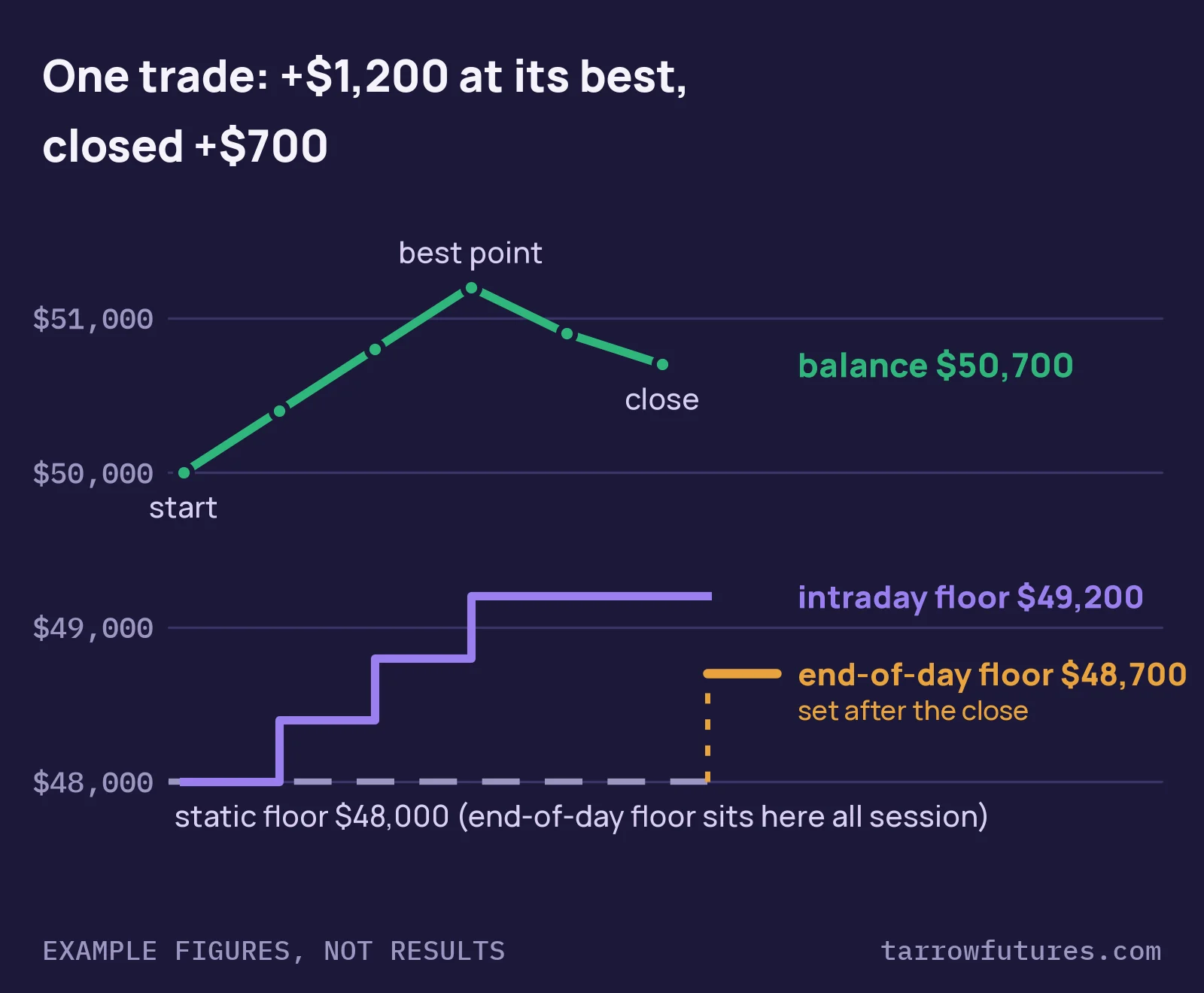
- Day 1: a trade runs to
+$1,200and closes at+$700. - Day 2: a trade closes at its high,
+$1,000. - Day 3: a
$1,200loss. - Day 4: the account loses another
$1,000if nothing stops it first.
Here is the room left at each close:
| After | Balance | Intraday floor | End-of-day floor | Static floor | Room: intraday | Room: end-of-day | Room: static |
|---|---|---|---|---|---|---|---|
| Day 1 | $50,700 |
$49,200 |
$48,700 |
$48,000 |
$1,500 |
$2,000 |
$2,700 |
| Day 2 | $51,700 |
$49,700 |
$49,700 |
$48,000 |
$2,000 |
$2,000 |
$3,700 |
| Day 3 | $50,500 |
$49,700 |
$49,700 |
$48,000 |
$800 |
$800 |
$2,500 |
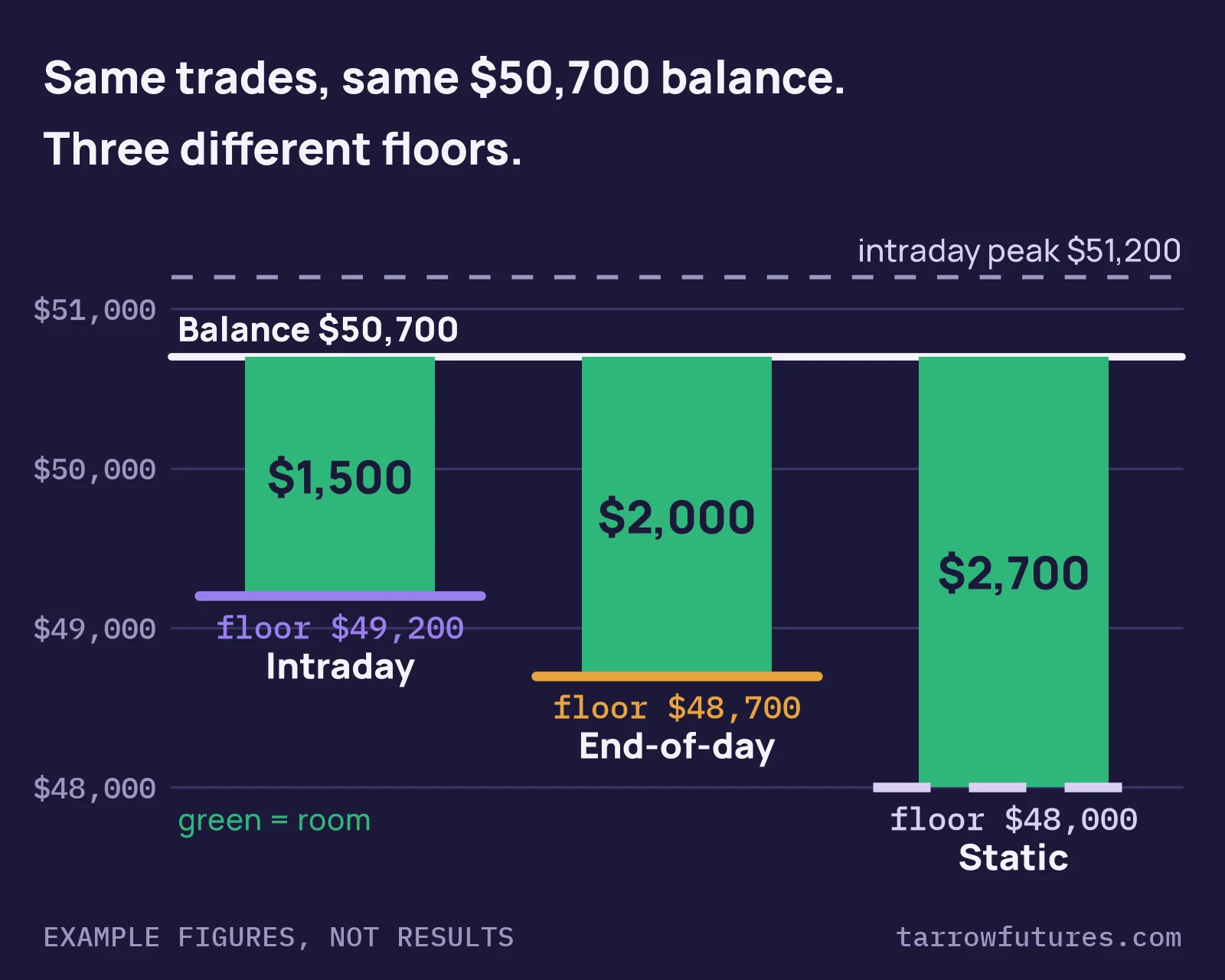
Look at day 3. The account is still $500 above where it started, and the trailing plans have $800 of room. The static plan has $2,500, the same trades and the same balance.
Day 4 is where they split. Both trailing floors sit at $49,700, so both accounts fail after an $800 loss, with the balance only $300 below the start. The static account takes the full $1,000 loss and ends at $49,500, with $1,500 of room left.
This is why "I'm still up on the account" doesn't tell you much on a trailing plan. The number that matters is the distance to the floor.
A smaller static against a bigger trailing
Plans don't always offer the same dollars on both rules, so compare the floors rather than the labels. Take a $1,000 static drawdown (floor $49,000) against a $2,000 trailing drawdown, with the balance at its peak (example figures, not results):
| Peak | Trailing floor | Static floor | Room: trailing | Room: static | Tighter rule |
|---|---|---|---|---|---|
$50,000 |
$48,000 |
$49,000 |
$2,000 |
$1,000 |
static |
$51,000 |
$49,000 |
$49,000 |
$2,000 |
$2,000 |
same |
$52,000 |
$50,000 |
$49,000 |
$2,000 |
$3,000 |
trailing |
The crossover: static floor + trailing drawdown. Here that is $49,000 + $2,000 = $51,000. Below that peak the smaller static plan has less room. Above it, the static plan has more.
So the smaller static plan is the tighter one early on, when most accounts are still near their starting balance. Work out both before you assume either rule is the easy one.
Free toolSkip the arithmetic: the drawdown room calculator does this for your own numbers.Get it ↓How a lock changes the comparison
On plans with a lock, the trailing floor stops rising at a set level, often the starting balance. With a $2,000 drawdown and a lock at $50,000, that happens at a $52,000 peak. Does a trailing drawdown reset? covers the lock in detail.
Say the peak has reached $55,000 and the balance is $54,000 (example figures, not results):
| Rule | Floor | Room |
|---|---|---|
| Trailing, no lock | $53,000 |
$1,000 |
Trailing, locked at $50,000 |
$50,000 |
$4,000 |
| Static from day one | $48,000 |
$6,000 |
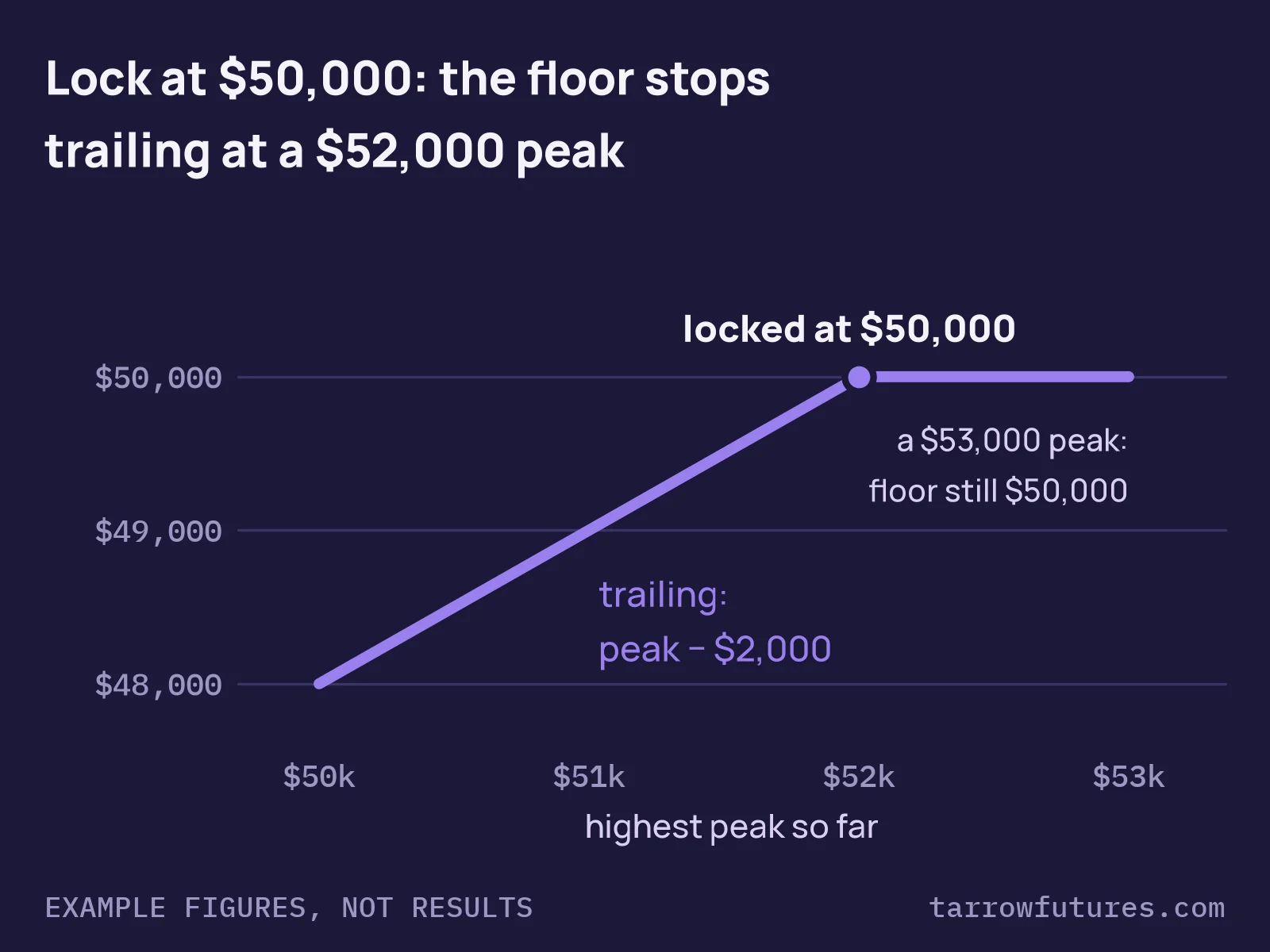
A locked floor behaves like a static one from that point on, but it sits higher. The gap to a static floor stays at $2,000.
Questions to ask about any plan
- Where is the floor today, in dollars?
- What moves it? Nothing, a new close, or every new high including open profit?
- Does it stop rising? If so, at what balance?
- Do open trades count toward a breach? A floor can be touched by a position you never closed.
- What else can stop me first? A daily loss limit can bind before any drawdown floor does.
- What does the rest of the plan cost me? Price, profit target, contract limits and consistency rules all change the comparison. The drawdown type is one line of the rulebook.
Common mistakes
- Comparing the labels instead of the dollars. A
$1,000static floor is closer than a$2,000trailing floor until the peak passes$51,000in the example above. - Reading more room as a reason to size up. Room is the most the account can lose before it fails. It isn't a target, and your own limit and the plan's contract limit still apply. How many contracts should I trade on a prop firm account? walks through the method.
- Assuming static means no other limits. A daily loss limit or a contract limit can still stop you.
- Treating profit as a cushion on a trailing plan. Before a lock, a new peak moves the floor up by the same amount.
- Relying on a summary. Rules change, and they differ between plans. The firm's current rulebook is the one that counts.
The drawdown calculator below takes your balance, peak and rule type and shows your floor and room.
Free tool · free with your email
Drawdown room calculator
See where your floor sits right now and how many stops your room can take. We email you the link, so it is one tap away next time.
✓ It's yours. The link is on its way to your inbox. Open the drawdown room calculator now
See what the drawdown room calculator does firstQuestions
What is the difference between a static and a trailing drawdown?
A static drawdown floor is set once, at the starting balance minus the drawdown, and never moves. A trailing drawdown floor follows your peak upward and never comes back down. On a $50,000 account with $2,000 of drawdown, the static floor stays at $48,000; after a $51,700 peak, the trailing floor is $49,700.
What does static drawdown mean?
The balance where the account fails is fixed from day one. On a $50,000 account with a $2,000 static drawdown, that balance is $48,000 no matter how far the account rises, so every dollar of profit adds a dollar of room.
Is a static drawdown better than a trailing drawdown?
For the same dollar amount, a static floor is never closer to your balance than a trailing one. That does not settle which plan is better, because plans also differ in drawdown size, price, profit target, contract limits and consistency rules. Compare the whole rulebook, and work out your room in dollars.
When does a smaller static drawdown beat a larger trailing drawdown?
Once your peak passes the static floor plus the trailing drawdown. A $1,000 static drawdown on a $50,000 account has its floor at $49,000. Against a $2,000 trailing drawdown, the static floor is the lower of the two once the peak is above $51,000. Below that peak, the static plan has less room.
Does a static drawdown ever move?
Not by definition. Plans can still add other limits, such as a daily loss limit or a contract limit, and those can stop you before the static floor does. Check how your plan defines it, including whether open trades count toward a breach.
What happens to a trailing drawdown once it locks?
On plans with a lock, the floor stops rising at a set level, often the starting balance, and behaves like a static floor from then on. It still sits higher than a static floor set at the start. With a lock at $50,000, the floor stays $2,000 above a $48,000 static floor.
Educational material only. Not financial, investment or trading advice, and not a recommendation to trade any contract or size. Prop firm rules differ and change; the current rulebook of the firm you use decides. Worked examples use example figures, not results. Futures trading involves substantial risk of loss. Evaluations are paid tests and most people who take one do not pass.