Risk & Drawdown
Can you scalp futures in a prop firm account?
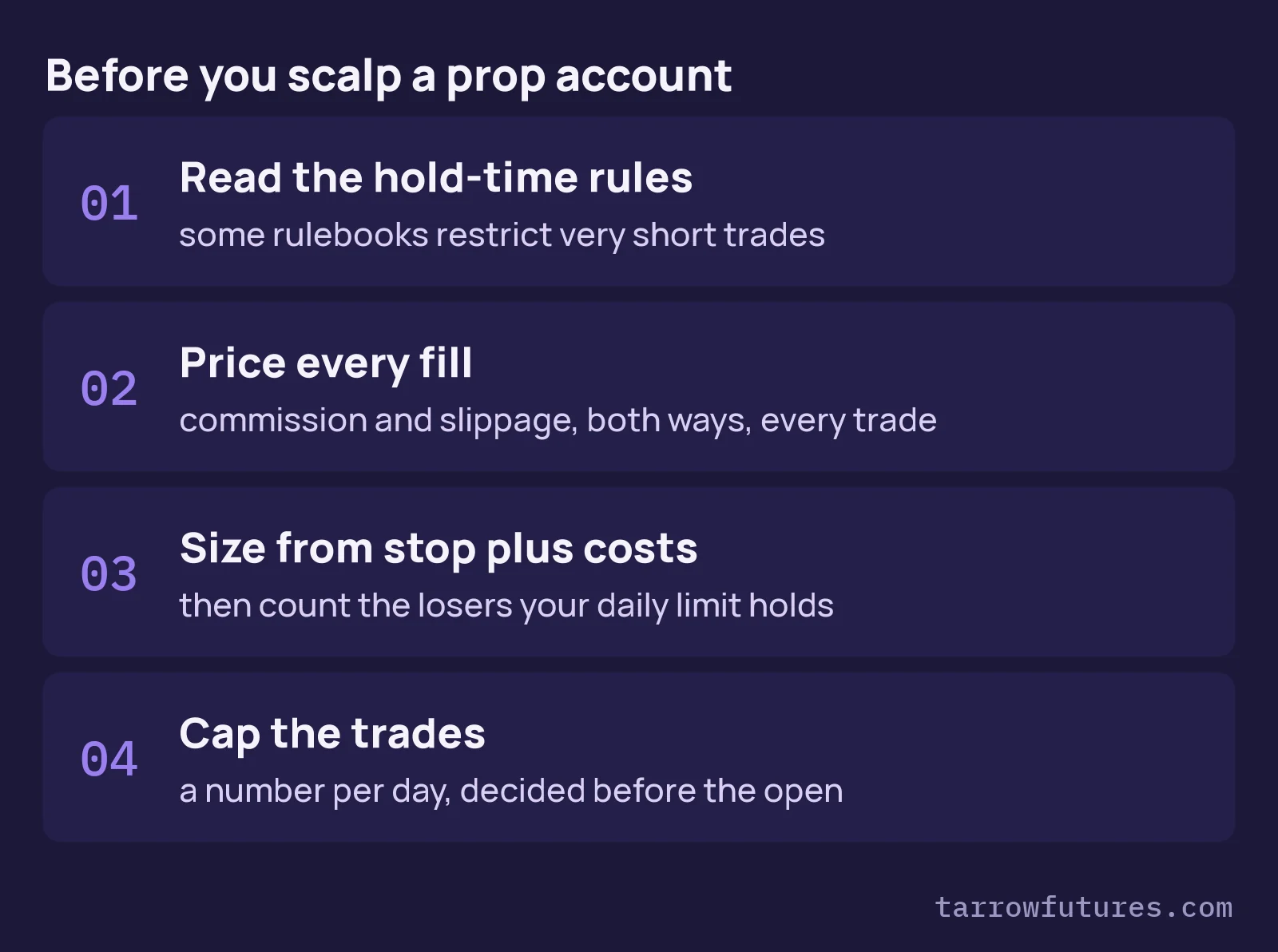
Yes, you can scalp futures in a prop firm account, as long as your firm's rulebook allows the way you do it: scalping is a style, not a rule break. Some rulebooks restrict very short holding times or certain high-frequency patterns, so read yours first. After that, what decides whether scalping fits is arithmetic: costs against a small stop, contracts sized from the stop plus costs, and how many losing trades the daily loss limit holds at that size.
This post works each one through in MNQ with example figures. CME Group's contract specs set MNQ at 0.25 points a tick and $2 a point, so one tick is $0.50 a micro. The commission and slippage figures below are examples, not quotes; your platform's fee table and your own fills decide the real ones.
Free tool · free with your email
Position size calculator
Turn today's loss budget and your stop into a contract count.
✓ It's yours. The link is on its way to your inbox. Open the position size calculator now
See what the position size calculator does firstWhat counts as scalping
Scalping means many short trades with small stops and small targets, often several in an hour, held for seconds to a few minutes. In this post a scalp is a 6-point stop on MNQ, 24 ticks, $12 a micro. That matches the scalping row in futures trading strategies ranked by difficulty, which uses the same yardstick for all fifteen strategies.
Rule 1: the rulebook comes first
Prop rulebooks don't usually ban scalping by name. What some do restrict:
- Very short holding times. A rule may say trades must stay open a minimum number of seconds, or that profits from trades held under that time don't count toward a target or a payout.
- High-frequency or pattern rules. Some firms restrict strategies that rely on very fast order entry or on specific fill behaviour.
- Different rules at different stages. A style allowed in the evaluation can be restricted after funding, or the reverse.
We can't list these by firm here, because they change and each firm words them differently. Search your firm's rulebook for "hold", "seconds", "high frequency" and "prohibited strategies" before the first trade, and keep a dated copy of what it says.
Rule 2: costs don't shrink with the stop
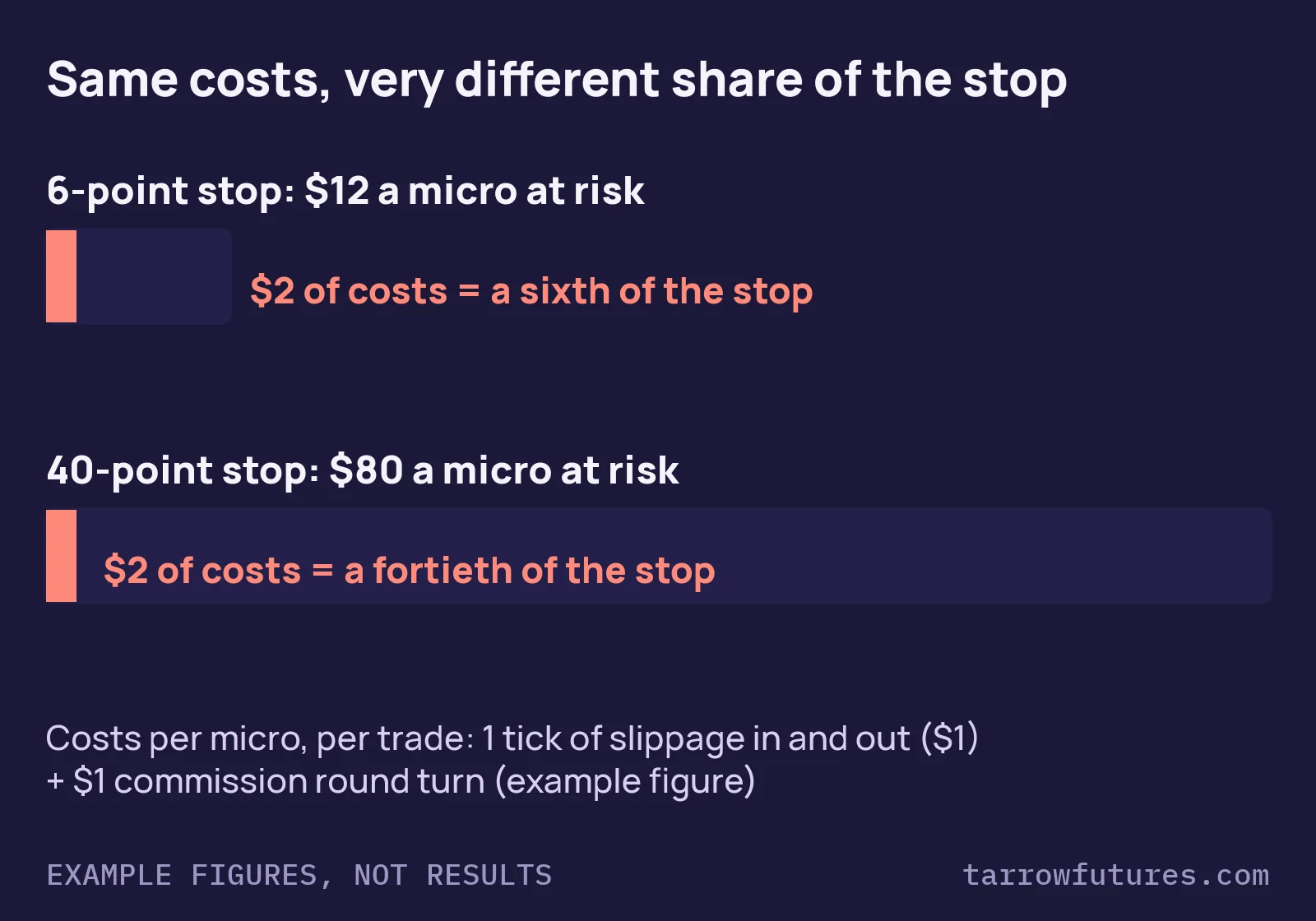
Commission and slippage are paid per contract, per trade. Example figures: one tick of slippage on the way in and one on the way out is 0.5 points, $1 a micro; add a $1 round-turn commission and every trade costs $2 a micro before it makes or loses anything.
On a 6-point stop ($12 a micro) that $2 is a sixth of the risk ($12 ÷ $2 = 6). On a 40-point stop ($80) it is a fortieth. The same costs that barely register on a wider strategy take a sixth of a scalper's stop on every trade, win or lose. Multiply by the trade count: 10 trades a day at 16 MNQ is 10 × 16 × $2 = $320 a day in costs, before a single point of profit or loss.
That is why a scalping plan that looks fine in points can fail in dollars. Backtest it with costs on every fill, and check your own fills against the plan for a few weeks; real slippage can be more than one tick in a fast market.
Rule 3: size from the stop plus costs
The usual sizing formula is the money you allow per trade ÷ (stop in points × point value), rounded down. For a scalper, add the costs to the stop before dividing:
contracts = budget per trade ÷ ((stop points × $2) + costs per micro)
Example figures, $200 a trade:
- Stop only:
$200 ÷ $12 = 16.67, so16MNQ. - Stop plus costs:
$200 ÷ ($12 + $2) = 14.29, so14MNQ.
The two extra contracts in the first answer are the ones the costs were paying for. At 16 MNQ a full loser costs 16 × $14 = $224, $24 over the $200 you meant to risk. The position size calculator does the stop part for your numbers; add your cost per contract to the stop cost before you divide.
Then cap the answer at the firm's maximum contracts or scaling plan for your current balance, whichever is lower.
Free toolSkip the arithmetic: the position size calculator does this for your own numbers.Get it ↓Rule 4: count the losers the daily limit holds
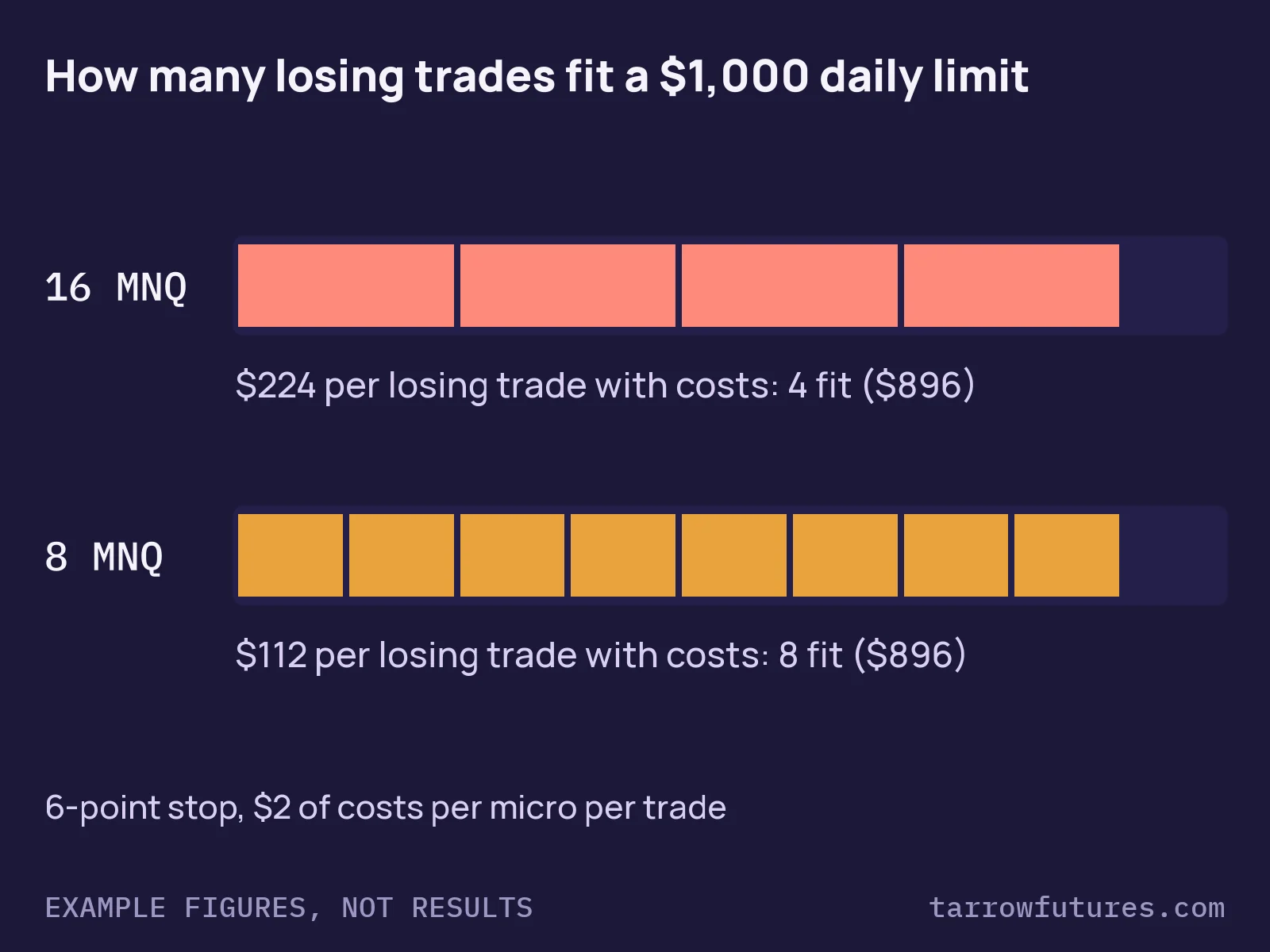
A scalper's risk isn't one big stop; it is several small ones arriving close together. Example figures, a $1,000 daily loss limit, a 6-point stop and $2 of costs a micro:
- At
16MNQ a loser costs$224.$1,000 ÷ $224 = 4.46, so4losing trades fit ($896); the fifth breaks the limit. - At
8MNQ a loser costs$112.$1,000 ÷ $112 = 8.93, so8fit ($896).
For a plan that trades ten times a day, four losers can come in one morning. Pick the size from the number of losers you want the day to hold, not the other way round, and stop for the day when that count is reached, even if the limit has room left. Read daily loss limit vs trailing drawdown for how the two limits stack.
Rule 5: watch an intraday trailing floor
On a drawdown that trails intraday, the floor follows the highest balance including open profit. A scalp that runs 5 points in your favour and then comes back to break even can still raise the floor, because the account touched a new high while the trade was open. At 16 MNQ, 5 points is 16 × 5 × $2 = $160 of open profit, and on that kind of rule the floor can move up by that much while you end the trade flat. What is an intraday trailing drawdown works this through; an end-of-day drawdown only moves at the close.
Common mistakes
- Sizing from the stop and ignoring costs. The extra contracts are paid for by the costs. Add them to the stop before dividing.
- No trade cap. Without a written number, the fifth and sixth trades come from the frustration of the fourth.
- Testing in points. A scalping backtest without commission and slippage on every fill is a different strategy from the one you will trade.
- Assuming the rulebook is the same after funding. Check the holding-time and strategy rules for each stage.
- Moving the stop to avoid a loss. On a
6-point stop, one widened stop can cost as much as several normal losers.
Size it before the open
Work out four numbers before the session: the stop, the cost per contract, the contract count from both, and the number of losing trades your daily limit holds at that size. The free position size calculator turns your daily limit and stop into a contract count; it is free with your email, below.
Educational only. Not financial advice. Contract specifications: CME Group MNQ (tick 0.25 point, $2 per point). Commission and slippage figures are examples, not quotes; check your platform's fee table. Diagrams use example figures, not results.
Free tool · free with your email
Position size calculator
Turn today's loss budget and your stop into a contract count. We email you the link, so it is one tap away next time.
✓ It's yours. The link is on its way to your inbox. Open the position size calculator now
See what the position size calculator does firstQuestions
Is scalping allowed in a prop firm account?
Scalping is a style, not a rule break, and many rulebooks don't mention it. Some restrict very short holding times or treat trades that profit by only a few ticks differently, and the rule can differ between the evaluation and the funded stage. Read your firm's current rulebook for holding-time and trading-pattern rules before you start.
Why are costs a bigger problem for scalpers?
Commission and slippage are charged per contract and per trade, whatever the stop. With example figures of one tick of slippage in and out plus a $1 round-turn commission, costs are $2 a micro per trade. That is a sixth of a 6-point MNQ stop ($12 ÷ $2 = 6) and a fortieth of a 40-point stop ($80 ÷ $2 = 40).
How many contracts should a scalper trade in a prop account?
Size from the stop plus costs. Contracts = the money you allow per trade ÷ ((stop in points × point value) + costs per contract), rounded down, then capped at the firm's maximum. Then check how many losing trades in a row your daily loss limit holds at that size.
How many trades a day should a scalper take in a prop account?
There is no correct number, but there should be a written one. With example figures of 16 MNQ on a 6-point stop, a $1,000 daily loss limit holds 4 losing trades including costs. Decide the cap before the open and count every attempt against it.
Does a trailing drawdown affect scalping?
Yes, if the floor trails intraday. Open profit can raise the floor during a trade, so a scalp that runs up and comes back can leave the floor higher than where the day started even though the trade closed flat. Check whether your floor trails intraday or at the end of the day.
Educational material only. Not financial, investment or trading advice, and not a recommendation to trade any contract or size. Prop firm rules differ and change; the current rulebook of the firm you use decides. Worked examples use example figures, not results. Futures trading involves substantial risk of loss. Evaluations are paid tests and most people who take one do not pass.