Risk & Drawdown
Daily loss limit vs trailing drawdown: two floors, one account
A daily loss limit caps how much the account can lose in one session and starts again the next day; a trailing drawdown is a floor under the whole account that follows your peak and never resets. On an account with both, today's limit is the distance from your balance to whichever floor is higher.
Most of the time that is the daily limit. As the account gives back profit from its peak, the trailing drawdown floor creeps closer, and at some point it becomes the one that counts. This post works out where that switch happens, with the same $50,000 account used across this blog: a $2,000 intraday trailing drawdown and a $1,000 daily loss limit. Plans differ in how they measure both, so your firm's current rulebook decides the details.
Free tool · free with your email
Position size calculator
Turn today's loss budget and your stop into a contract count.
✓ It's yours. The link is on its way to your inbox. Open the position size calculator now
See what the position size calculator does firstTwo floors, side by side
| Daily loss limit | Trailing drawdown | |
|---|---|---|
| What it caps | one session's loss | the account's loss from its peak |
| Where the floor sits (design used here) | day's starting balance − $1,000 |
peak balance − $2,000 |
| When it moves | resets at the start of each day | rises with each new peak, never down |
| Carries over to tomorrow | no | yes |
| A breach | ends the day or fails the account, by plan | fails the account |
(example figures, not results)
Some plans measure the daily limit from the previous close, or let it trail during the day, or include open trades. The arithmetic below uses the simplest version: a daily floor at the day's starting balance minus the limit.
Today's limit = balance − the higher of the two floors.
Three mornings, worked
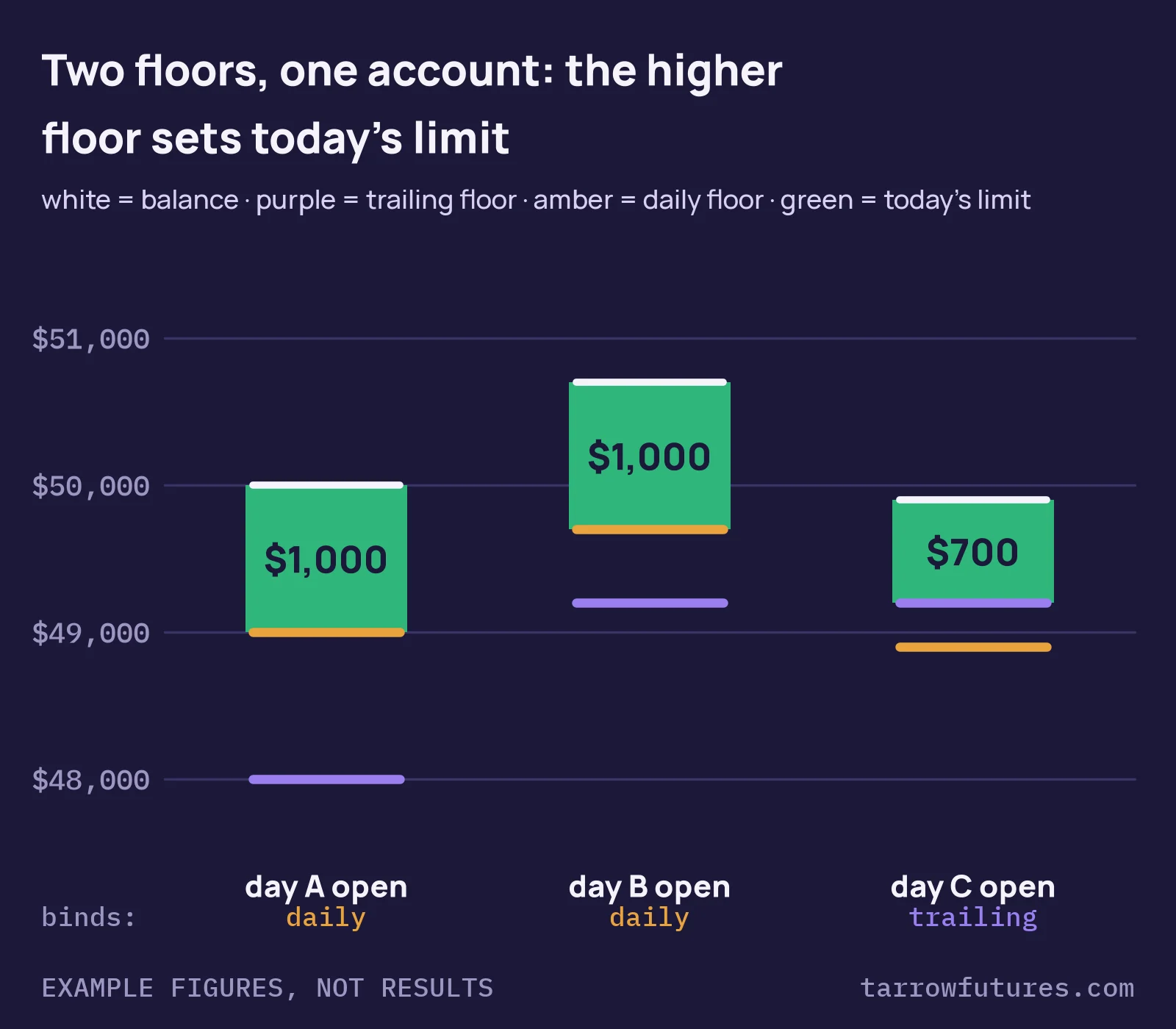
The account starts on day A. During day A a trade runs to +$1,200 and closes at +$700, which is the example in Intraday trailing drawdown explained. Day B loses $800. Here is each morning (example figures, not results):
| Morning | Balance | Peak | Trailing floor | Daily floor | Room to trailing | Room to daily | Today's limit | Binds |
|---|---|---|---|---|---|---|---|---|
| Day A | $50,000 |
$50,000 |
$48,000 |
$49,000 |
$2,000 |
$1,000 |
$1,000 |
daily |
| Day B | $50,700 |
$51,200 |
$49,200 |
$49,700 |
$1,500 |
$1,000 |
$1,000 |
daily |
| Day C | $49,900 |
$51,200 |
$49,200 |
$48,900 |
$700 |
$1,000 |
$700 |
trailing |
The arithmetic on day C:
- Trailing floor = peak − drawdown =
$51,200 − $2,000 = $49,200 - Daily floor = start − limit =
$49,900 − $1,000 = $48,900 - The higher floor is
$49,200, so today's limit =$49,900 − $49,200 = $700
On day C the daily limit still says $1,000, but the account fails $700 below the open. A plan built on "I can lose $1,000 today" breaches the trailing drawdown $300 before the daily limit ever comes into play.
Where the switch happens
The trailing floor takes over once it sits above the daily floor:
peak − drawdown > start − daily limit
Rearranged: the trailing floor binds when the day starts more than drawdown − daily limit below the peak. Here that is $2,000 − $1,000 = $1,000.
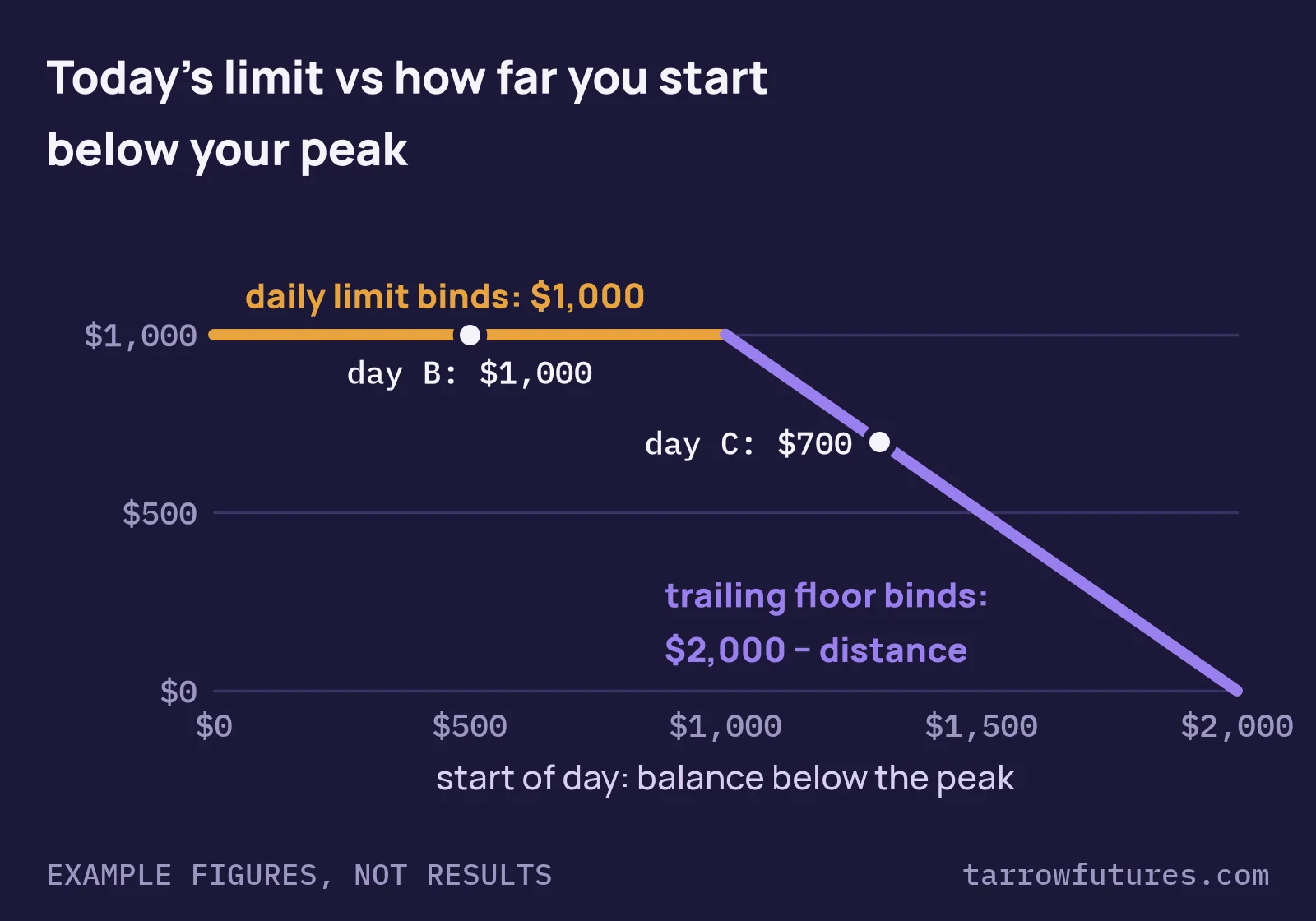
So (example figures, not results):
| Start of day, below the peak | Room to trailing | Today's limit | Binds |
|---|---|---|---|
$0 |
$2,000 |
$1,000 |
daily |
$500 (day B) |
$1,500 |
$1,000 |
daily |
$1,000 |
$1,000 |
$1,000 |
both |
$1,300 (day C) |
$700 |
$700 |
trailing |
$1,800 |
$200 |
$200 |
trailing |
Up to $1,000 below the peak, the daily limit is the whole story. Past it, every dollar further below the peak is a dollar off today's limit. Until the floor locks, if your plan has a lock, profit does not widen this: a new peak moves the trailing floor up with it. Does a trailing drawdown reset? covers the lock.
Inside one day the floors can swap
On an intraday trailing drawdown the trailing floor moves during the session, while the daily floor stays where the day started. Day A, step by step (example figures, not results):
| Moment | Balance | Trailing floor | Daily floor | Loss allowed from here | Binds |
|---|---|---|---|---|---|
| Start | $50,000 |
$48,000 |
$49,000 |
$1,000 |
daily |
Trade at +$800 |
$50,800 |
$48,800 |
$49,000 |
$1,800 |
daily |
Best point, +$1,200 |
$51,200 |
$49,200 |
$49,000 |
$2,000 |
trailing |
Closed at +$700 |
$50,700 |
$49,200 |
$49,000 |
$1,500 |
trailing |
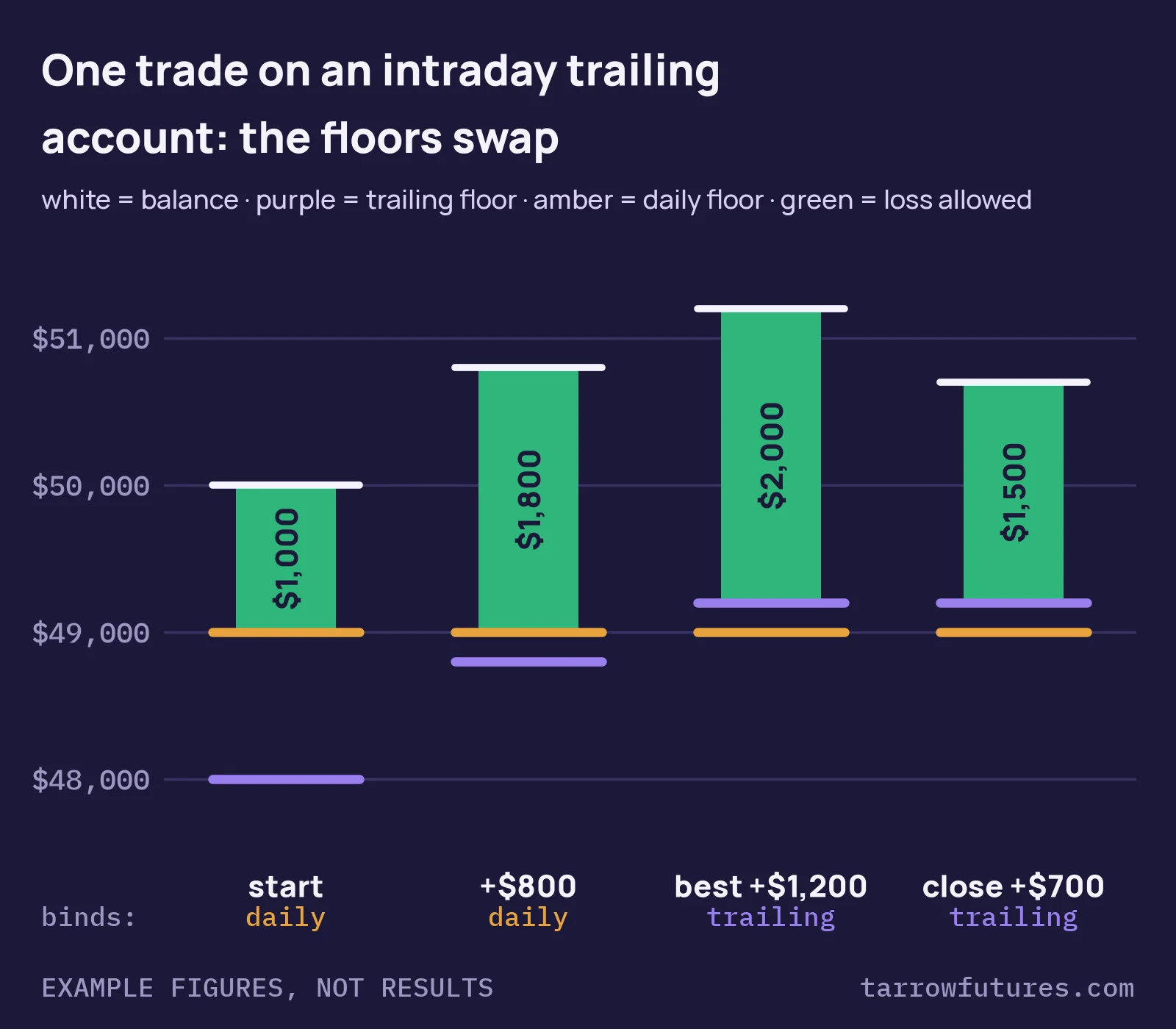
Once the trade's peak is more than $1,000 above the day's start, the trailing floor ($49,200) sits above the daily floor ($49,000). From then on, the account fails at the trailing floor. A trader watching only the daily limit would think the account can fall to $49,000 today; it fails at $49,200.
Size from the floor that binds
Size comes from the smaller of the two distances, plus any limit of your own. How many contracts should I trade on a prop firm account? explains the method; here it is on two mornings with MNQ at $0.50 a tick and a 40-tick stop ($20 a contract), planning to survive 3 stops ($60 a contract). Example figures, not results:
| Morning | Today's limit | Contracts: limit ÷ $60, rounded down |
What 3 stops cost |
|---|---|---|---|
| Day B | $1,000 |
16.67, so 16 MNQ |
$960 |
| Day C | $700 |
11.67, so 11 MNQ |
$660 |
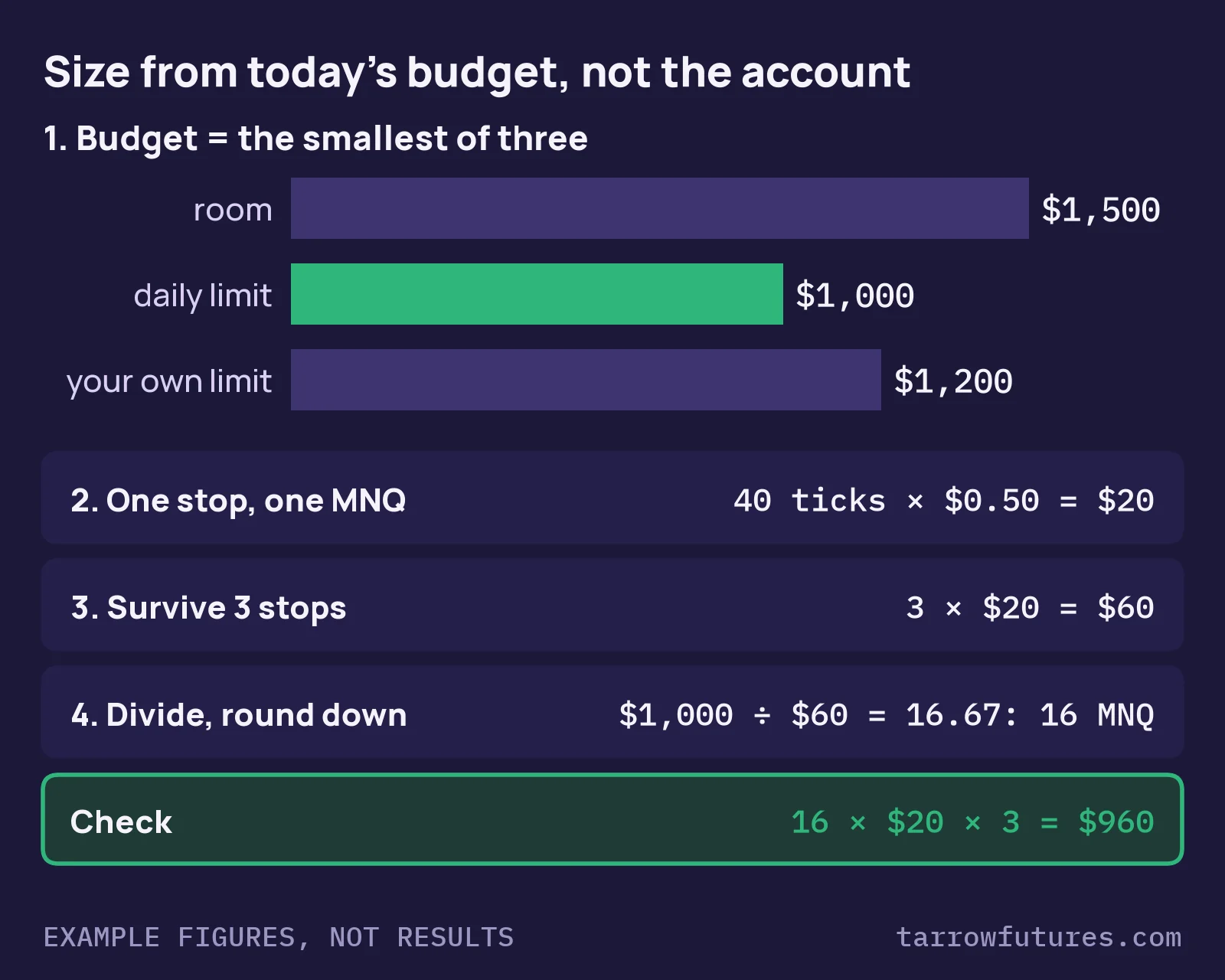
The picture is day B with a personal limit of $1,200 added: the smallest of $1,500 room, the $1,000 daily limit and $1,200 is $1,000, so the daily limit binds and the answer is 16 MNQ.
Same account, same daily limit, five fewer contracts on day C, because the binding floor changed. Working it out from the daily limit alone would size day C at 16 MNQ, and three stops at $960 would cross the trailing floor.
The position size calculator below takes your room, your daily limit and your own limit, uses the smallest, and turns it into a contract count for your stop.
Common mistakes
- Treating the daily limit as today's budget without checking room. It is a cap, not a promise. Room to the trailing floor can be smaller.
- Forgetting that a red day costs twice. It uses up that day's limit and lowers room to the trailing floor. Only the daily limit comes back tomorrow.
- Assuming the daily floor is measured your way. Starting balance, previous close, open trades or closed trades: each plan defines it. Read the definition.
- Watching one floor during a winning trade. On an intraday trailing account a good run can lift the trailing floor above the daily floor before lunch.
- Not knowing what a breach does. Ending the day and failing the account are very different outcomes. Find out which applies before you need to know.
Free tool · free with your email
Position size calculator
Turn today's loss budget and your stop into a contract count. We email you the link, so it is one tap away next time.
✓ It's yours. The link is on its way to your inbox. Open the position size calculator now
See what the position size calculator does firstQuestions
What is a daily loss limit in a prop firm?
The most the account may lose in one trading day. In the simplest design it sets a daily floor at the day's starting balance minus the limit, so a $1,000 limit on a $50,000 start puts the floor at $49,000 for that session. It starts again the next day. Plans differ on how it is measured, so read the rulebook.
Is the daily loss limit the same as the max drawdown?
No. The daily loss limit caps one session and starts again each day. The maximum (often trailing) drawdown is a floor under the whole account that carries over from day to day and, if it trails, only moves up. An account with both is bound by whichever floor is closer to the balance.
Which comes first, the daily loss limit or the trailing drawdown?
Whichever floor is higher. Today's limit = balance minus the higher of the two floors. With $2,000 of drawdown and a $1,000 daily limit, the daily limit binds until the account starts a day more than $1,000 below its peak; after that the trailing floor is closer.
Does the daily loss limit reset every day?
Yes, at the firm's end-of-day time; that is what makes it daily. The trailing drawdown does not reset. A losing day uses up that day's limit and also reduces your room to the trailing floor, and only the daily limit comes back the next morning.
Does the daily loss limit include open trades?
It depends on the plan. Some check your balance including open profit and loss during the session; some use closed trades. Read the rulebook's definition before you hold a losing position near the limit.
What happens if I hit the daily loss limit?
Plans handle it differently. Some close your positions and stop trading for the rest of the day; others treat it as a breach that fails the account. The rulebook decides, so find out which before the day you need it.
Educational material only. Not financial, investment or trading advice, and not a recommendation to trade any contract or size. Prop firm rules differ and change; the current rulebook of the firm you use decides. Worked examples use example figures, not results. Futures trading involves substantial risk of loss. Evaluations are paid tests and most people who take one do not pass.