Risk & Drawdown
Does a trailing drawdown reset? Lock levels and payouts explained
No: a trailing drawdown does not reset each day, and it never moves back down. The floor only rises with your peak balance until it reaches a lock level, if your plan has one, and then it stays fixed; a payout usually lowers your balance while the floor stays put, so your room shrinks by the amount you withdraw.
Three questions hide inside "does it reset?": does it reset every day, when does it stop, and what does a payout do to it. This post answers each with the same $50,000 account and $2,000 drawdown used in What is a trailing drawdown?, with a lock at the starting balance. Plans differ, so treat the numbers as the mechanism; your firm's current rulebook decides the details.
Free tool · free with your email
Drawdown room calculator
See where your floor sits right now and how many stops your room can take.
✓ It's yours. The link is on its way to your inbox. Open the drawdown room calculator now
See what the drawdown room calculator does firstThe short answers
| Question | Short answer | Where the rulebook settles it |
|---|---|---|
| Does it reset every day? | No. The floor carries over; only a daily loss limit restarts | Drawdown section, daily loss limit section |
| Does it ever move down? | No. Losing days leave it where it was | Drawdown section |
| When does it stop trailing? | At the lock level, if the plan has one | "Lock", "stops trailing" or "threshold" |
| Does a payout reset it? | Usually your room falls by the payout; the floor does not give it back | Payout section |
| Does a paid reset restore it? | It starts the account over from the starting floor | Reset or "restart" terms |
(example figures, not results)
Why it does not reset each day
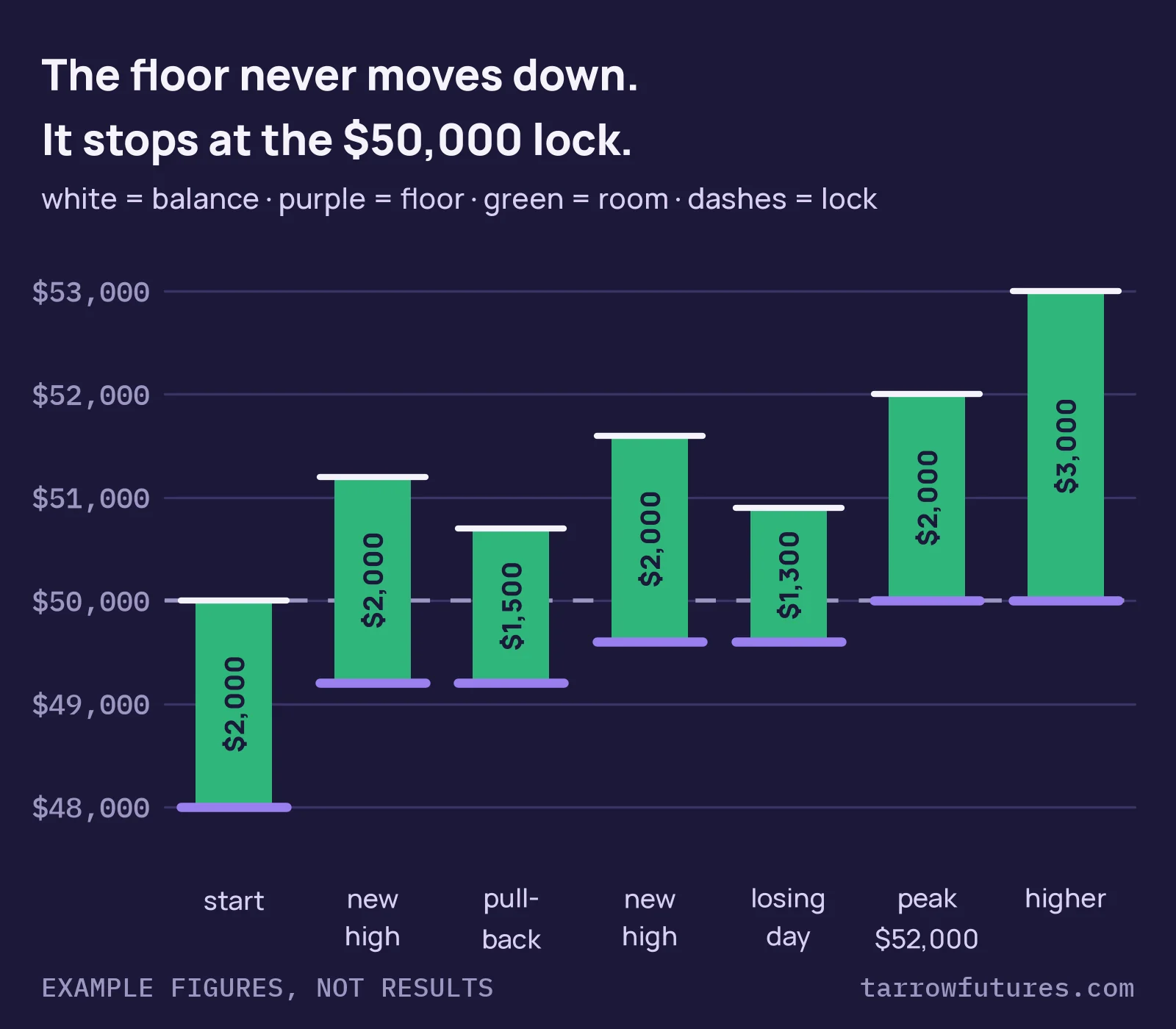
A trailing floor follows your highest balance. A new day does not create a new high, so it has nothing to move the floor with. A losing day cannot move it either, because the rule only ever looks up.
Here is one account over seven moments, on a $2,000 trailing drawdown with a lock at $50,000 (example figures, not results):
| Moment | Balance | Peak so far | Floor | Room |
|---|---|---|---|---|
| Start | $50,000 |
$50,000 |
$48,000 |
$2,000 |
| New high | $51,200 |
$51,200 |
$49,200 |
$2,000 |
| Pullback | $50,700 |
$51,200 |
$49,200 |
$1,500 |
| New high | $51,600 |
$51,600 |
$49,600 |
$2,000 |
| Losing day | $50,900 |
$51,600 |
$49,600 |
$1,300 |
Peak reaches $52,000 |
$52,000 |
$52,000 |
$50,000 (locked) |
$2,000 |
| Higher | $53,000 |
$53,000 |
$50,000 |
$3,000 |
The arithmetic for the rows that move: floor = peak − $2,000, so $51,200 − $2,000 = $49,200 and $51,600 − $2,000 = $49,600. Room = balance − floor, so after the losing day $50,900 − $49,600 = $1,300.
Two things to notice. First, the pullback and the losing day never lowered the floor; they lowered room. Second, while the floor is still trailing, room never goes above $2,000. Each new high adds a dollar to the floor for every dollar it adds to the balance. Only the lock changes that.
Which peak counts depends on the type. On an intraday trailing drawdown the peak includes open profit; on an end-of-day drawdown it is your highest close. The table works the same way for both, with a different peak. Intraday trailing drawdown explained and What does end-of-day drawdown mean? cover each in depth.
When does a trailing drawdown stop? The lock level
A lock is the level at which the floor stops trailing and becomes fixed, like a static floor. It is often at or near the starting balance. Some plans have one, some do not, and the level varies.
The peak you need to reach the lock is:
Peak to lock = lock level + drawdown
With a lock at $50,000 and a $2,000 drawdown, that is $50,000 + $2,000 = $52,000. Once your peak reaches $52,000, the floor is $50,000 and stays there. A later peak of $53,000 does not move it.
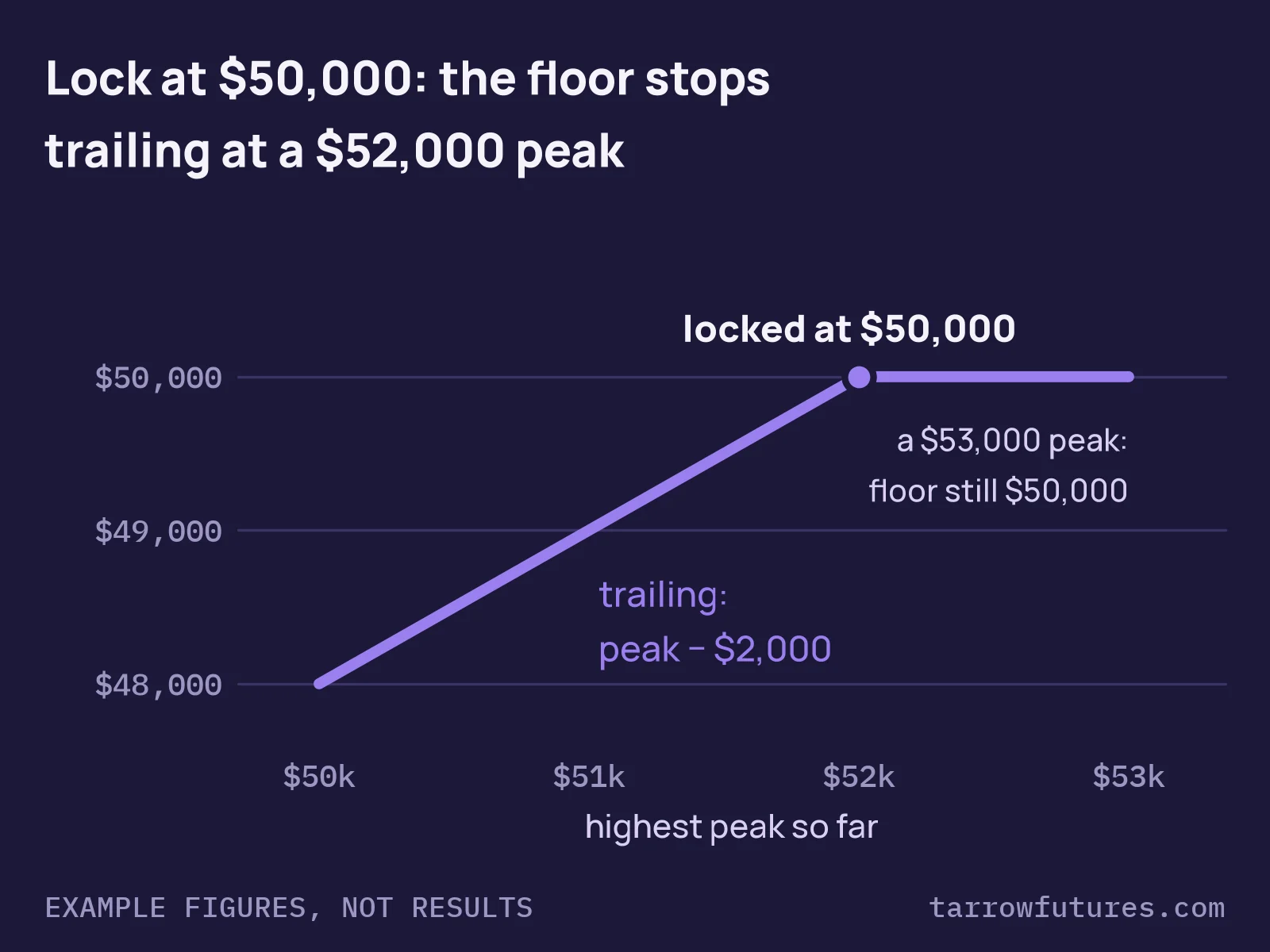
The same sum works for any lock (example figures, not results):
| Lock level | Drawdown | Peak needed to lock | Floor after the lock |
|---|---|---|---|
$50,000 |
$2,000 |
$52,000 |
$50,000 |
$50,500 |
$2,000 |
$52,500 |
$50,500 |
$50,000 |
$2,500 |
$52,500 |
$50,000 |
| No lock | $2,000 |
never | keeps trailing |
After the lock, profit finally builds room. On the account above, a balance of $53,000 has $53,000 − $50,000 = $3,000 of room, $1,000 more than the headline drawdown. Before the lock, the same $1,000 of extra profit would have pulled the floor up with it.
That is why traders talk about "getting to the lock". It is the point where the rule stops taking back what you make, not a finish line. Until then, plan with room, not with the account balance.
Free toolSkip the arithmetic: the drawdown room calculator does this for your own numbers.Get it ↓Does a trailing drawdown reset after a payout?
This is where plans differ most, so read the payout section of your rulebook before you plan a withdrawal. The design to check first: the floor stays where it is and the payout lowers your balance. In that design, room falls by exactly the amount you take out.
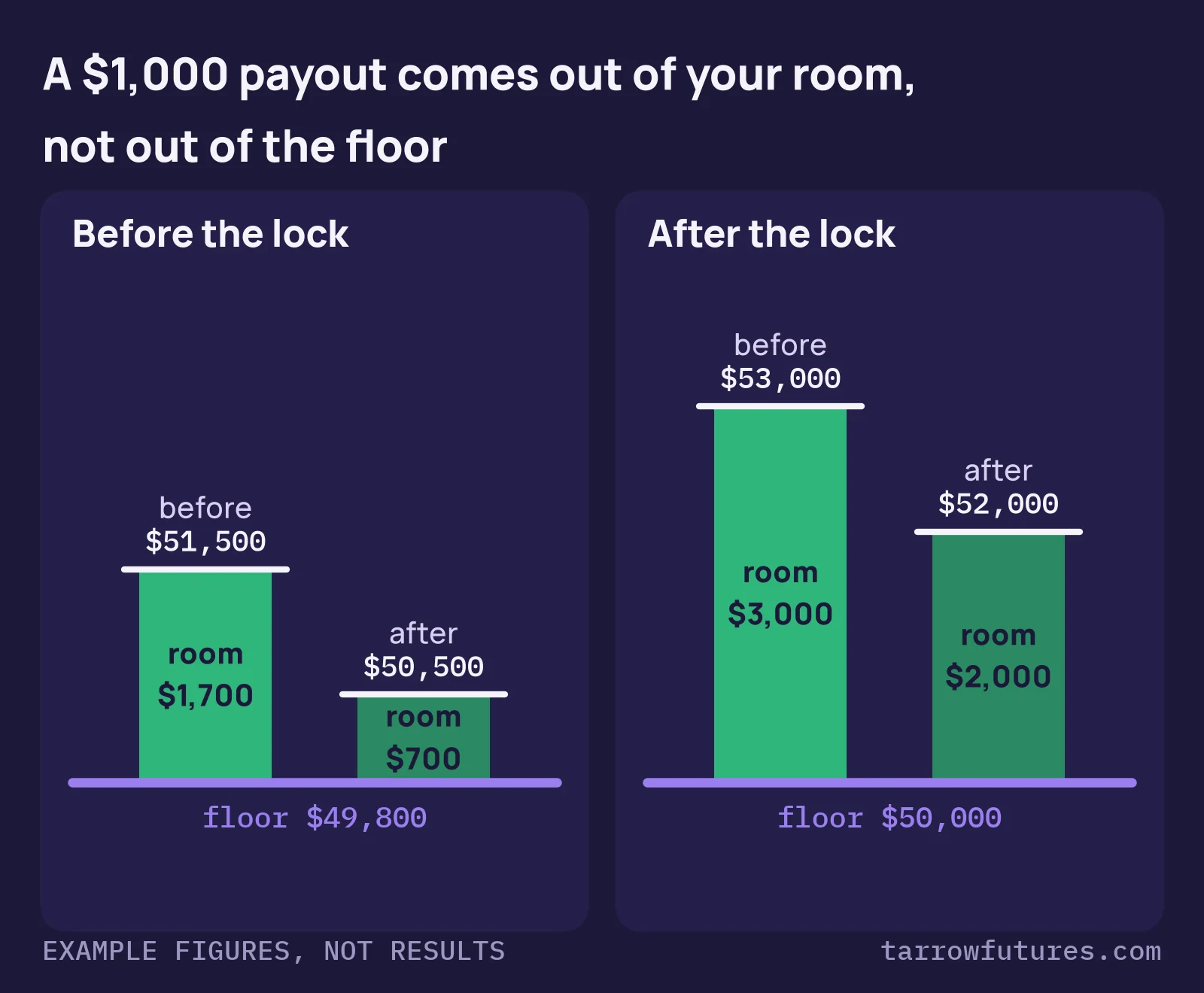
Worked on that design with a $1,000 payout (example figures, not results):
| Before the payout | After a $1,000 payout |
|
|---|---|---|
Before the lock: peak $51,800, floor $49,800 |
balance $51,500, room $1,700 |
balance $50,500, room $700 |
After the lock: floor $50,000 |
balance $53,000, room $3,000 |
balance $52,000, room $2,000 |
Before the lock, the floor is $51,800 − $2,000 = $49,800, and a $1,000 withdrawal leaves $50,500 − $49,800 = $700 of room: about a third of what the account started with. After the lock, the same withdrawal leaves $2,000. That gap is why it matters whether your plan sets a minimum balance or buffer above the floor before a payout is allowed.
Questions to answer from the payout section:
- Does the floor stay where it is after a withdrawal, or move?
- Is there a minimum balance you must keep above the floor (often called a buffer) before you can request a payout?
- Does the trailing restart, change type or lock after the first payout?
- Do the consistency rule or minimum trading days apply again before the next one?
Before you request one, log where the account stands: the prop account tracker keeps every account's floor, room to the floor and target on one screen, so you can check the room a lower balance would leave.
Three things people call a reset
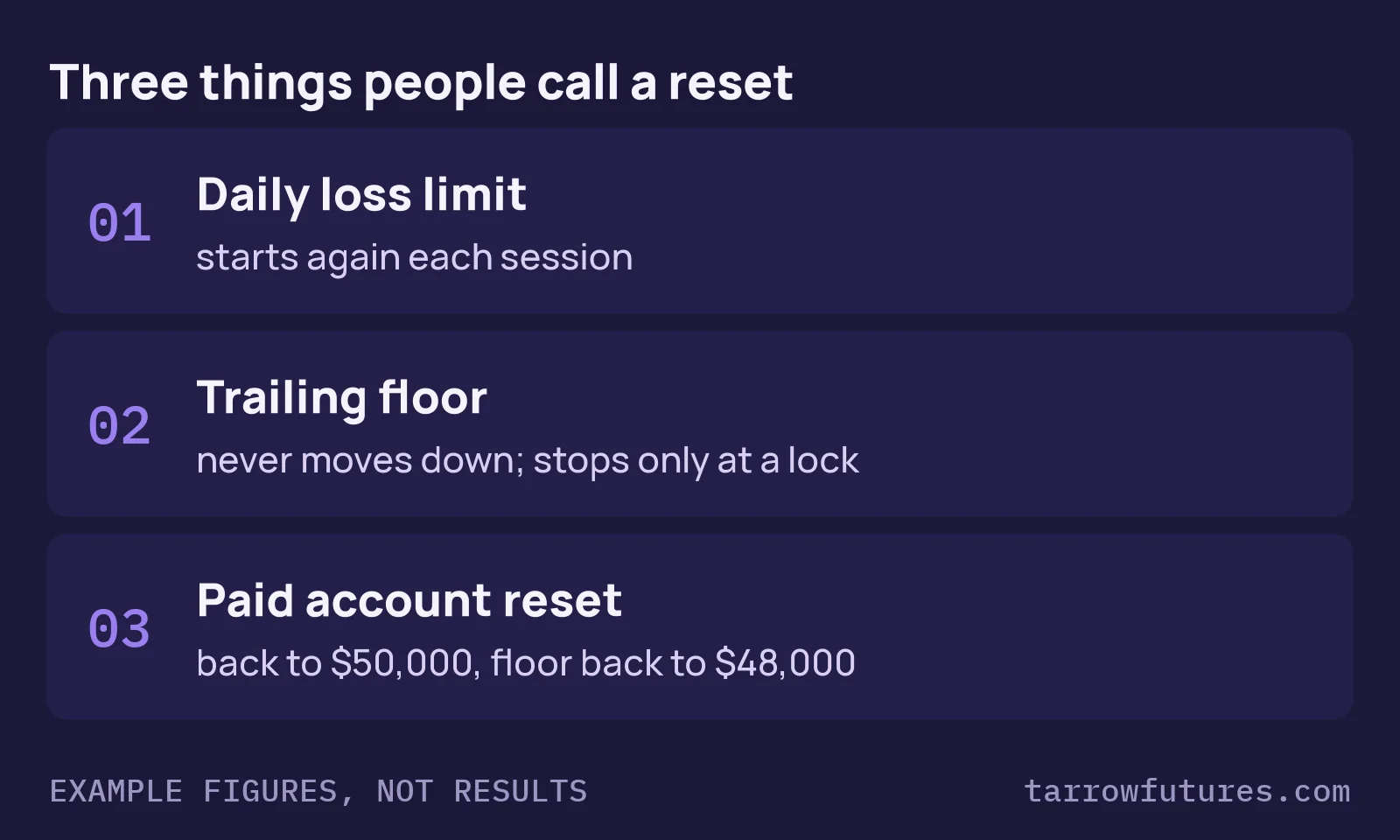
"Reset" means three different things, and mixing them up is how traders end up planning with room they do not have.
- The daily loss limit. If your plan has one, it does start again each session. It is a second, separate floor; daily loss limit vs trailing drawdown works through how the two interact.
- The trailing floor. It does not reset. It stays at the highest point it has reached, and stops only at a lock.
- A paid account reset. Some evaluations let you pay to start over. On the example account that would put the balance back to
$50,000and the floor back to$48,000, with$2,000of room; check what your plan's reset restores. It is a fresh start bought with a fee, not the floor moving down. The evaluation cost calculator adds resets to the total you spend.
Common mistakes
- Expecting room back overnight. A good night's sleep does not lower the floor. Recompute room every morning from the peak, not from yesterday's start.
- Counting on a lock you have not read. Not every plan has one, and the level varies. If the rulebook does not state it, ask before you buy.
- Withdrawing before the lock without checking room. In the example, a
$1,000payout before the lock cut room from$1,700to$700. Work out the room after the payout, not just the payout. - Treating profit before the lock as a cushion. Until the floor locks, every new high moves the floor up by the same amount. Room stays at most
$2,000. - Mixing up a daily reset with a drawdown reset. The daily loss limit restarts. The trailing floor does not.
The drawdown room calculator below does the floor and room arithmetic for intraday, end-of-day and static drawdowns, with a lock, and turns the room into ticks and stops for your contract.
Free tool · free with your email
Drawdown room calculator
See where your floor sits right now and how many stops your room can take. We email you the link, so it is one tap away next time.
✓ It's yours. The link is on its way to your inbox. Open the drawdown room calculator now
See what the drawdown room calculator does firstQuestions
Does a trailing drawdown reset every day?
No. A trailing floor follows your highest balance and never moves back down, so a new day does not restore your room. What resets each day is a daily loss limit, if your plan has one. The trailing floor carries over from one day to the next.
When does a trailing drawdown stop trailing?
When the floor reaches the plan's lock level, if it has one. With a $2,000 drawdown and a lock at the $50,000 starting balance, the floor stops once your peak reaches $52,000 and stays at $50,000 after that. Plans without a lock trail for as long as the account is open.
What is a trailing drawdown lock?
A level at which the trailing floor stops moving and becomes fixed, like a static floor. It is often set at or near the starting balance. The rulebook states the lock level and whether the plan has one at all.
Does a trailing drawdown reset after a payout?
Usually not in the sense of giving you room back. If the floor stays where it is, the withdrawal lowers your balance and your room falls by the same amount. Some plans also move the floor, set a minimum balance for payouts or change the rules after a withdrawal. The payout section of your firm's current rulebook decides.
Does a trailing drawdown move down after a losing day?
No. A losing day does not create a new high, so the floor stays where it was and your room is smaller by the amount you lost until you make it back.
Does paying for an account reset reset the drawdown?
A paid reset usually starts the account again from the starting balance, so the floor goes back to the starting balance minus the drawdown. That is a new start, not the trailing floor moving down. Check what your plan's reset restores before you buy one.
Educational material only. Not financial, investment or trading advice, and not a recommendation to trade any contract or size. Prop firm rules differ and change; the current rulebook of the firm you use decides. Worked examples use example figures, not results. Futures trading involves substantial risk of loss. Evaluations are paid tests and most people who take one do not pass.