Free tool · Education only
What will this evaluation really cost you?
The sticker price is one attempt. Enter your fees and the attempts or months you expect, and see the total spent so far, the total if your plan plays out, and the profit needed just to break even on fees.
Unlocked. Your link is on its way by email.
Free with your email
Open the evaluation cost calculator
Enter your email to open the calculator. We also send you the link, so it is one tap away next time.
Preview below. It opens the moment you unlock it.
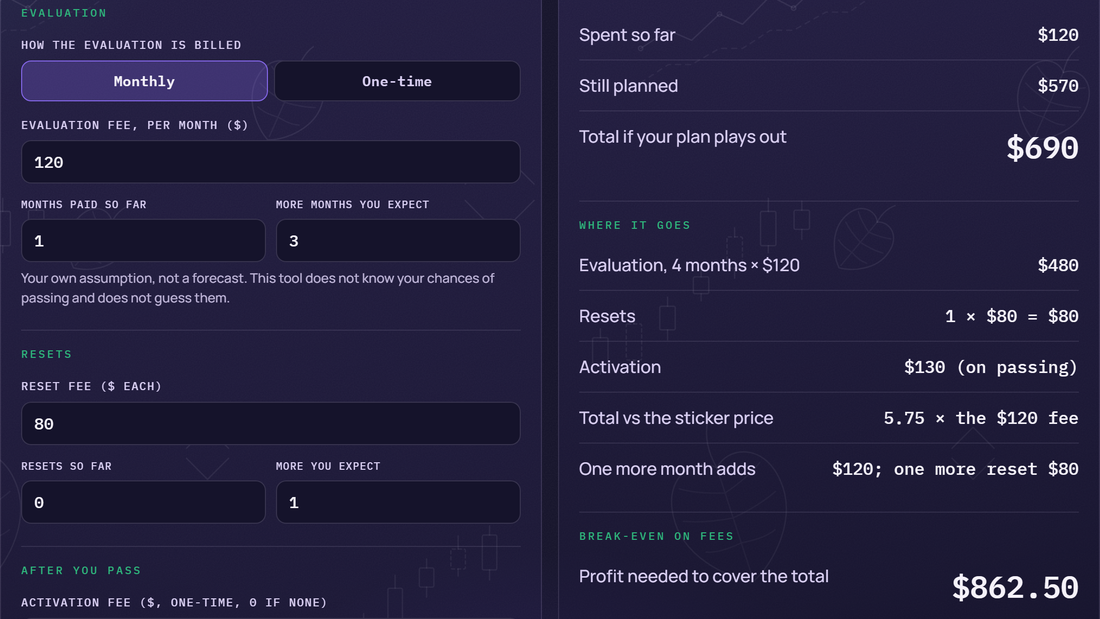
Evaluation
Your own assumption, not a forecast. This tool does not know your chances of passing and does not guess them.
Resets
After you pass
Data and other fees
Platform, routing or any other fee your firm lists. Blank counts as $0.
Getting the fees back
Both from your firm's payout rules. The break-even assumes the fees come back in one withdrawal.
Where it goes
Break-even on fees
How the rule works, in pictures
What a prop firm evaluation really costs
The price on the checkout page is the cost of one attempt. The real cost of an evaluation is every fee you pay until you either stop or get paid: the evaluation fee for each attempt (or each month, if it bills monthly), every reset, the activation fee some firms charge when you pass, market data fees, and anything else your firm lists. Add them up, then divide by the share of profit you keep: that is the profit a funded account has to make and pay out before the fees are covered.
total cost = evaluation fee × attempts (or months) + reset fee × resets + activation fee + data + other
break-even profit = (total cost + withdrawal fee) ÷ your profit split
Worked example
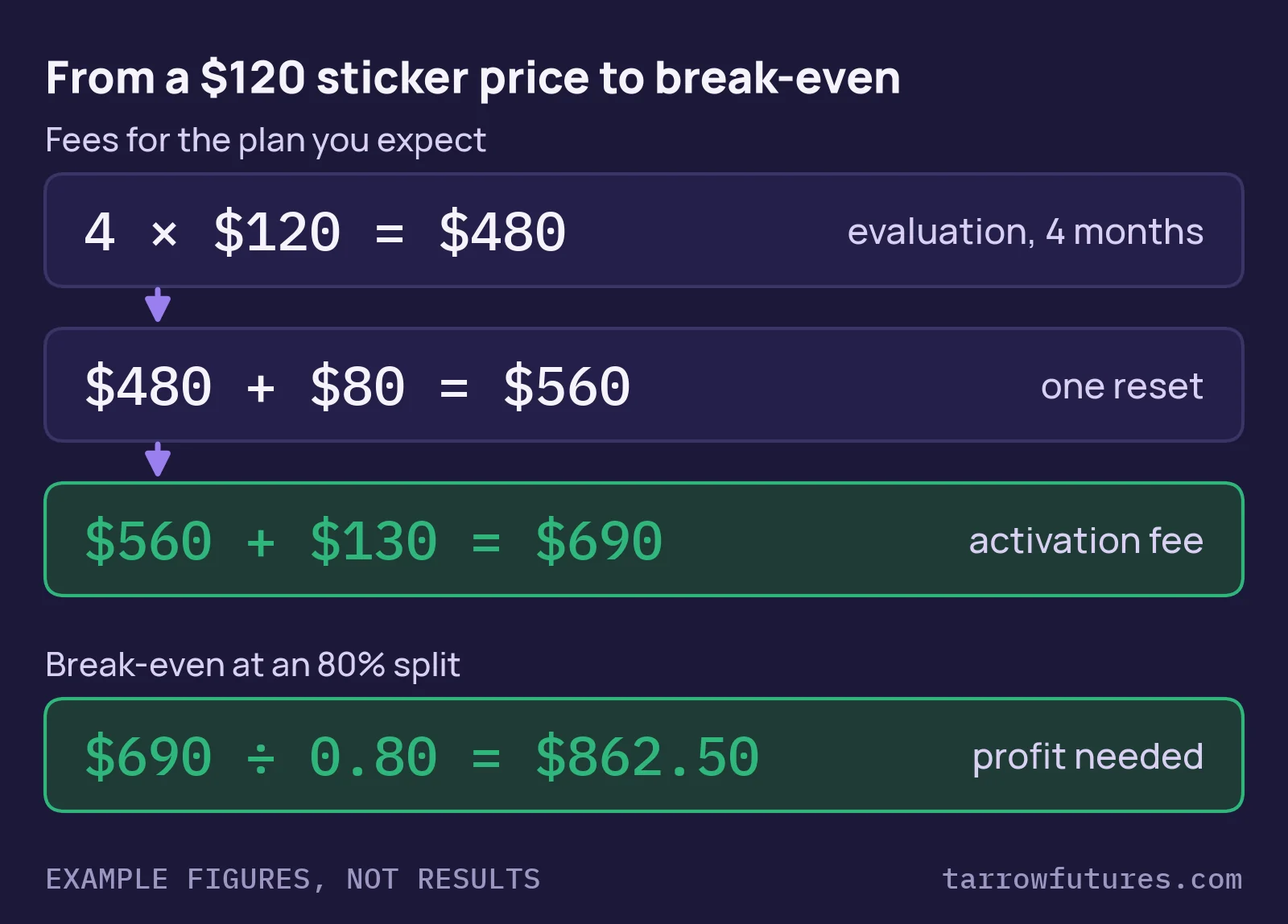
Example figures, not any firm's prices and not a result. An evaluation billed at $120 a month. You
have paid for 1 month and, as your own assumption, expect 3 more: 4 × $120 = $480.
One reset you expect at $80 makes it $560. An activation fee of $130
when you pass makes it $690, or 5.75× the $120 sticker price. Keeping
80% of profit, the funded account has to make $690 ÷ 0.80 = $862.50 before the fees are
paid back. Those are the numbers the calculator opens with.
The fees, one by one
- Evaluation fee
- What you pay to take the test. A one-time fee covers one attempt until you pass or fail it; a monthly fee renews until you pass or cancel, so a slow pass costs more months. Compare the two on the total for the number of months or attempts you expect, not on the sticker price.
- Reset fee
- What some firms charge to restart an evaluation after a rule breach, without buying a new one. Each reset returns the account to its starting balance and rules; it is one more attempt, so count it in the total.
- Activation fee
- A one-time fee some firms charge after you pass, to switch on the funded account. It is easy to leave out of
a budget because it comes last. If your firm has none, enter
0. - Data and other fees
- Some firms include real-time market data; others charge it monthly on top. Platform, routing or withdrawal fees belong here too. Your firm's fee page and rulebook decide what applies.
- Profit split
- The share of funded-account profit that is paid to you. It is why break-even is higher than the fees
themselves: at an
80%split, every$1of fees needs$1.25of profit.
Why the number of attempts is yours
The calculator asks how many more attempts or months you expect, and treats the answer as your assumption. It does not print a pass rate or guess your chances, because a figure for "traders in general" says nothing about you. Your own history is the better guide: how many attempts have you paid for so far, and what ended them? If the total for the attempts you expect is more than you can afford to lose, that is the answer. Only pay for an evaluation with money you can afford to lose.
Questions
How much does a prop firm evaluation cost in total?
The evaluation fee times the number of attempts or months you pay for, plus every reset, any activation fee, market data and other fees. With example figures of $120 a month for 4 months, one $80 reset and a $130 activation fee, the total is $690, or 5.75 times the $120 sticker price.
What is a reset fee in a prop firm evaluation?
A fee some firms charge to restart an evaluation after a rule breach, without buying a new one. The account goes back to its starting balance and rules. Each reset is another attempt, so it belongs in the total cost.
What is a prop firm activation fee?
A one-time fee some firms charge after you pass the evaluation, to switch on the funded account. It is easy to leave out of a budget because it comes last. Your firm's fee page says whether it applies.
Is a monthly evaluation cheaper than a one-time fee?
It depends on how many months you expect to pay for. Divide the one-time fee by the monthly fee: if you expect to need more months than that, the monthly option costs more in total. The number of months is your own assumption.
How much profit do I need to cover my evaluation fees?
Divide the total fees, plus any withdrawal fee, by the profit split you keep. With example figures, $690 of fees at an 80% split needs $862.50 of funded-account profit, paid out, before the fees are covered.
Does this calculator tell me my chances of passing?
No. It does not show a pass rate or guess your chances. The number of attempts or months is your own assumption, and the calculator only adds up the fees you enter. Only pay for an evaluation with money you can afford to lose.
Know a trader running an evaluation? Send them this evaluation cost calculator. It's free for them too.
Education only. This calculator shows arithmetic from the numbers you enter. It is not advice and not a recommendation to trade any contract or any size. Firms define drawdown, lock levels, daily limits, contract caps and copy-trading rules differently, and your firm's current rulebook decides. Tick values are standard CME Group contract specifications; verify them on your platform. Futures trading involves substantial risk of loss. Prop firm evaluations are paid tests that most people do not pass.