Prop Firm Rules
The consistency rule: the formula, and how much more profit you need
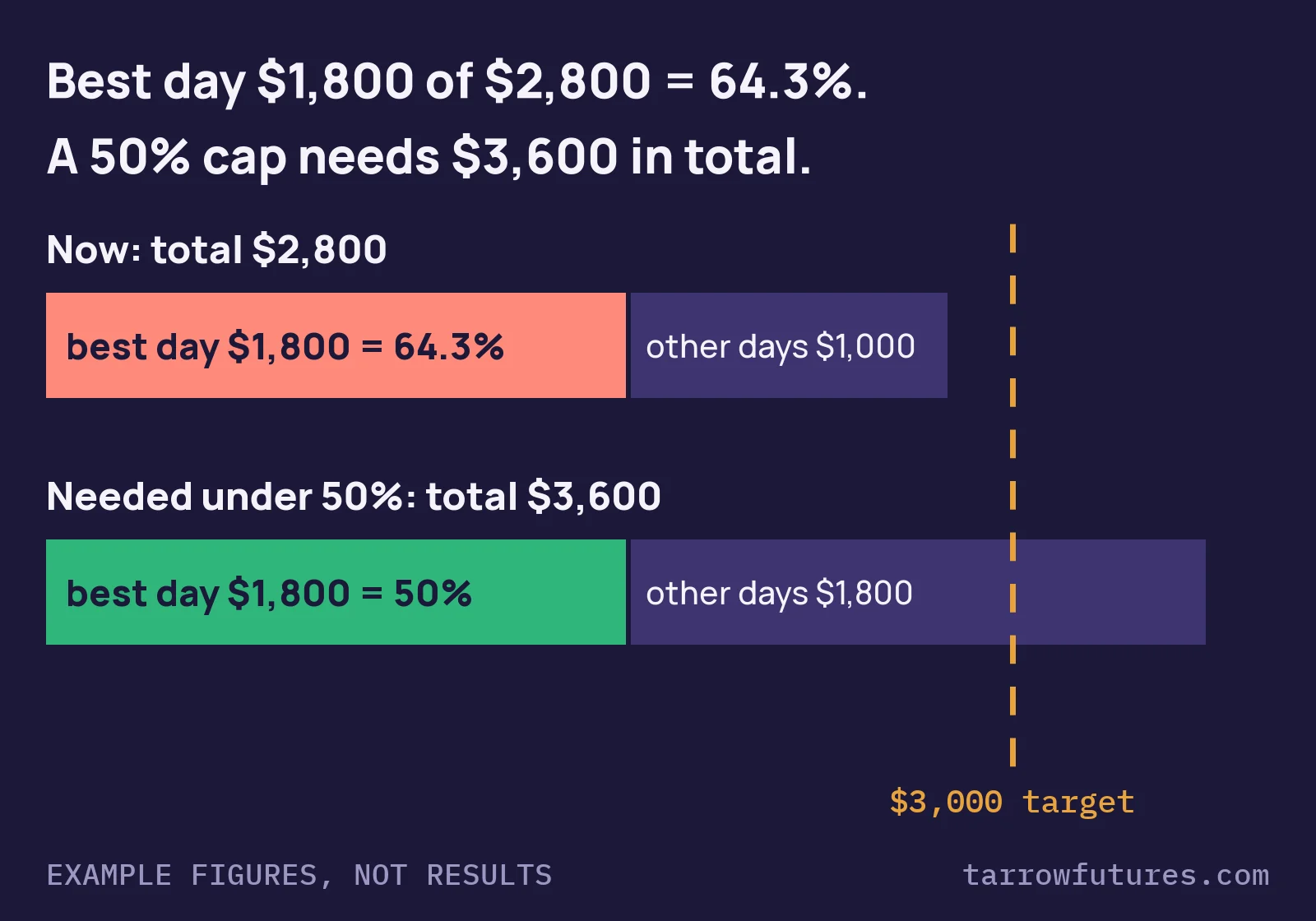
A consistency rule caps how much of your total profit can come from your single best day. The formula is best day ÷ total profit ≤ cap; if a day goes over, the total profit you need becomes best day ÷ cap, so a $1,800 best day under a 50% rule needs $3,600 in total.
That is the whole calculation. What catches traders is that the rule rewards a big day with more work: a day over the cap has to be paid for with more profit on smaller days, while the trailing drawdown keeps counting. This post works the formula through at 15%, 30%, 40% and 50%, and covers the three ways plans word it. Rules differ between firms and plans, so the numbers here explain the mechanism; your rulebook decides the details.
Free tool · free with your email
Consistency rule checker
Paste your daily P&L and see if your best day fits the rule, and where your target moves if not.
✓ It's yours. The link is on its way to your inbox. Open the consistency rule checker now
See what the consistency rule checker does firstThe formula
Three lines cover every version:
- Share = best day ÷ total profit
- Fits when share ≤ cap
- Total profit needed = best day ÷ cap. More profit needed = that total − current profit
A worked case (example figures, not results): a $3,000 profit target, 5 trading days, $2,800 of profit so far, and a best day of $1,800.
- Share =
$1,800 ÷ $2,800 = 64.3% - Under a
50%cap: total needed =$1,800 ÷ 0.50 = $3,600 - More needed =
$3,600 − $2,800 = $800
The $3,600 is above the $3,000 target, so in practice the target has moved up by $600. And the extra $800 has to come from days smaller than $1,800. A new day bigger than the best day becomes the new best day, and the sum starts again.
How much more profit you need at 15%, 30%, 40% and 50%
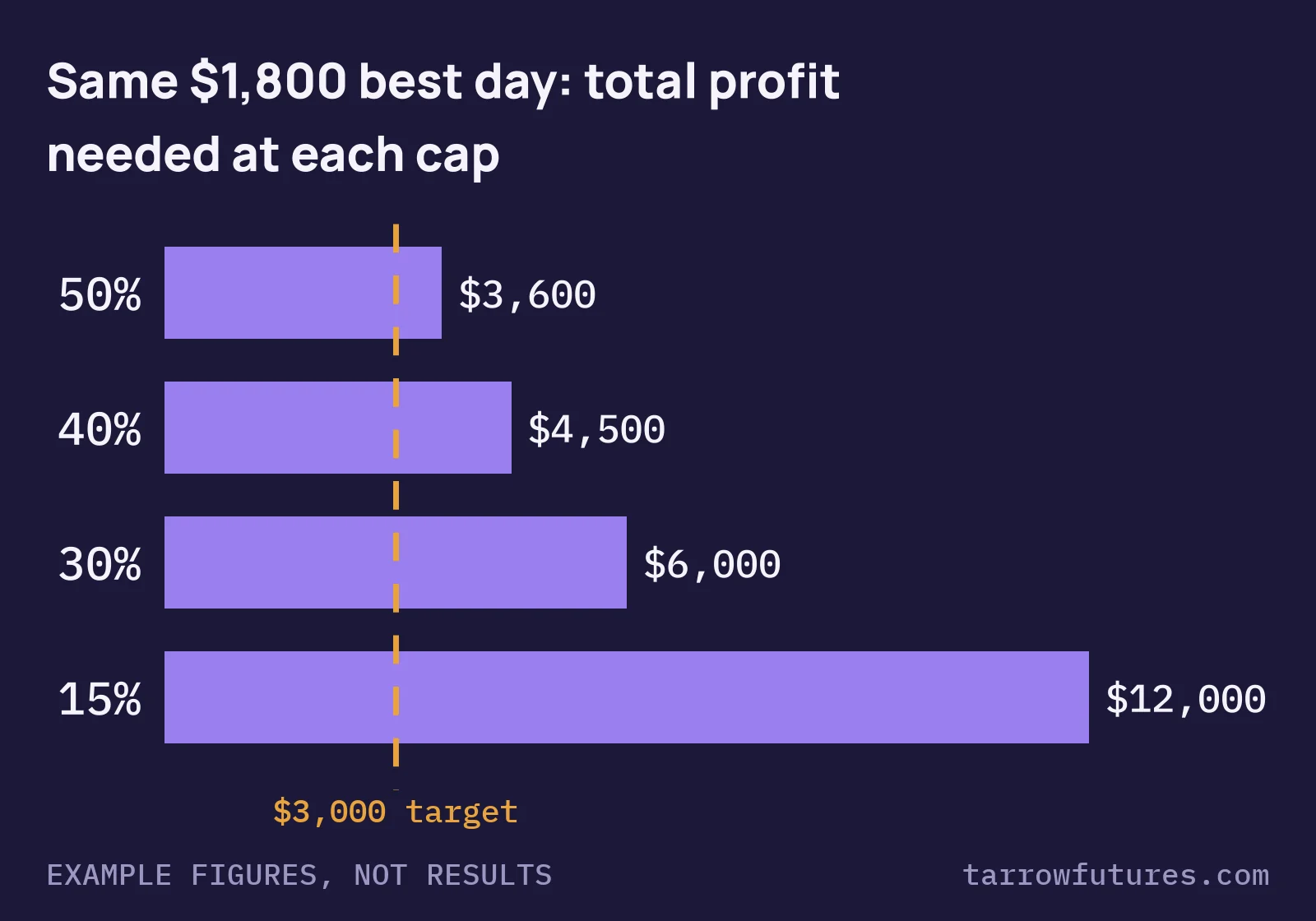
Same account, same $1,800 best day, same $2,800 of profit so far (example figures, not results):
| Cap | Calculation | Total profit needed | More profit needed | Days at $400 to get there |
|---|---|---|---|---|
50% |
$1,800 ÷ 0.50 |
$3,600 |
$800 |
2 |
40% |
$1,800 ÷ 0.40 |
$4,500 |
$1,700 |
5 (4.25 rounded up) |
30% |
$1,800 ÷ 0.30 |
$6,000 |
$3,200 |
8 |
15% |
$1,800 ÷ 0.15 |
$12,000 |
$9,200 |
23 |
The tighter the cap, the faster the bill grows. At 50%, one big day costs two more ordinary days. At 15%, the same day needs $12,000 of total profit, four times the $3,000 target. A tight cap changes what kind of trading the plan is built for, which is why it is worth reading before you buy, not after a good day.
What a 40% consistency rule means before the big day
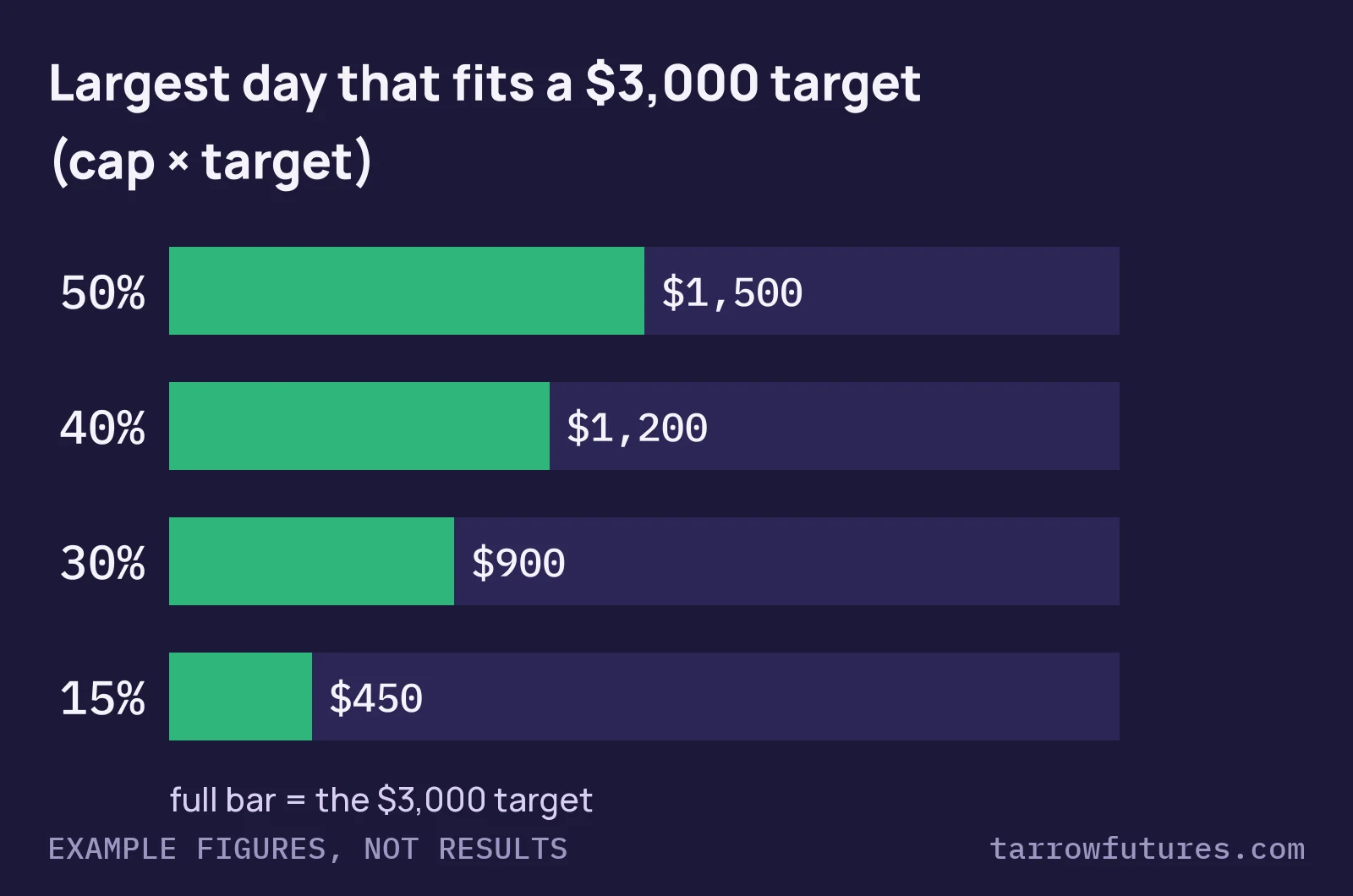
The table above is the after-the-fact sum. The same rule read forwards tells you the largest day that fits if you finish exactly on target: cap × target.
With a $3,000 target (example figures, not results):
| Cap | Largest day that fits on target |
|---|---|
50% |
$1,500 |
40% |
$1,200 |
30% |
$900 |
15% |
$450 |
So a 40% consistency rule on a $3,000 target means no day above $1,200 if you want the target to stay at $3,000. That number is worth knowing before the open. A trader who sizes for a $2,000 day under that rule is, in effect, choosing a higher target.
Three ways plans word the rule
The percentage is only half the rule. The other half is what it is a percentage of, and when it is checked.
What the share is taken of:
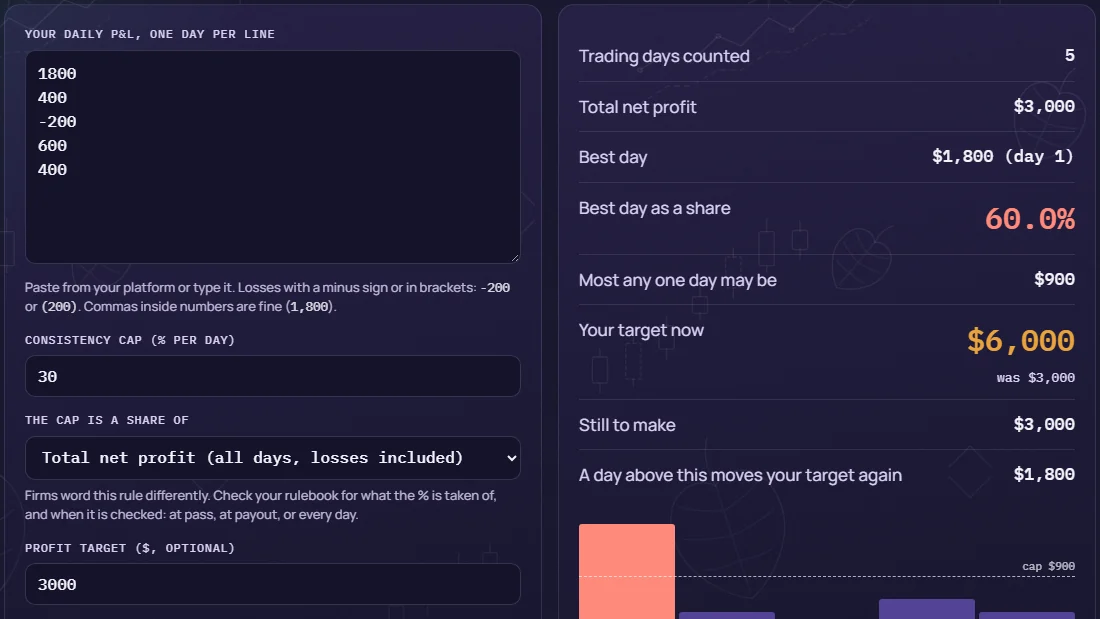
- Total net profit. Losing days count. Take daily P&L of
$1,800,$400,−$200,$600and$400. Net profit is$3,000, and the best day is$1,800 ÷ $3,000 = 60%of it. Under a30%cap, total net profit needs to reach$1,800 ÷ 0.30 = $6,000: another$3,000. - Profit from winning days only. Losses are left out. The same days give
$3,200of winning-day profit, so the share is$1,800 ÷ $3,200 = 56.3%. Under30%, winning days need to total$6,000, which is$2,800more, and net profit would be$5,800if no further day loses. - The profit target. The cap is a fixed dollar figure:
30%of a$3,000target is$900, whatever your total is.
When it is checked: at the end of the evaluation, at each payout request, or every day. A rule checked only at payout can let an account pass and then hold back the first withdrawal.
What a breach does: raise the profit needed (the moving target above), delay a payout until the share fits, or fail the account. These are very different outcomes for the same day, so find the one that applies to you.
Losing days make the share worse
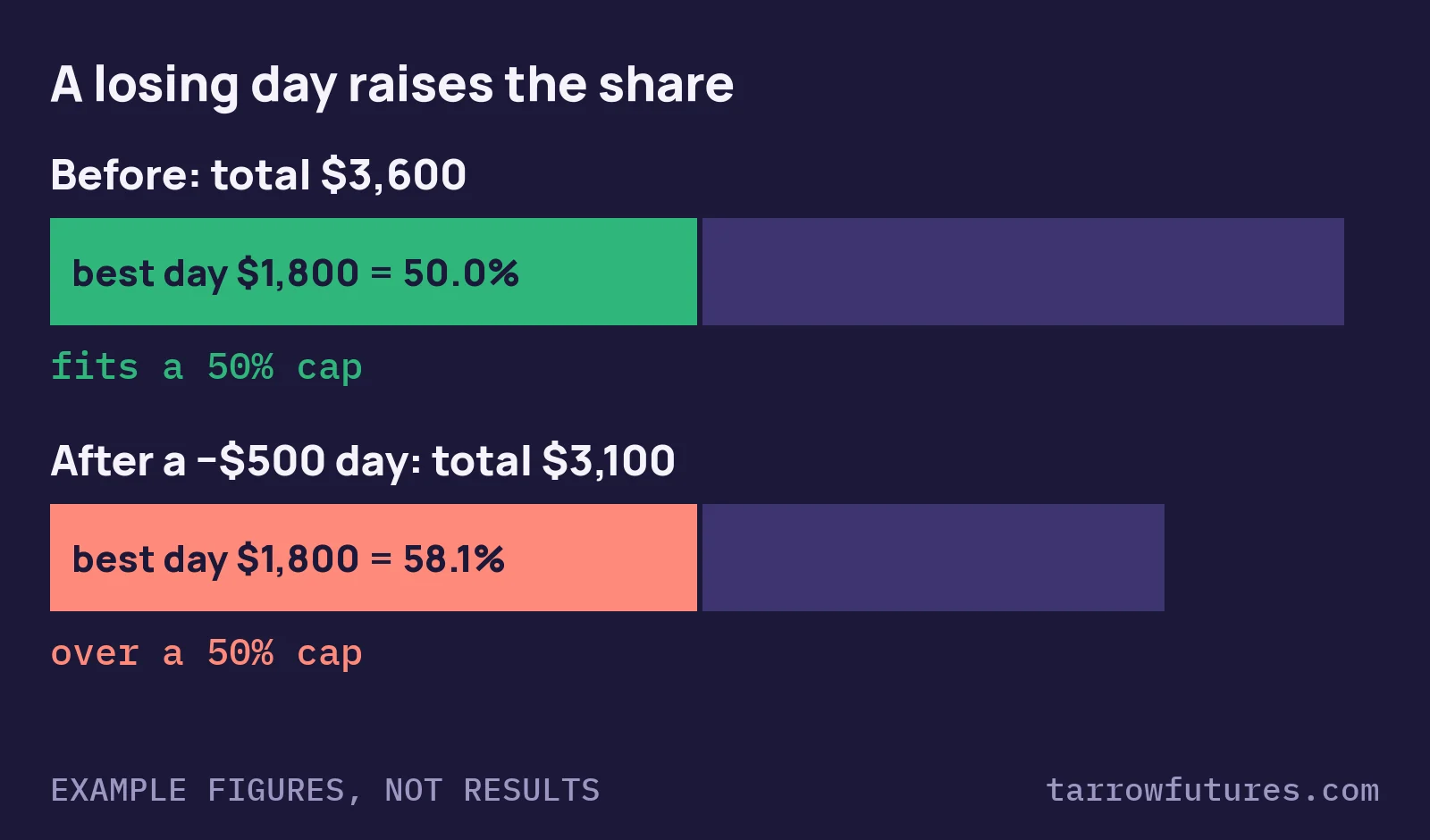
On a net-profit basis, a losing day lowers the total without lowering the best day, so the share goes up.
Example (example figures, not results): best day $1,800, total net profit $3,600, cap 50%. The share is exactly 50%, so it fits. Then a −$500 day: total $3,100, share $1,800 ÷ $3,100 = 58.1%. It no longer fits, and you need $500 more just to get back to where you were. The loss costs you twice: once against the drawdown and once against the consistency rule.
How big can tomorrow be?
If you have no target to anchor to, the day that breaks the cap by itself is any day larger than cap × total ÷ (1 − cap), measured with the new day included.
With $3,000 of profit and a 40% cap (example figures, not results): 0.40 × $3,000 ÷ 0.60 = $2,000. A $2,000 day would make the total $5,000 and the share $2,000 ÷ $5,000 = 40%, right on the cap. Anything above $2,000 goes over.
With a target, the simpler figure is the larger of your current best day and cap × target. Days at or under it leave the target where it is.
The consistency rule checker does all of this for your own daily P&L: paste the days, set the cap and the basis, and it shows your share, the cap in dollars, where your target moves and the largest day that keeps it still.
Common mistakes
- Checking only at the end. The cheapest time to apply the rule is before a big day, by knowing the largest day that fits.
- Assuming the share is of the target. If your plan measures net profit, the cap in dollars shrinks after a losing day.
- Chasing the extra profit with bigger size. More profit is needed on smaller days. Sizing up to finish faster risks a new best day, which moves the target again, and spends drawdown room. How many contracts should I trade on a prop firm account? covers sizing from your room.
- Using another firm's percentage. Caps, bases and timing all vary between firms and plans. Read your own current rulebook; percentages quoted online may be out of date or for a different plan.
- Forgetting the drawdown while you fix the share. Every extra day you trade to dilute a big day is another day against the floor.
Free tool · free with your email
Consistency rule checker
Paste your daily P&L and see if your best day fits the rule, and where your target moves if not. We email you the link, so it is one tap away next time.
✓ It's yours. The link is on its way to your inbox. Open the consistency rule checker now
See what the consistency rule checker does firstQuestions
What is the consistency rule in a prop firm?
A rule that caps how much of your total profit can come from one day. If the cap is 40%, your best day may be at most 40% of the profit the rule measures. It stops one large day from carrying a whole evaluation or payout.
How do you calculate the consistency rule?
Divide your best day by your total profit. If the result is at or under the cap, you fit. If it is over, the total profit your best day needs behind it is best day ÷ cap, and the extra profit needed is that figure minus your current total.
What does a 40% consistency rule mean?
No single day may be more than 40% of your total profit. With a $3,000 target, the largest day that fits when you finish exactly on target is 40% × $3,000 = $1,200. A $1,800 day needs $1,800 ÷ 0.40 = $4,500 of total profit behind it.
What does a 30% consistency rule mean?
Your best day may be at most 30% of total profit. A $1,800 best day then needs $1,800 ÷ 0.30 = $6,000 in total. On a $3,000 target, the largest day that fits on target is $900.
What does a 50% consistency rule mean?
Your best day may be at most half of total profit. With a $1,800 best day and $2,800 of profit, you need $1,800 ÷ 0.50 = $3,600 in total, so another $800, made on days smaller than $1,800.
Do losing days count toward the consistency rule?
It depends on what the percentage is taken of. If it is total net profit, losing days lower the total, so the same best day becomes a bigger share. If it is profit from winning days only, losing days do not change the share. The rulebook says which.
What happens if I break the consistency rule?
Plans handle it differently. Common versions raise the profit you need before you pass or can request a payout, delay a payout, or fail the account. The rulebook decides, so read it before a large day, not after.
Educational material only. Not financial, investment or trading advice, and not a recommendation to trade any contract or size. Prop firm rules differ and change; the current rulebook of the firm you use decides. Worked examples use example figures, not results. Futures trading involves substantial risk of loss. Evaluations are paid tests and most people who take one do not pass.