Prop Firm Rules
How much does a prop firm evaluation really cost? Fees, resets and activation, worked
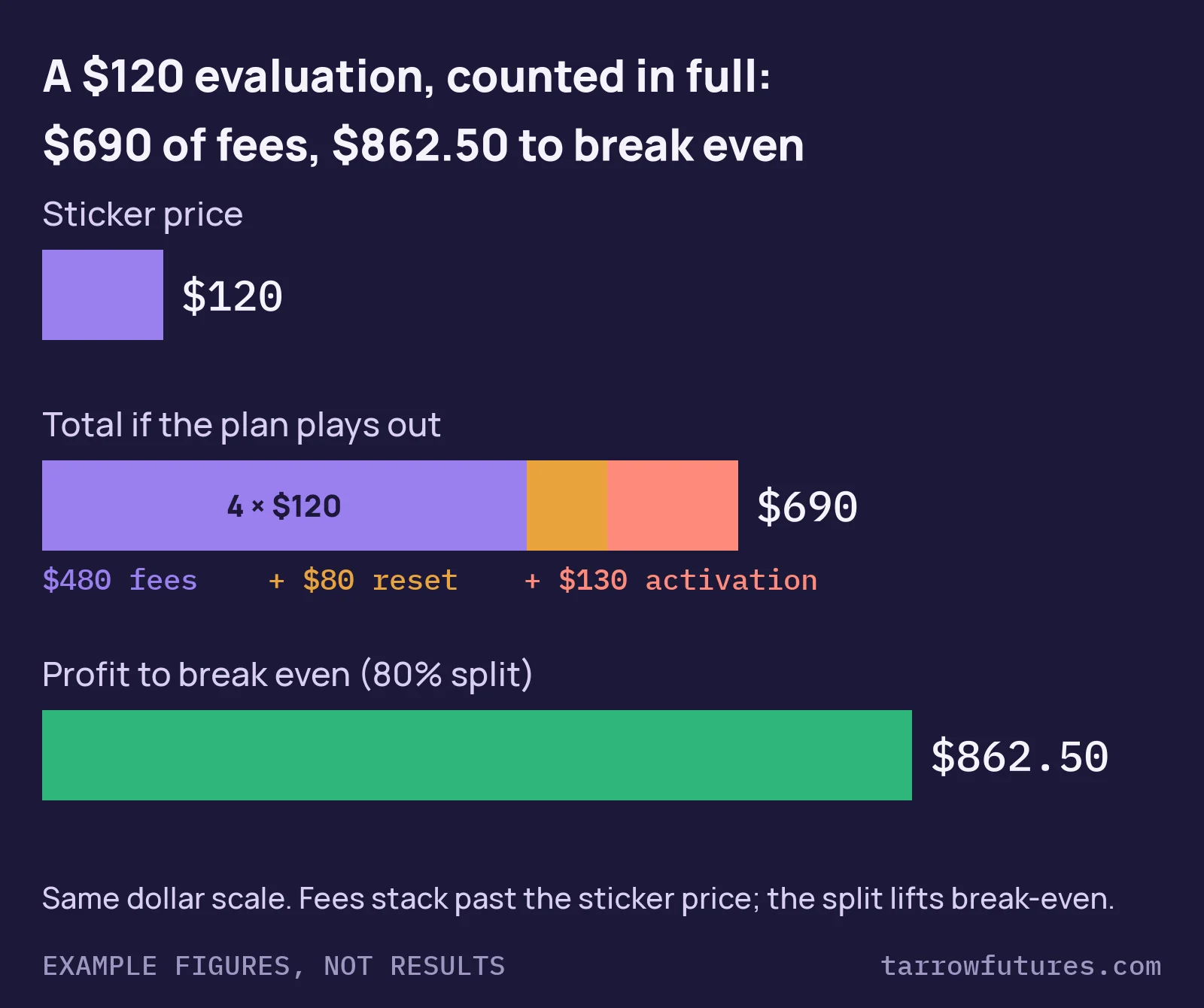
A prop firm evaluation costs its sticker price for one attempt, but the real cost is every fee you pay until you stop or get paid: the evaluation fee for each attempt or month, every reset, any activation fee after a pass, and data or other fees. On example figures, a $120-a-month evaluation that takes 4 months, with one $80 reset and a $130 activation fee, costs $690, which is 5.75 times the sticker price.
Divide that total by the share of profit you keep and you have the profit a funded account must make and pay out before the fees are covered: $690 ÷ 0.80 = $862.50 at an 80% split. The figures in this post are examples for a hypothetical plan, not any firm's prices and not results. Your firm's fee page and rulebook decide what applies.
Free tool · free with your email
Evaluation cost calculator
Add up evaluation fees, resets and activation for the attempts you expect, and the profit needed to break even on them.
✓ It's yours. The link is on its way to your inbox. Open the evaluation cost calculator now
See what the evaluation cost calculator does firstThe formula
``` total cost = evaluation fee × attempts (or months) + reset fee × resets + activation fee + data and other fees
break-even profit = (total cost + withdrawal fee) ÷ your profit split ```
Every fee goes in the total once for each time you expect to pay it. The number of attempts or months is your own assumption; nobody can tell you in advance how long an attempt will take.
The worked example
Example figures, not any firm's prices and not a result:
| Fee | Working | Running total |
|---|---|---|
| Evaluation fee, monthly | 4 × $120 |
$480 |
| One reset | + $80 |
$560 |
| Activation fee at the pass | + $130 |
$690 |
| Data and other fees | + $0 (enter yours) |
$690 |
| Against the sticker price | 690 ÷ 120 |
5.75× |
| Profit to break even at an 80% split | 690 ÷ 0.80 |
$862.50 |
The split is why break-even sits above the fees themselves. At 80%, every $1 of fees needs $1.25 of profit. At 90% it needs about $1.11; at 70% about $1.43.
These are the numbers the evaluation cost calculator opens with, so you can change one input at a time and watch the total move.
One-time or monthly: the clock decides
A one-time fee covers one attempt until it passes or fails. A monthly fee renews on each billing date until you pass or cancel. Which is cheaper depends on how long the attempt runs, and that is the number nobody knows before the first trade.
Example figures: a one-time fee of $200 with no time limit, against $120 a month.
| Attempt ends in | Monthly at $120 |
One-time at $200 |
|---|---|---|
| Month 1 | $120 |
$200 |
| Month 2 | $240 |
$200 |
| Month 3 | $360 |
$200 |
| Month 4 | $480 |
$200 |
The monthly plan is cheaper only if the attempt ends before the second billing date. After that, each month adds $120 while the one-time fee stays at $200. Two things change the picture: some one-time plans have a deadline, and a fail on either plan means paying again for the next attempt. How long it takes to hit a profit target works through why the number of days is not up to you.
Resets: one more attempt, priced separately
A reset restarts the evaluation from the starting balance after a rule breach, without buying a new one. Where a plan offers it, the reset fee is often lower than a new purchase, but it buys the same thing: another attempt.
| Resets | At $80 each |
Total with 4 months at $120 |
|---|---|---|
0 |
$0 |
$480 |
1 |
$80 |
$560 |
3 |
$240 |
$720 |
On a monthly plan, find out whether a reset restarts the billing date or is charged on top of the monthly fee. In the second case, a reset in week three of a month is a reset plus that month's fee, and the next billing date still arrives on time. A reset also returns the account to its starting rules, so read what a trailing drawdown reset does before counting on one.
The activation fee: the one that comes last
Some plans charge a one-time activation fee after a pass, to switch on the next account. Because it comes last, it is the fee most often left out of a budget. Where a firm offers a version of the plan without one, the monthly price is usually higher, and the comparison is the same clock problem as before.
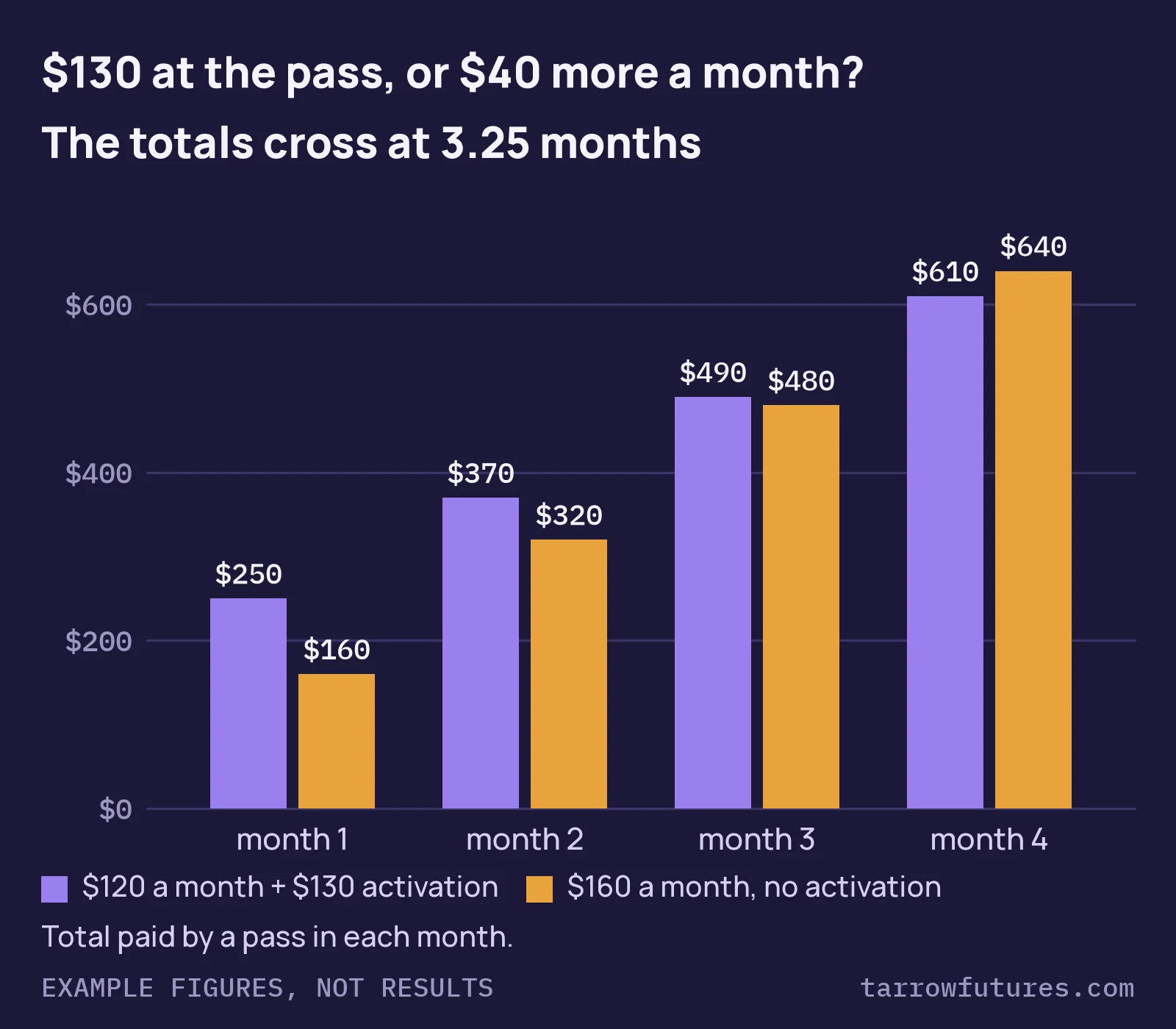
Example figures: $120 a month plus $130 at the pass, against $160 a month with no activation fee.
| Pass in | $120 a month + $130 |
$160 a month, no activation |
|---|---|---|
| Month 1 | $250 |
$160 |
| Month 2 | $370 |
$320 |
| Month 3 | $490 |
$480 |
| Month 4 | $610 |
$640 |
The no-activation plan costs less for a pass in the first three months; from month 4 the plan with the activation fee does. The gap is $40 a month against a one-time $130, so the totals cross at 130 ÷ 40 = 3.25 months. A fail costs less on the cheaper monthly plan either way, because no activation fee is ever charged.
Data and other fees
Some plans include real-time market data; others bill it monthly on top of the evaluation fee. Platform fees, order-routing fees and withdrawal or payment-method fees belong in the total too. They are small next to the evaluation fee, but they are charged every month or every withdrawal, so they grow with time the same way a monthly fee does. If your plan charges none of them, enter 0.
Break-even is a budget line, not a forecast
$862.50 is the profit the funded account has to make and pay out before the $690 is covered. Two things sit between those numbers and money in your account: the payout rules, such as a buffer before the first withdrawal, a minimum number of trading days and a cap on each withdrawal; and any withdrawal fee, which is added to the total before dividing by the split.
None of this says an evaluation will pass or that a funded account will pay out. It is the line a budget has to clear, worked out before you buy.
Seven lines to find on the fee page and in the rulebook
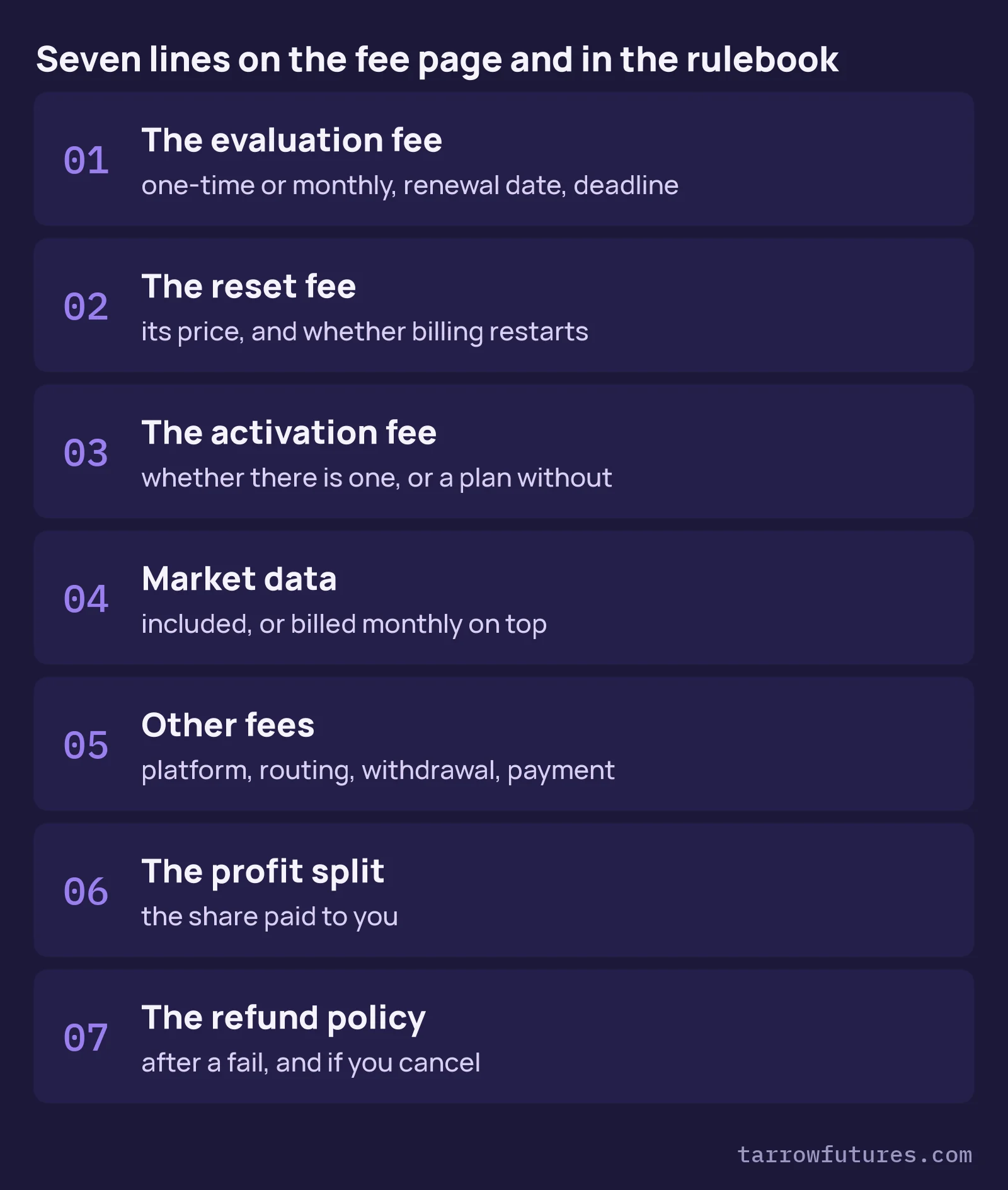
- The evaluation fee. One-time or monthly, the renewal date, and any deadline on a one-time attempt.
- The reset fee. Whether there is one, what it costs, and whether it restarts the billing date.
- The activation fee. Whether there is one, and whether a version of the plan comes without it.
- Market data. Included, or billed monthly on top.
- Other fees. Platform, routing, withdrawal and payment-method fees.
- The profit split. The share paid to you, and whether it changes over time.
- The refund policy. Usually the fee is not returned after a fail; check what happens if you cancel mid-month.
Common mistakes
- Comparing plans on the sticker price.
$120was$690once 4 months, a reset and the activation fee were counted. - Leaving out the activation fee. It is charged at the pass, which is exactly when a budget stops being checked.
- Counting a reset as free. At
$80, three resets add$240, and a reset doesn't stop the monthly billing on every plan. - Stopping at the fees. The split turns
$690of fees into$862.50of profit to break even. - Treating the number of attempts as known. It is your assumption. Use your own history: how many attempts have you paid for so far, and what ended them?
Run your own numbers
The free evaluation cost calculator adds up the fees for the attempts or months you expect, as your own assumption, and shows the total, the multiple of the sticker price and the profit needed to break even at your split. Free with your email, below.
Only buy an evaluation with money you can afford to lose in full. The fee is spent whether the evaluation passes or fails, and if the total for the attempts you expect is more than you can afford to lose, that is the answer.
Diagrams are illustrations drawn by Tarrow Futures, not market data. Worked examples use example figures for a hypothetical plan, not any firm's prices and not results. Educational only, not financial advice. Trading futures involves substantial risk of loss.
Free tool · free with your email
Evaluation cost calculator
Add up evaluation fees, resets and activation for the attempts you expect, and the profit needed to break even on them. We email you the link, so it is one tap away next time.
✓ It's yours. The link is on its way to your inbox. Open the evaluation cost calculator now
See what the evaluation cost calculator does firstQuestions
How much does a prop firm evaluation cost?
The price on the checkout page covers one attempt, or one month on a monthly plan. The real cost is every fee until you stop or get paid. On example figures, an evaluation at $120 a month that takes 4 months, with one $80 reset and a $130 activation fee, costs $690, which is 5.75 times the $120 sticker price.
Is a one-time or a monthly evaluation cheaper?
It depends on how long the attempt takes, which nobody knows in advance. On example figures, a one-time $200 fee with no time limit is cheaper than $120 a month once the attempt runs into a second billing month, since 2 × $120 = $240. A fail ends either one, and the next attempt is paid for again.
Is a reset cheaper than buying a new evaluation?
Often the reset fee is lower than a new purchase, but count it as one more attempt in the total. On a monthly plan, check whether the reset restarts the billing date or is charged on top of the monthly fee. The rulebook or the fee page says which.
What is a prop firm activation fee?
A one-time fee some plans charge after a pass, to switch on the next account. It comes last, so it is easy to leave out of a budget. Some firms offer a plan without one at a higher monthly fee; on example figures, $120 a month plus $130 at the pass costs less than $160 a month with none until the pass takes 4 months.
How much profit do I need to break even on evaluation fees?
Divide the total fees, plus any withdrawal fee, by the share of profit you keep. On example figures, $690 of fees at an 80% split needs $690 ÷ 0.80 = $862.50 of profit paid out before the fees are covered. That is arithmetic for a budget, not an expectation that any account gets there.
Educational material only. Not financial, investment or trading advice, and not a recommendation to trade any contract or size. Prop firm rules differ and change; the current rulebook of the firm you use decides. Worked examples use example figures, not results. Futures trading involves substantial risk of loss. Evaluations are paid tests and most people who take one do not pass.