Prop Firm Rules
How long does it take to hit a prop firm profit target? The fewest days the rules allow
There is no set time to hit a prop firm profit target, and nobody can promise one, because your results decide it. What the rules do fix is the fewest days it can take: the larger of the plan's minimum trading days and the days a consistency cap forces, which is 1 ÷ cap, rounded up. With a 5-day minimum and a 40% cap, the earliest an evaluation can pass is day 5 (example figures).
This post works out that floor, what a time limit and a monthly fee add, and why a big day does not shorten the count under a consistency rule. The figures are examples for a hypothetical plan that explain the mechanism; they are not results and not any firm's rules. Your rulebook decides the details.
Free tool · free with your email
Consistency rule checker
Paste your daily P&L and see if your best day fits the rule, and where your target moves if not.
✓ It's yours. The link is on its way to your inbox. Open the consistency rule checker now
See what the consistency rule checker does firstThe example plan
Used through this post (example figures, not results):
- Starting balance
$50,000, profit target$3,000, trailing drawdown$2,000 - Consistency cap
40%: no single day may be more than40%of total profit - Minimum
5trading days - Fee
$120, billed monthly, no time limit
The floor from a consistency cap
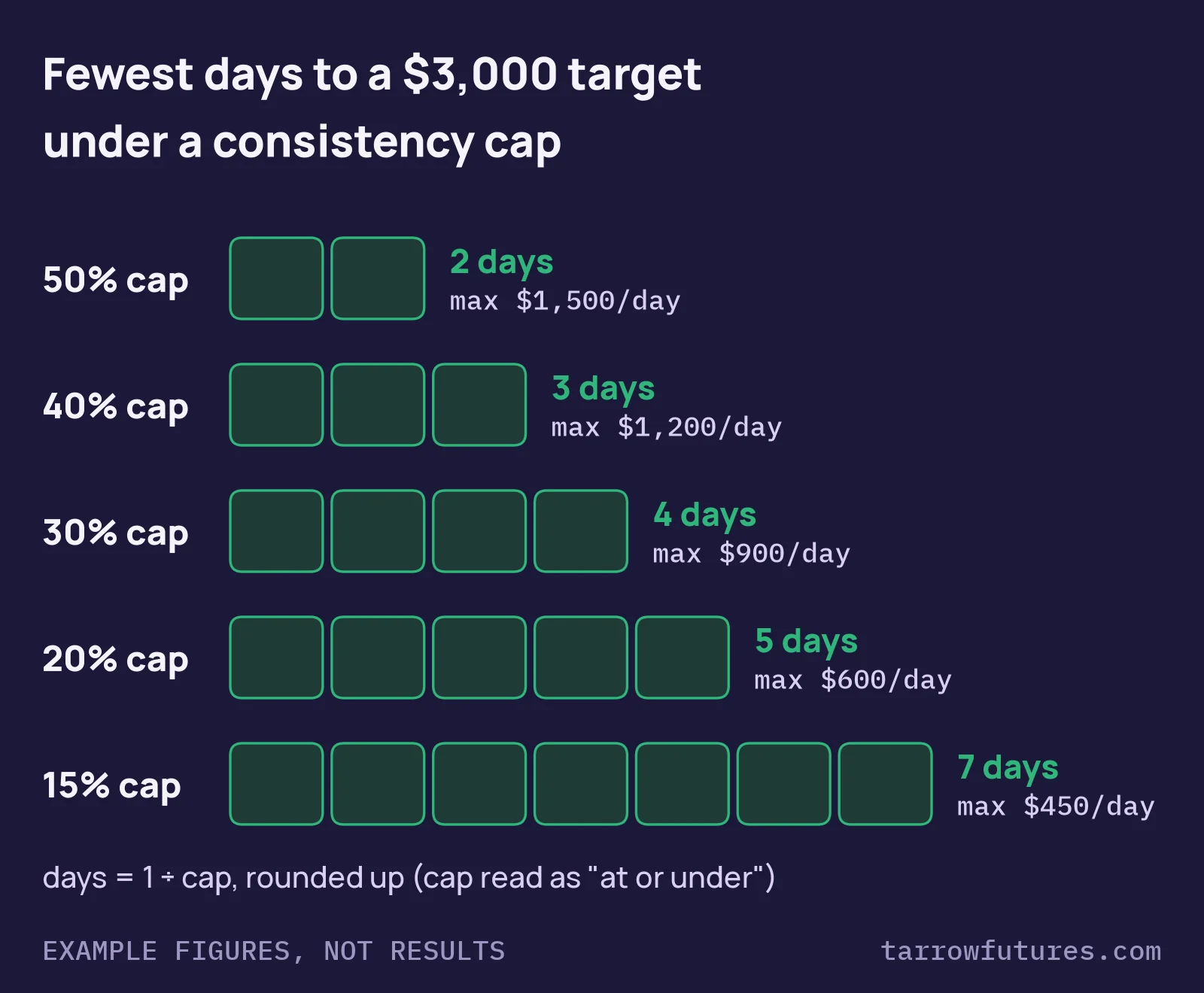
A consistency rule caps the share of total profit one day can make up (how the formula works). Finish exactly on target, and the largest day that fits is cap × target. Under a 40% cap that is 0.40 × $3,000 = $1,200, and two days of $1,200 make only $2,400. So the target needs at least 3 days.
In general the fewest days is 1 ÷ cap, rounded up:
| Cap | Largest day on a $3,000 target |
Fewest days |
|---|---|---|
50% |
$1,500 |
2 |
40% |
$1,200 |
3 |
30% |
$900 |
4 |
20% |
$600 |
5 |
15% |
$450 |
7 |
These are floors, not estimates: they assume every day is exactly the largest day that fits, and no losing days. The wording matters too. The table reads the cap as "at or under". If the rule says a day must be under the cap, a 50% cap needs 3 days, because two $1,500 days are each exactly 50%, and a 20% cap needs 6 for the same reason.
Two rules, one floor
The minimum trading days rule sets its own count (what counts as a day). The fewest days possible is the larger of the two numbers.
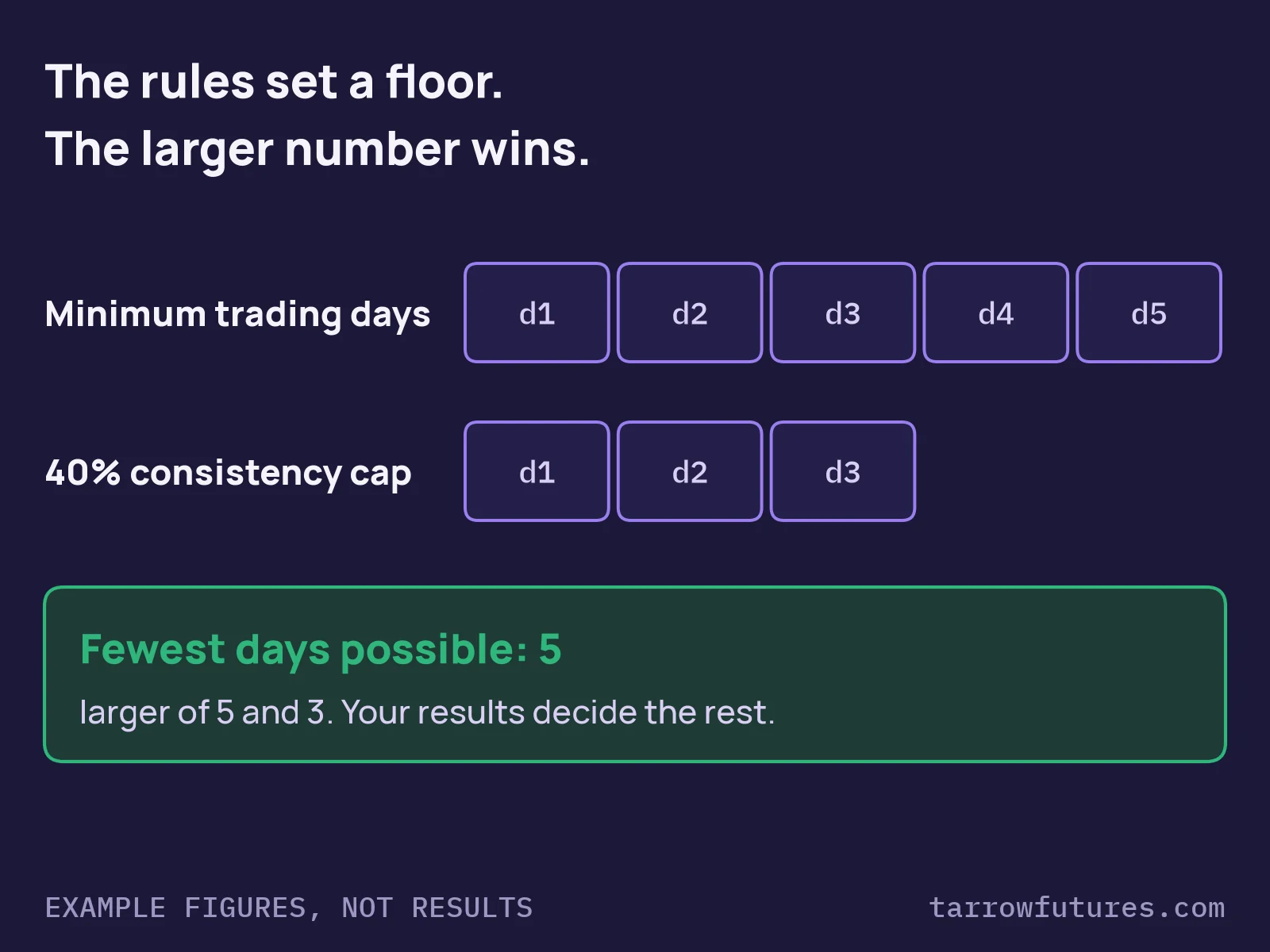
On the example plan: the minimum is 5 days, the 40% cap forces 3. The larger is 5, so the earliest the evaluation can pass is day 5. Reaching $3,000 on day 3 does not change that.
A plan with a 15% cap and a 5-day minimum has a floor of 7 days, because 7 is larger than 5. A plan with neither rule has no floor from the rules at all.
Measure the target in your own risk
The day count above is a floor. How long it actually takes depends on results, which vary from day to day and can be negative. One way to see the size of the job without forecasting anything is to measure the target and the drawdown in your own risk per trade.
With $200 of risk per trade (example figure):
- The target is
$3,000 ÷ $200 = 15times your risk per trade - The trailing drawdown is
$2,000 ÷ $200 = 10losing trades from the high, before any winners
So on this plan the target is 1.5 times the drawdown. That ratio is set by the rulebook and your size, not by the market, and it is worth writing down before you buy.
A big day does not shorten it
Under a consistency cap, a day over the cap raises the total profit you need. On the example plan, an $1,800 day is over the $1,200 that fits on target. The total it needs behind it is $1,800 ÷ 0.40 = $4,500, so the job grows from $3,000 to $4,500, and the extra $1,500 has to come from smaller days.
The size that makes a large day possible also reaches the daily loss limit and the drawdown faster on a losing day. Position size from the stop and the loss limit works that side through.
Free toolSkip the arithmetic: the consistency rule checker does this for your own numbers.Get it ↓A time limit counts the calendar
Some plans set a deadline to reach the target. It can be counted in calendar days or in trading days, and the difference is large:
- A deadline of
30calendar days counts weekends and holidays. Thirty days hold20to22weekdays, depending on the start day, and fewer if a market holiday falls inside - A deadline of
30trading days counts only days you trade
Many plans have no deadline. Then the floor from the rules is the only limit on the short side, and nothing ends the evaluation on the long side except the drawdown, a rule break or the fee.
No deadline still has a cost
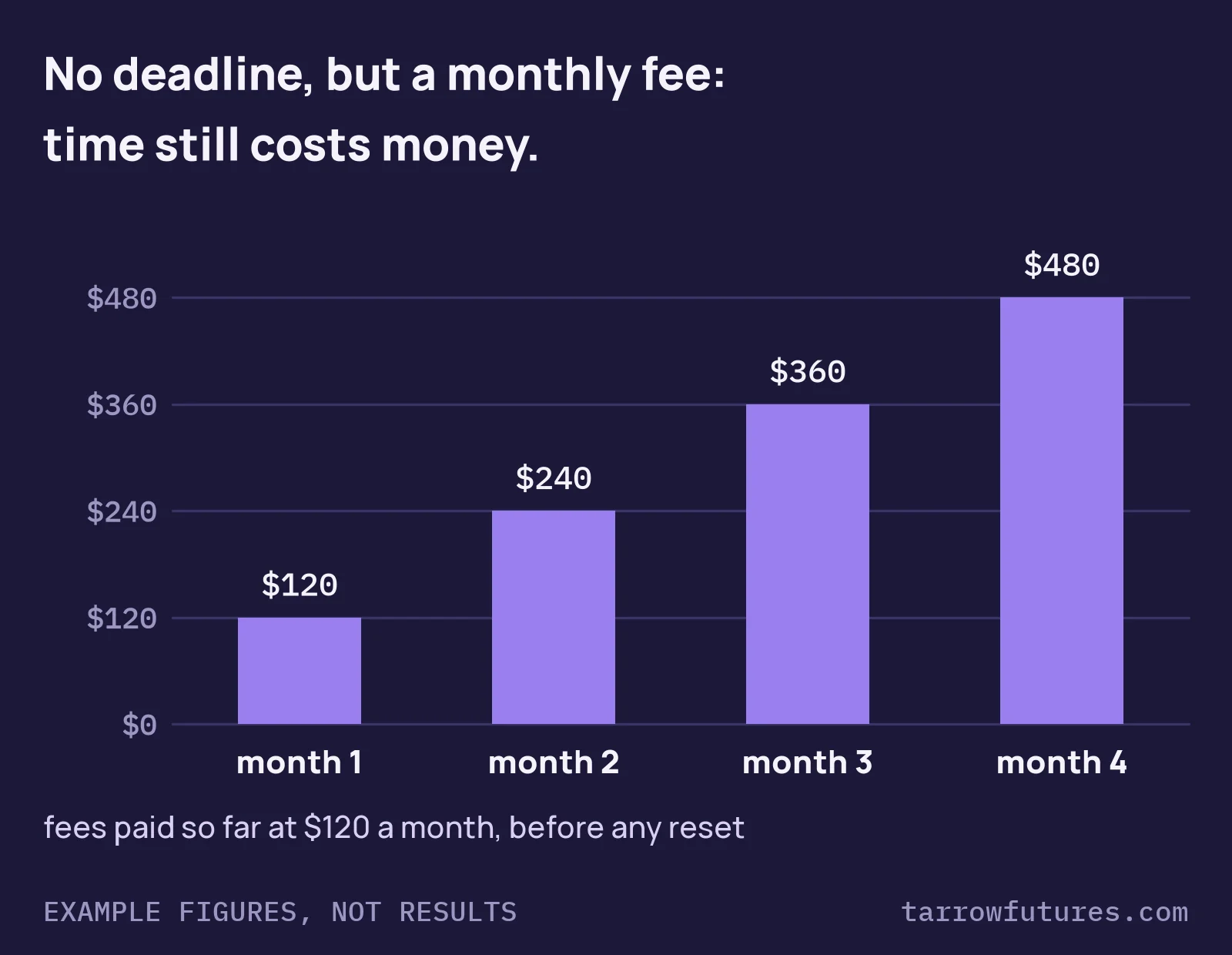
On a plan billed monthly, every billing date before the pass adds the fee again. At the example $120 a month:
| Passes in | Fees paid |
|---|---|
month 1 |
$120 |
month 2 |
$240 |
month 3 |
$360 |
month 4 |
$480 |
That is before any reset fee, and before any activation fee charged after the pass. A one-time fee does not grow with time, but a reset after a rule break starts the count, and often the fee, again. Read when the plan renews, so you know the date the next fee is charged.
Five lines to find in the rulebook
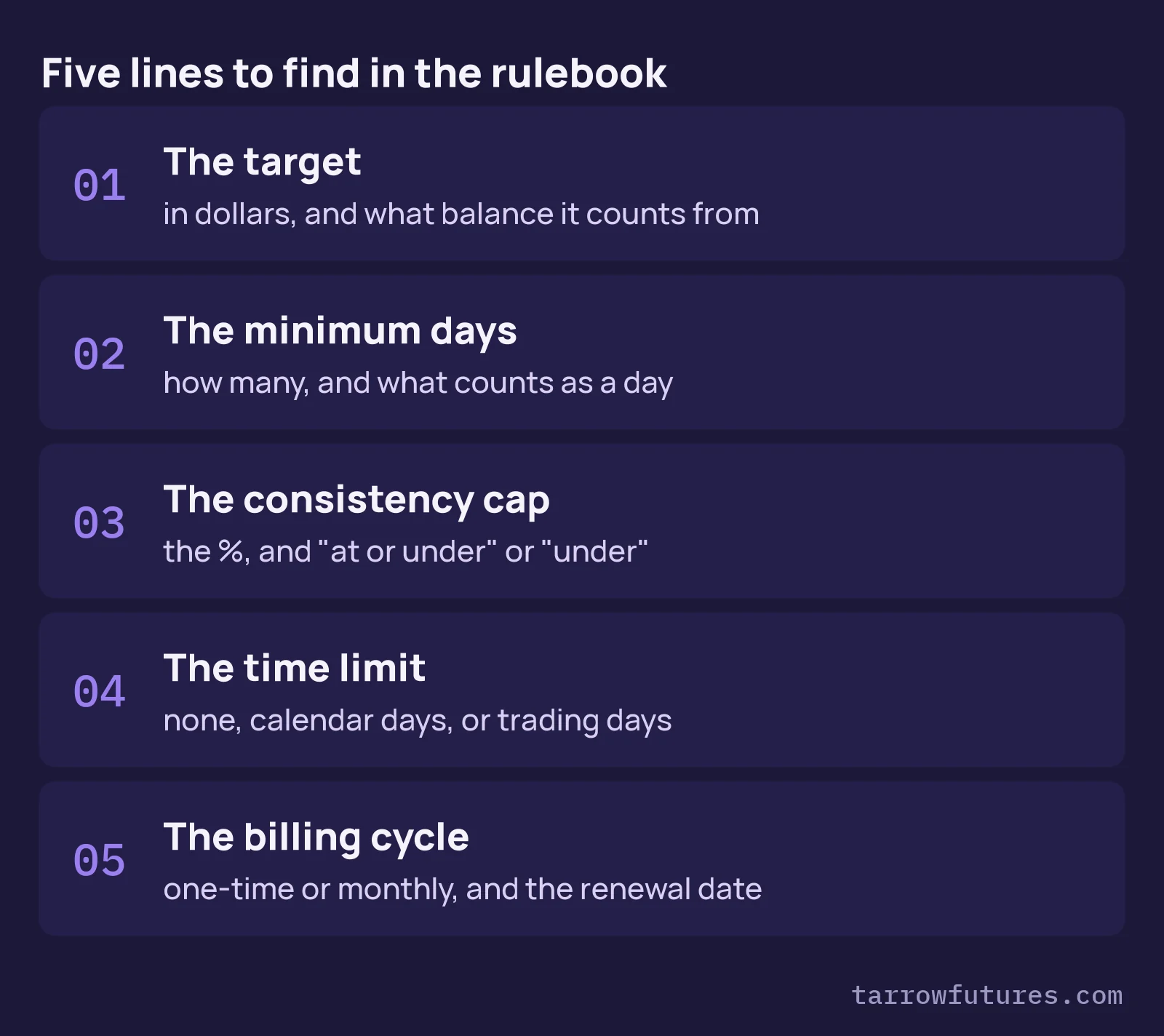
- The target. In dollars, and what balance it counts from.
- The minimum days. How many, and what counts as a day.
- The consistency cap. The percentage, whether it reads "at or under" or "under", and what the share is taken of.
- The time limit. None, calendar days or trading days.
- The billing cycle. One-time or monthly, and the renewal date.
Then work out the floor: 1 ÷ cap rounded up, against the minimum days, and take the larger.
Common mistakes
- Treating the target as the finish line. On the example plan,
$3,000on day3is not a pass; day5is the earliest. - Planning around one big day. Under a
40%cap, an$1,800day moves the target to$4,500. - Reading a calendar deadline as trading days. Thirty calendar days are
20to22weekdays. - Ignoring the renewal date. On a monthly plan, each month before the pass adds the fee.
- Reading the rules once. Rules change. Read the current version before you plan the evaluation.
Check your biggest day against the cap
The free consistency rule checker takes your daily P&L, your cap and your target, and shows the largest day that fits and how much the target moves when a day goes over. Free with your email, below.
Diagrams are illustrations drawn by Tarrow Futures, not market data. Worked examples use example figures for a hypothetical plan, not any firm's rules and not results. Educational only, not financial advice. Trading futures involves substantial risk of loss.
Free tool · free with your email
Consistency rule checker
Paste your daily P&L and see if your best day fits the rule, and where your target moves if not. We email you the link, so it is one tap away next time.
✓ It's yours. The link is on its way to your inbox. Open the consistency rule checker now
See what the consistency rule checker does firstQuestions
How long does it take to hit a prop firm profit target?
There is no set time, and nobody can promise one, because it depends on your results. The rules fix only the fewest days it can take, which is the larger of the plan's minimum trading days and the days a consistency cap forces. With a 5-day minimum and a 40% cap, the earliest an evaluation can pass is day 5 (example figures).
What is the fastest you can pass a prop firm evaluation?
The larger of two numbers in the rulebook. One is the minimum trading days. The other comes from the consistency cap, 1 ÷ the cap rounded up, because no day can be more than the cap's share of the profit. A plan with neither rule has no floor from the rules.
How many days does a 40% consistency rule need?
At least 3. No single day can be more than 40% of total profit, and two days can make up at most 80%. On a $3,000 target, the largest day that fits when you finish exactly on target is 40% × $3,000 = $1,200.
Is there a time limit to hit the profit target?
Some plans set one, counted in calendar days or in trading days; many have none. A deadline in calendar days counts weekends and holidays, so 30 calendar days hold 20 to 22 weekdays depending on the start day. Your rulebook says which you have.
Does taking longer cost more?
On a plan billed monthly, yes. Each billing date before the pass adds the fee again, so an example $120 monthly evaluation costs $360 if it passes in month 3. A one-time fee does not grow with time, but resets do.
Can a big day get me to the target faster?
Not under a consistency cap. A day over the cap raises the total profit you need: under a 40% cap, an $1,800 day needs $1,800 ÷ 0.40 = $4,500 of total profit behind it instead of $3,000 (example figures).
Educational material only. Not financial, investment or trading advice, and not a recommendation to trade any contract or size. Prop firm rules differ and change; the current rulebook of the firm you use decides. Worked examples use example figures, not results. Futures trading involves substantial risk of loss. Evaluations are paid tests and most people who take one do not pass.