Prop Firm Rules
Prop firm news trading rules: the window, the list and the penalty
Prop firm news trading rules stop you trading for a few minutes before and after listed economic releases, such as CPI, the jobs report and the FOMC statement. A typical rule names the events, sets a window such as 2 minutes either side, and states a penalty, which can be anything from a voided trade to a failed account.
The rule is short, and it still catches traders who were otherwise disciplined, because CPI comes out at 8:30 ET while index futures are already trading, and a position or a resting order from earlier in the morning can sit inside the window without the trader doing anything. This post covers what the rules restrict, the release times and the next dates, and what a fill during a release does to the size you planned. Rules differ by firm and plan, so the numbers here explain the mechanism; your rulebook decides the details.
Free printable · free with your email
The Floor Sheet
Every account's floor, room and max loss for the day on one page. Up to 8 accounts.
✓ It's yours. The link is on its way to your inbox.
Check your inbox in the next few minutes.
What a news rule restricts
Every news rule answers three questions. Read all three for your plan before the first release day:
| Question | What to look for in the rulebook |
|---|---|
| Which events | A named list (CPI, the jobs report, FOMC) or a link to a calendar, and which impact level counts |
| How wide | Minutes before and after the release, and whether the window is the same for every event |
| What it stops | Holding a position, opening one, or any order working inside the window |
| The penalty | Trade voided, profit removed, a warning, or the account failed |
| Which accounts | The evaluation, the funded account, or both |
The "what it stops" line matters most. A rule that only bans opening a trade lets you hold one through the release. A rule that bans holding a position means being flat before the window opens. A rule that covers orders means a stop or limit order resting from earlier counts if it fills inside the window.
The window on the clock
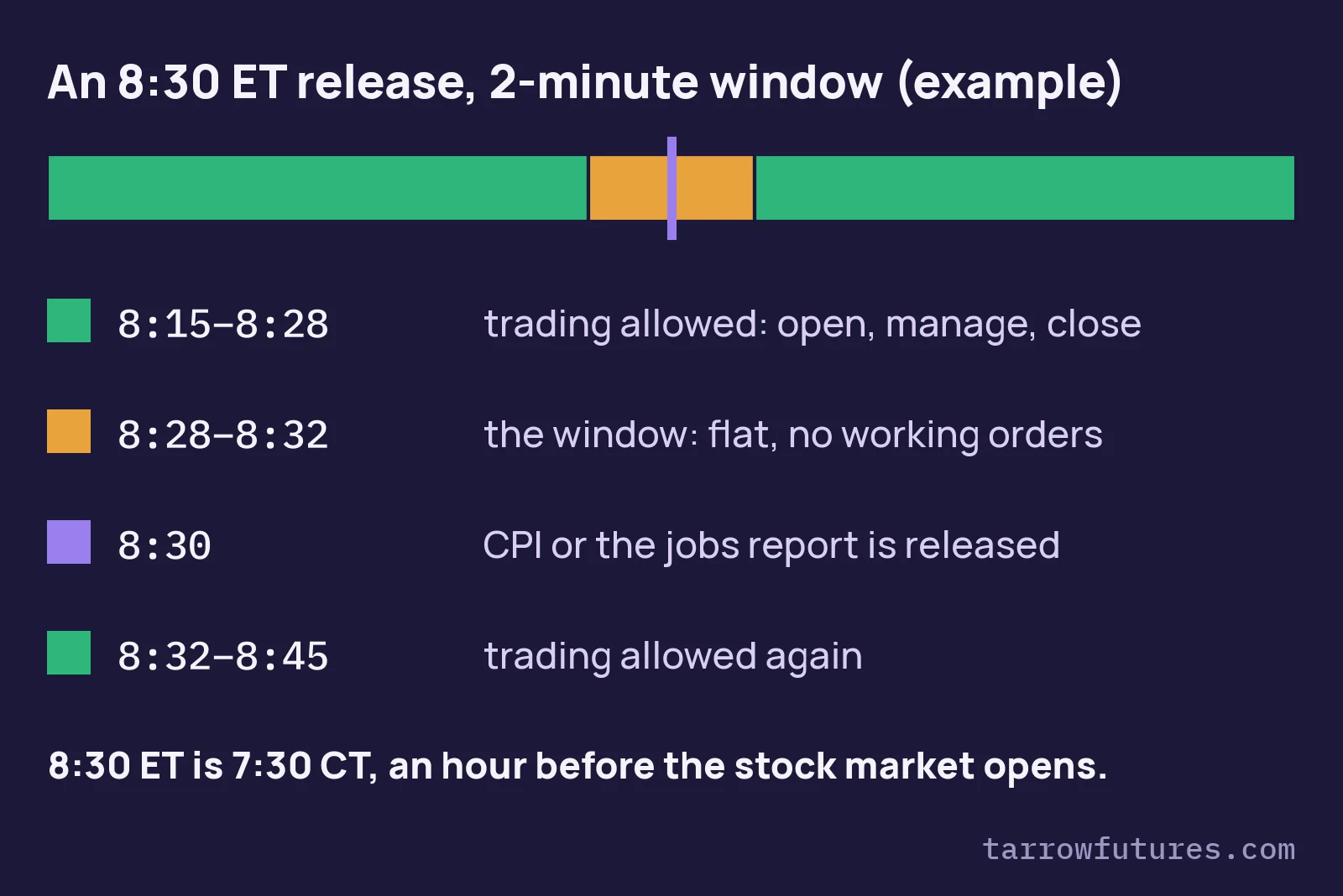
With a 2-minute window around an 8:30 release (example rule), the window runs from 8:28 to 8:32 ET. A trade opened at 8:20 and still open at 8:29 is inside it, even if it was planned the night before and closes at a profit. Under a rule that covers orders, a buy stop placed at 8:00 and filled at 8:30 is a trade inside the window too.
Traders in Chicago see the clock an hour earlier: 8:30 ET is 7:30 CT, and the 2:00 ET Fed statement is 1:00 CT. Rulebooks often state times in ET while a platform shows local time. Convert once, write the CT times down, and use those.
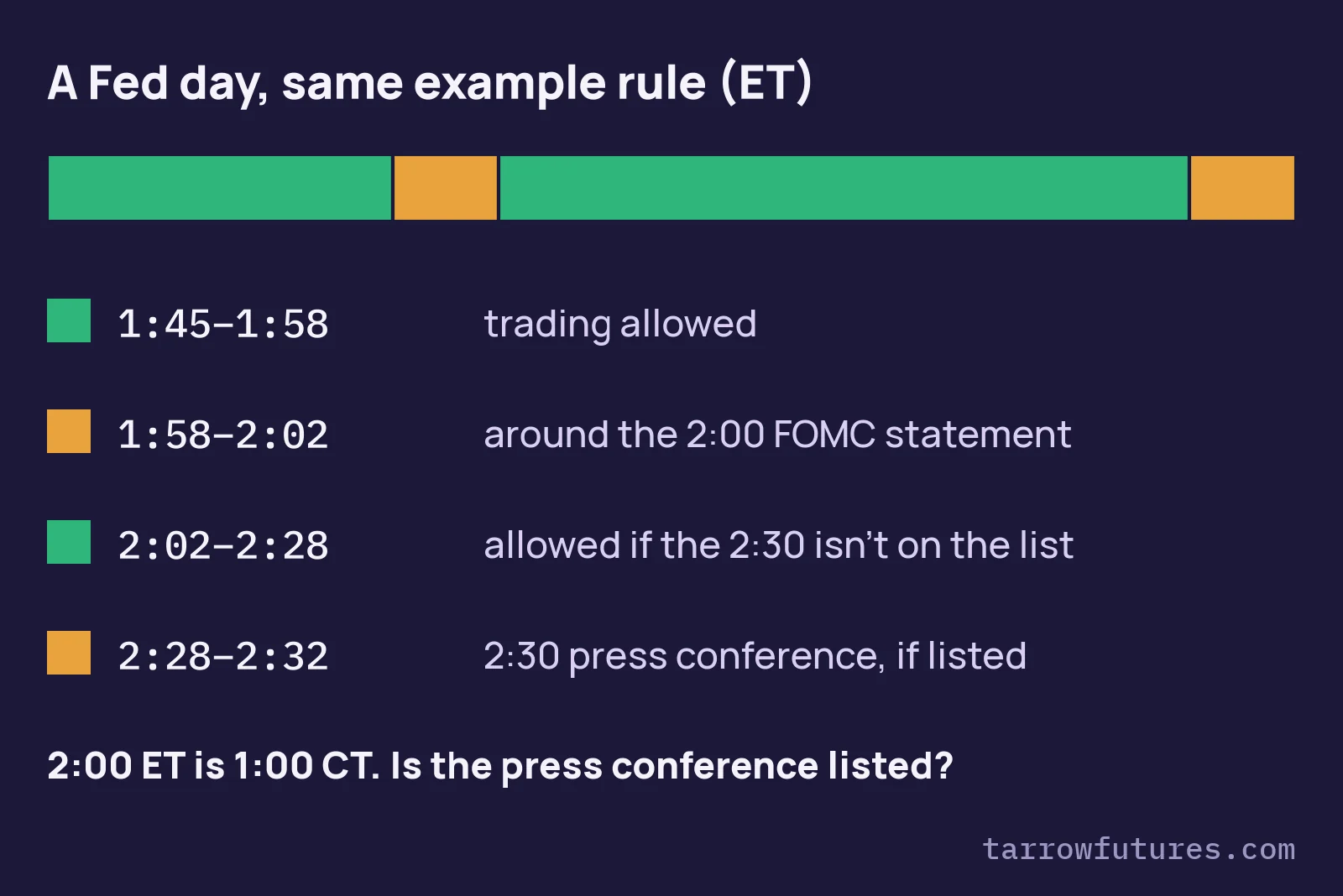
A Fed day can have two windows. The Federal Reserve's calendar lists the FOMC meeting at 2:00 p.m. ET and the press conference at 2:30 p.m. on the meeting's last day. Whether the press conference is restricted depends on whether the firm's list names it.
Release times and the next dates
| Release | Time (ET) | Time (CT) | Next dates | Source |
|---|---|---|---|---|
| CPI | 8:30 a.m. |
7:30 a.m. |
10 Nov 2026 · 10 Dec 2026 · 13 Jan 2027 | BLS release schedule, read 6 Nov 2026 |
| Jobs report (Employment Situation) | 8:30 a.m. |
7:30 a.m. |
4 Dec 2026 · 8 Jan 2027 | BLS release schedule, read 6 Nov 2026 |
| FOMC statement | 2:00 p.m. |
1:00 p.m. |
9 Dec 2026 · 27 Jan 2027 | Federal Reserve calendar, read 6 Nov 2026 |
| FOMC press conference | 2:30 p.m. |
1:30 p.m. |
the same days | Federal Reserve calendar, read 6 Nov 2026 |
The BLS updates its schedule as needed, and the Fed marks its future meeting dates as tentative until the meeting before confirms them. Check both pages in the week of the release. Your firm may list more events than these four; its list is the one that counts.
Free printableKeep these numbers to hand: the the floor sheet puts them on one printable page.Get it ↓Why release minutes are a sizing problem
A stop order becomes a market order when price touches it, and it fills at the next price available. In the seconds after a release, the next available price can be well past the stop. That turns a news rule into a position-size rule wearing a calendar.
A worked case on MNQ, which is $2 a point (CME contract specs). Example figures, not results:
- Planned:
4MNQ, stop20points away. Risk =4 × 20 × $2 = $160 - If the stop fills
40points away instead:4 × 40 × $2 = $320 - Against a
$1,000daily loss limit (example), the plan left$840of room after a stop. The filled stop leaves$680
The 40 points is an example, not a measured figure: how far a stop slips depends on the day, the contract and the order book at that second. The point is that the plan's risk assumed a fill at the stop. If you allow yourself to hold through a release where your plan permits it, size for a fill well past the stop, or hold fewer contracts.
Common mistakes
- Reading the event list once. Lists and windows change. Read the current rulebook in the week you trade, not the one you read when you bought.
- Forgetting resting orders. A stop or limit from earlier in the session can fill inside the window. If your rule covers orders, cancel them before the window opens.
- Using the wrong clock. A window stated in ET and a platform in CT is an hour of difference. Convert before the day, not at
7:29. - Assuming the evaluation and funded rules match. The rulebook may treat them differently. Check which rule applies to the account you are trading.
- Treating a voided trade as harmless. A voided winner removes profit you were counting on. Check whether a voided loser still counts against your drawdown; the rulebook says how it handles each.
- Planning the day around the release. If the window covers the setup you trade, that setup is off that day. Write it down before the open.
A five-minute check before release days
- On Sunday, write the week's listed releases and their times in ET and CT.
- Next to each, write your firm's window, what it stops and the penalty.
- Block the window in your plan, including the press conference on a Fed day if it is listed.
- Before the window, be flat if the rule requires it, and cancel working orders if the rule covers them.
- If you hold through a release your plan permits, size for a fill past your stop.
The free Floor Sheet has a box for exactly this: the release, the time and each firm's rule for it, next to your floor math and pre-trade checklist. It is free with your email, below. For the rest of a plan's rules, read daily loss limit vs trailing drawdown and the consistency rule.
Diagrams are illustrations drawn by Tarrow Futures, not market data. Release times and dates are from the Bureau of Labor Statistics and Federal Reserve pages named above, read on 6 November 2026. Worked examples use example figures, not results. Educational only, not financial advice. Trading futures involves substantial risk of loss.
Free printable · free with your email
The Floor Sheet
Every account's floor, room and max loss for the day on one page. Up to 8 accounts. We email you the link, so it is one tap away next time.
✓ It's yours. The link is on its way to your inbox.
Check your inbox in the next few minutes.
Questions
What is a news trading rule in a prop firm?
A rule that restricts trading for a set number of minutes before and after listed economic releases, such as CPI, the jobs report and the Fed's rate decision. Depending on the plan, it can ban holding a position, opening one, or having orders working inside the window. The firm's rulebook names the events, the width of the window and the penalty.
Can you trade the news in a futures prop firm?
It depends on the plan. Plans differ in whether they restrict news at all, which releases they list, and whether the rule covers the evaluation, the funded account or both. Read the news section of your plan's rulebook for the account type you are on.
What time is CPI released?
8:30 a.m. Eastern, which is 7:30 a.m. Central, on the date the Bureau of Labor Statistics publishes. The next releases are 10 November 2026, 10 December 2026 and 13 January 2027 (BLS schedule, read 6 November 2026).
What time is the FOMC statement released?
The Federal Reserve's calendar lists the FOMC meeting at 2:00 p.m. Eastern (1:00 p.m. Central) on the meeting's last day and the press conference at 2:30 p.m. The next one is 9 December 2026 (Federal Reserve calendar, read 6 November 2026).
What happens if I break a prop firm news rule?
It depends on the firm. The trade can be voided, the profit from it removed, a warning issued, or the account failed. The rulebook states which. Find it before the release day, because the penalty decides how much the rule should change your plan.
Does a resting stop or limit order count as trading during news?
Under some rulebooks, yes. A stop or limit order that fills inside the window is a trade inside the window, even if you placed it an hour before. If your rule mentions orders as well as positions, cancel working orders before the window opens.
Educational material only. Not financial, investment or trading advice, and not a recommendation to trade any contract or size. Prop firm rules differ and change; the current rulebook of the firm you use decides. Worked examples use example figures, not results. Futures trading involves substantial risk of loss. Evaluations are paid tests and most people who take one do not pass.