Prop Firm Rules
What is a prop firm evaluation, and how does it work?
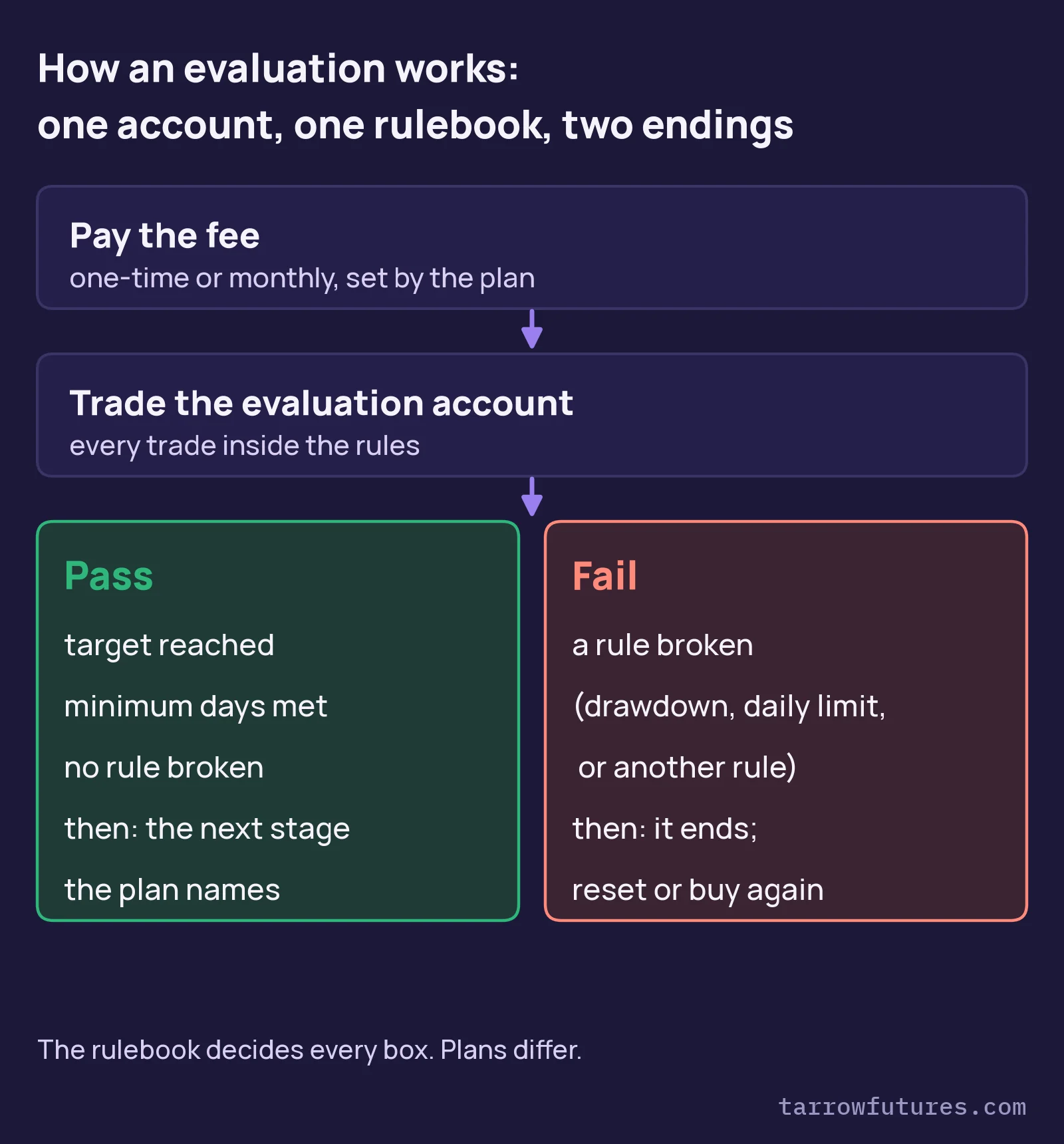
A prop firm evaluation is a paid test account. You pay a fee, trade under a written rulebook, and pass by reaching a profit target without breaking a rule; break one, such as the drawdown or the daily loss limit, and the evaluation ends.
That is the whole mechanism. The rest of this post is what the rulebook contains, what a pass and a fail each lead to, and what the fee really covers. The figures are examples for a hypothetical plan that explain the mechanism; they are not results and not any firm's rules. Your rulebook decides the details.
Free guide · free with your email
Build It, Break It, Then Trade It
A 32-page guide to stress-testing an automated strategy against slippage, webhook delays and prop firm rules.
✓ It's yours. The link is on its way to your inbox.
Check your inbox in the next few minutes.
The example plan
Used through this post (example figures, not results):
- Starting balance
$50,000, profit target$3,000 - Trailing drawdown
$2,000, so the floor starts at$48,000 - Daily loss limit
$1,000 - Minimum
5trading days, consistency cap40% - Fee
$120, billed monthly
What you are buying
The fee buys an account and a set of rules. You trade the account, and the firm checks every trade against the rules. The account balance is a measuring stick: the evaluation is about whether your trading reaches the target inside the rules, not about the balance itself.
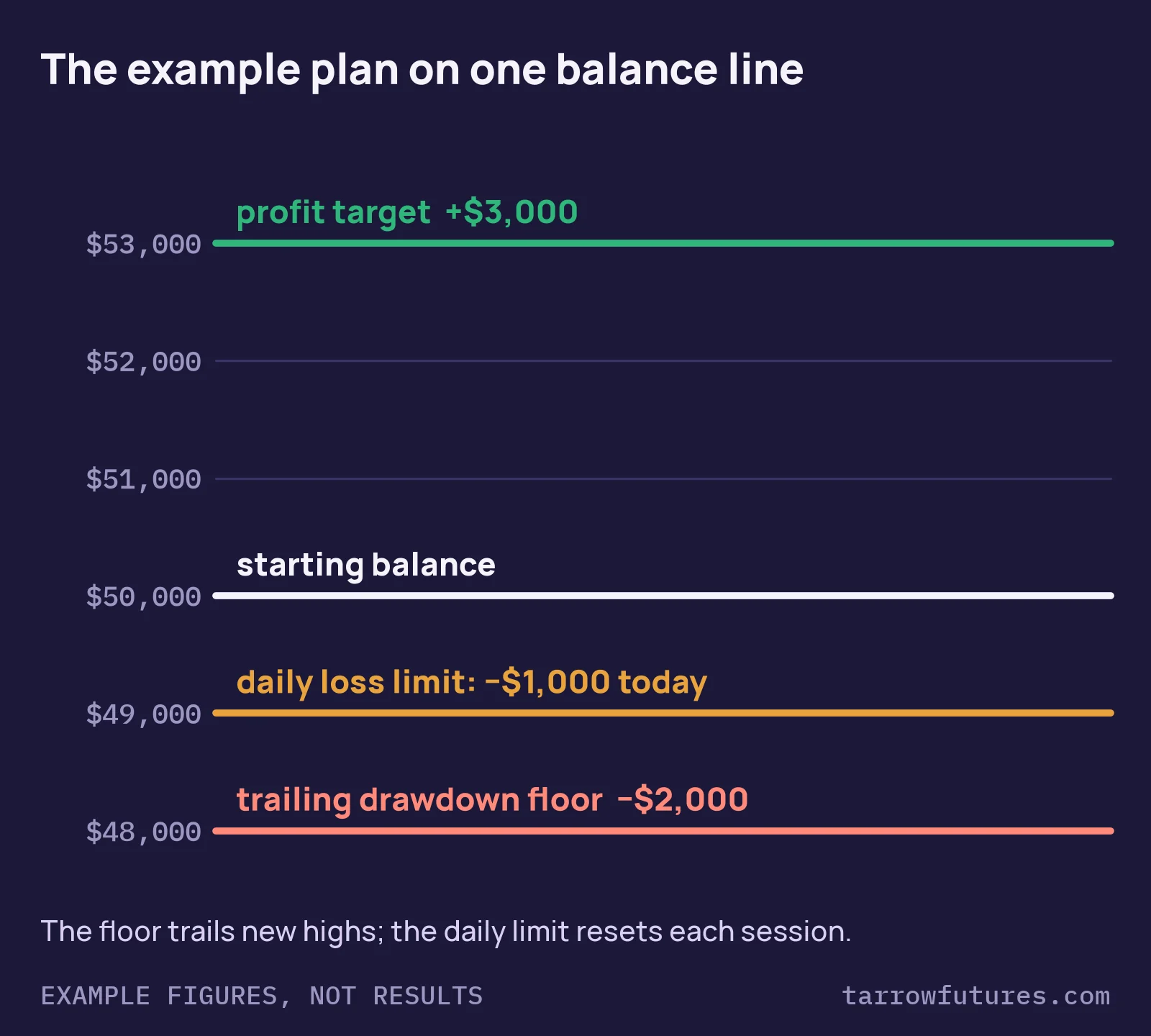
Three numbers frame the whole evaluation. On the example plan, the target sits $3,000 above the start, the floor $2,000 below it, and the daily loss limit allows $1,000 of loss in any one session.
The rules that end an evaluation
Most rulebooks have the same handful of lines. Each one can end the evaluation on its own.
The drawdown. The lowest the account may go. It can be static, set at the end of each day, or trailing during the day; the type changes everything (how a trailing drawdown works). On the example plan with an intraday trailing drawdown, a run to $51,200 lifts the floor to $51,200 − $2,000 = $49,200. A pullback to $50,700 leaves only $1,500 of room, though the account is up $700.
The daily loss limit. The most you may lose in one session. Start the day at $50,000 and the limit sits at $49,000. It resets each session; the drawdown does not. How the two interact.
The day rules. A minimum number of trading days, and often a consistency cap on how much of the profit one day can be. With a 5-day minimum and a 40% cap, the earliest the example plan can pass is day 5, even if the target is reached on day 3 (the fewest days the rules allow).
Everything else. Some plans restrict trading around scheduled news, holding positions overnight, the contracts you may trade or the maximum size. These are written rules too, and breaking one can end the evaluation the same way. News rules are the most common.
Measure the rules in your own risk
The dollar figures feel large until you measure them in your own risk per trade. With $200 of risk per trade (example figure):
| Line | Dollars | In risk units |
|---|---|---|
| Profit target | $3,000 |
15 |
| Trailing drawdown | $2,000 |
10 |
| Daily loss limit | $1,000 |
5 |
So the plan asks for 15 units of profit while allowing 10 units of loss from the high, and 5 in a day. That ratio is set by the rulebook and your size, not by the market. Position size from the stop and the limits works the size side through.
How an evaluation ends
There are two endings, shown in the diagram at the top of this post.
A pass. The target is reached, the minimum days are met, and no rule was broken on the way. The account moves to the next stage the plan names. Some plans add a second evaluation stage first; some charge an activation fee after a pass. The rulebook says what the next account is, which rules carry over, and how payouts work, including any buffer before a withdrawal. Read that section before you buy, not after you pass.
A fail. A rule is broken and the evaluation account closes. The fee is not returned. You can stop, buy a new evaluation, or buy a reset if the plan offers one, which starts the same plan again from the starting balance for its own fee.
Free guideKeep these numbers to hand: the build it, break it, then trade it puts them on one printable page.Get it ↓What the fee really covers
The fee covers the attempt, not the outcome. On a monthly plan, each billing date before the pass adds it again:
| Passes in | Fees paid at $120 a month |
|---|---|
month 1 |
$120 |
month 2 |
$240 |
month 3 |
$360 |
That is before any reset fee or activation fee. A one-time fee does not grow with time, but a fail followed by a new purchase or reset starts the cost again. The evaluation is paid for whether it passes or not, which is worth knowing about every firm in this industry, including the one you pick.
Ask for the pass rate, with its date
We don't quote a pass rate here, because we have no audited, dated source for one. If a firm publishes its pass rate, ask three questions before you rely on it: what period it covers, how it counts an attempt (each purchase, each reset, or each trader), and whether it is the rate for the evaluation alone or for reaching a payout. A figure without those three answers is unverified.
Only buy an evaluation with money you can afford to lose in full. The fee is spent whether the evaluation passes or fails.
Six lines to find before you buy
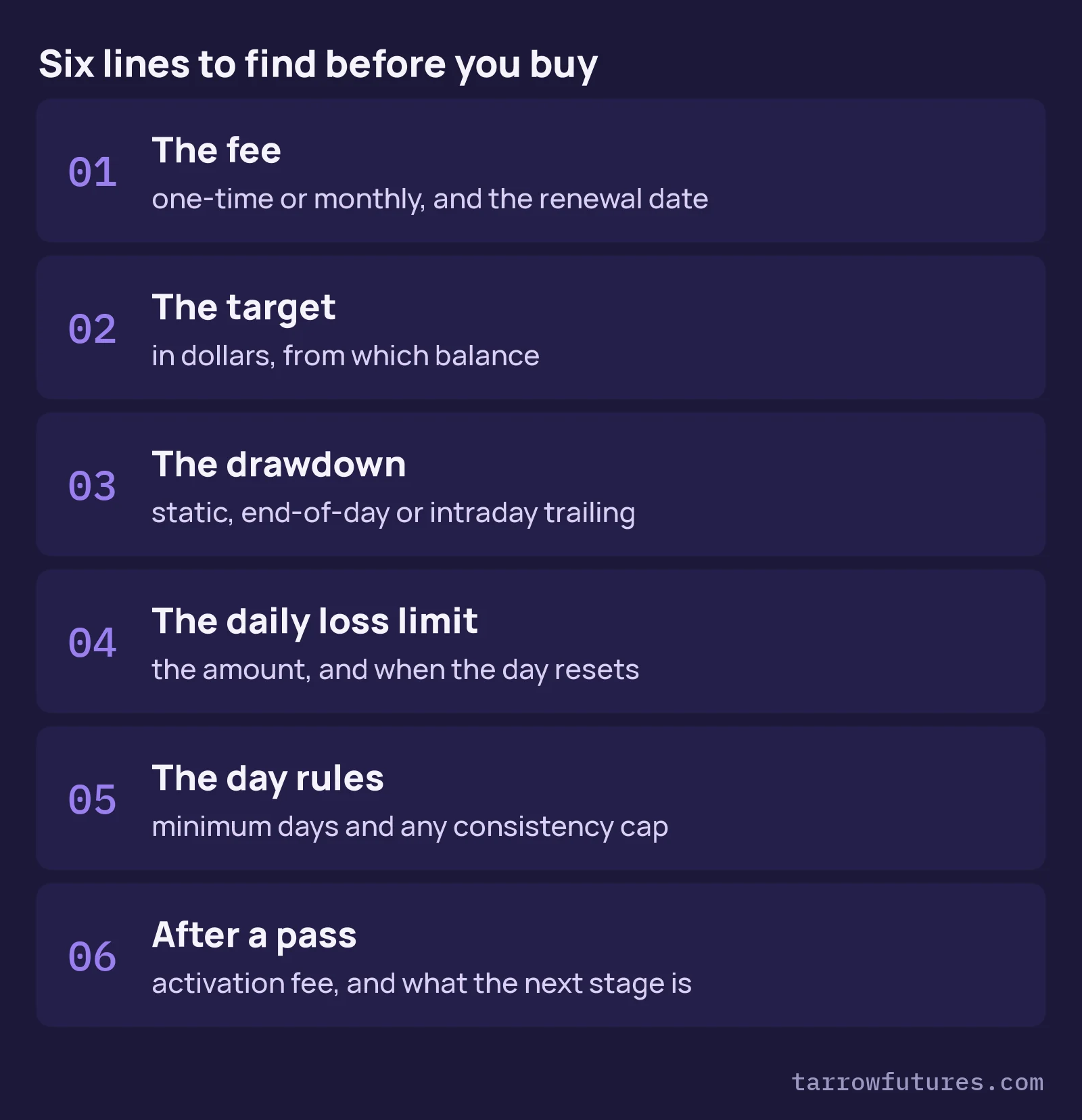
- The fee. One-time or monthly, and the renewal date.
- The target. In dollars, and which balance it counts from.
- The drawdown. Static, end-of-day or intraday trailing, and whether it stops trailing.
- The daily loss limit. The amount, and when the trading day resets.
- The day rules. Minimum days and any consistency cap.
- After a pass. Any second stage, any activation fee, and the rules of the next account.
Common mistakes
- Treating the target as the only rule. On the example plan,
$3,000reached on day3is not a pass; day5is the earliest. - Reading the drawdown as fixed. A trailing drawdown moves up with new highs: after a run to
$51,200, the example floor is$49,200. - Ignoring the billing cycle. On a monthly plan, every month before the pass adds the fee.
- Buying before reading what a pass leads to. The next stage has its own rules and fees.
- Reading the rules once. Rules change. Read the current version before you buy.
Test the plan before you pay for the test
The free guide Build It, Break It, Then Trade It walks through stress-testing a strategy against prop firm rules, slippage and execution delays before you spend a fee on it. Free with your email, below.
Diagrams are illustrations drawn by Tarrow Futures, not market data. Worked examples use example figures for a hypothetical plan, not any firm's rules and not results. Educational only, not financial advice. Trading futures involves substantial risk of loss.
Free guide · free with your email
Build It, Break It, Then Trade It
A 32-page guide to stress-testing an automated strategy against slippage, webhook delays and prop firm rules. We email you the link, so it is one tap away next time.
✓ It's yours. The link is on its way to your inbox.
Check your inbox in the next few minutes.
Questions
What is a prop firm evaluation?
A paid test account. You pay a fee, trade an account with a written set of rules, and pass by reaching a profit target without breaking any rule. Break a rule, such as the drawdown or the daily loss limit, and the evaluation ends.
How does a prop firm evaluation work?
You buy a plan, which sets the account size, the profit target, the drawdown, the daily loss limit and any day rules. You trade until you either reach the target with every rule kept and the minimum days met, which is a pass, or break a rule, which ends it. On an example $50,000 plan, the target might be $3,000 and the drawdown $2,000.
What happens if you fail a prop firm evaluation?
The evaluation account closes. You can stop, buy a new evaluation, or buy a reset if the plan offers one, which starts the same plan again from the starting balance. The fee you paid is not returned.
What happens after you pass a prop firm evaluation?
You move to the next stage the plan names. Some plans have a second evaluation stage first, and some charge an activation fee after a pass. The rulebook says what the next account is, its rules and how payouts work, so read that section before you buy.
What is the pass rate for prop firm evaluations?
We don't quote one here because we have no audited, dated source for it. Ask the firm for its published pass rate, the period it covers and how it counts an attempt, and treat a figure without those three as unverified.
Is a prop firm evaluation a one-time fee?
It depends on the plan. Some charge once; others bill monthly until you pass or cancel. On a monthly plan at an example $120, an evaluation that passes in month 3 has cost $360 in fees, before any reset or activation fee.
Educational material only. Not financial, investment or trading advice, and not a recommendation to trade any contract or size. Prop firm rules differ and change; the current rulebook of the firm you use decides. Worked examples use example figures, not results. Futures trading involves substantial risk of loss. Evaluations are paid tests and most people who take one do not pass.