Prop Firm Rules
Why traders fail prop firm evaluations: the rule mechanics, in numbers
Most prop firm evaluations that fail end on a rule, not on time running out. The usual rules are a trailing drawdown that followed open profit up, a daily loss limit counted on equity, a consistency cap, a news window, a contract limit, and size raised after a good day that turns the next bad day into a breach.
None of these needs a losing week. Each can end an evaluation that is in profit. The examples below are selected to show the rules, not typical results; the figures are for a hypothetical plan, not any firm's rules. Your rulebook decides the details.
Free email course · free with your email
Don't Blow Your Account
Five short emails, one rule a day that ends evaluations, each worked out in numbers.
✓ You're in. Day 1 is on its way to your inbox.
Check your inbox in the next few minutes.
The example plan
Used through this post (example figures, not results):
- Starting balance
$50,000, profit target$3,000 - Intraday trailing drawdown
$2,000, so the floor starts at$48,000 - Daily loss limit
$1,000 - Consistency cap
40% - Contract limit
3minis (or30micros) until the account is up$1,500
We don't quote a failure rate here, because we have no audited, dated source for one. This post is about the mechanics: how each rule ends an evaluation, in numbers.
1. The trailing floor followed open profit up
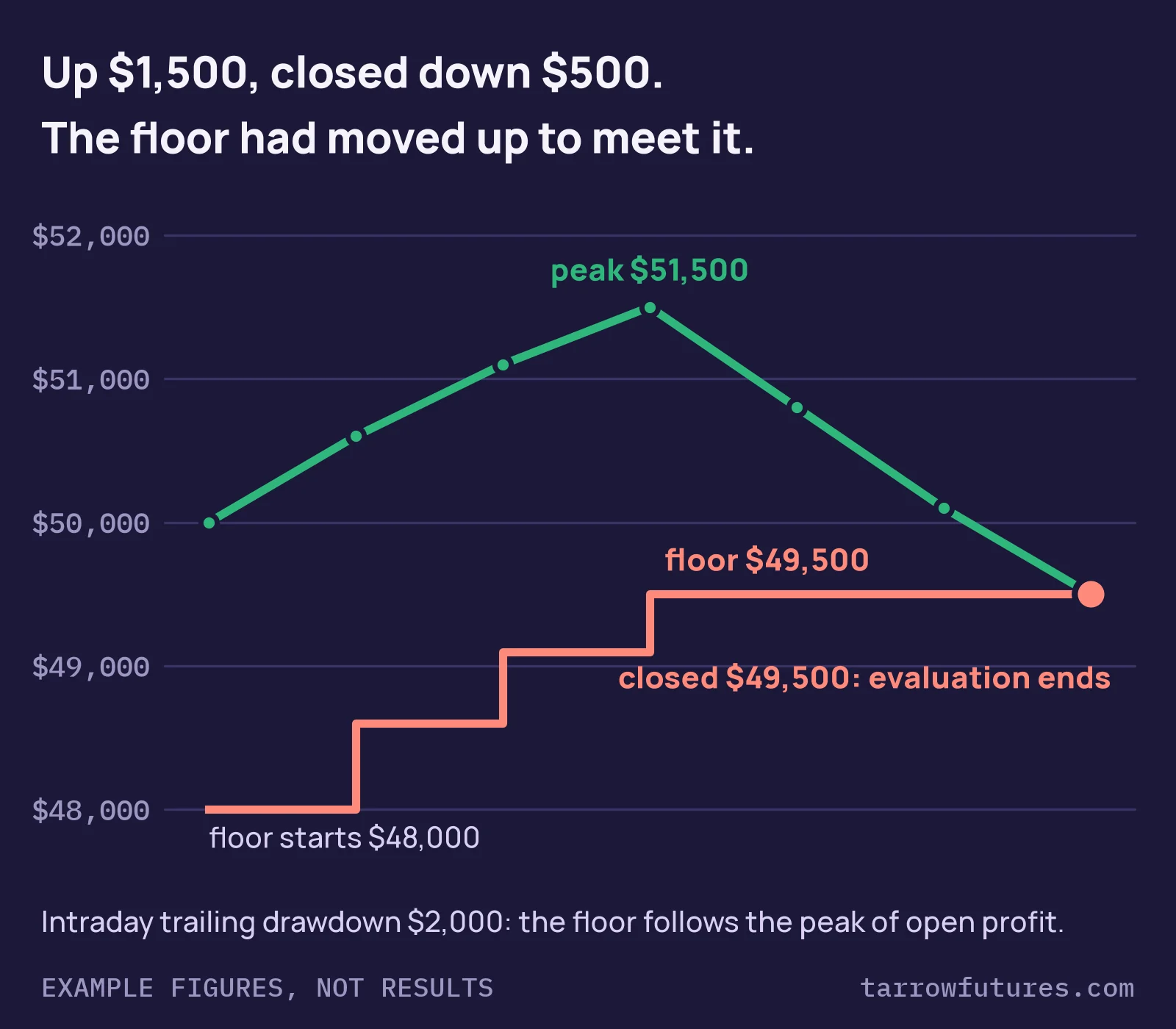
With an intraday trailing drawdown, the floor rises with the highest point of the account, open profit included. It never comes back down.
On the example plan, a trade runs to $1,500 of open profit. The account peaks at $51,500, so the floor rises to $51,500 − $2,000 = $49,500. The trade reverses and closes at $49,500, down $500 on the day. That close sits on the floor, and the evaluation ends.
The trader was up $1,500 that morning and lost $500 on the day, well inside the $1,000 daily limit. The rule that ended it was the drawdown, measured from the peak, not from the start. Read how a trailing drawdown works and static vs trailing drawdown for the three types.
2. The daily loss limit counted the worst moment
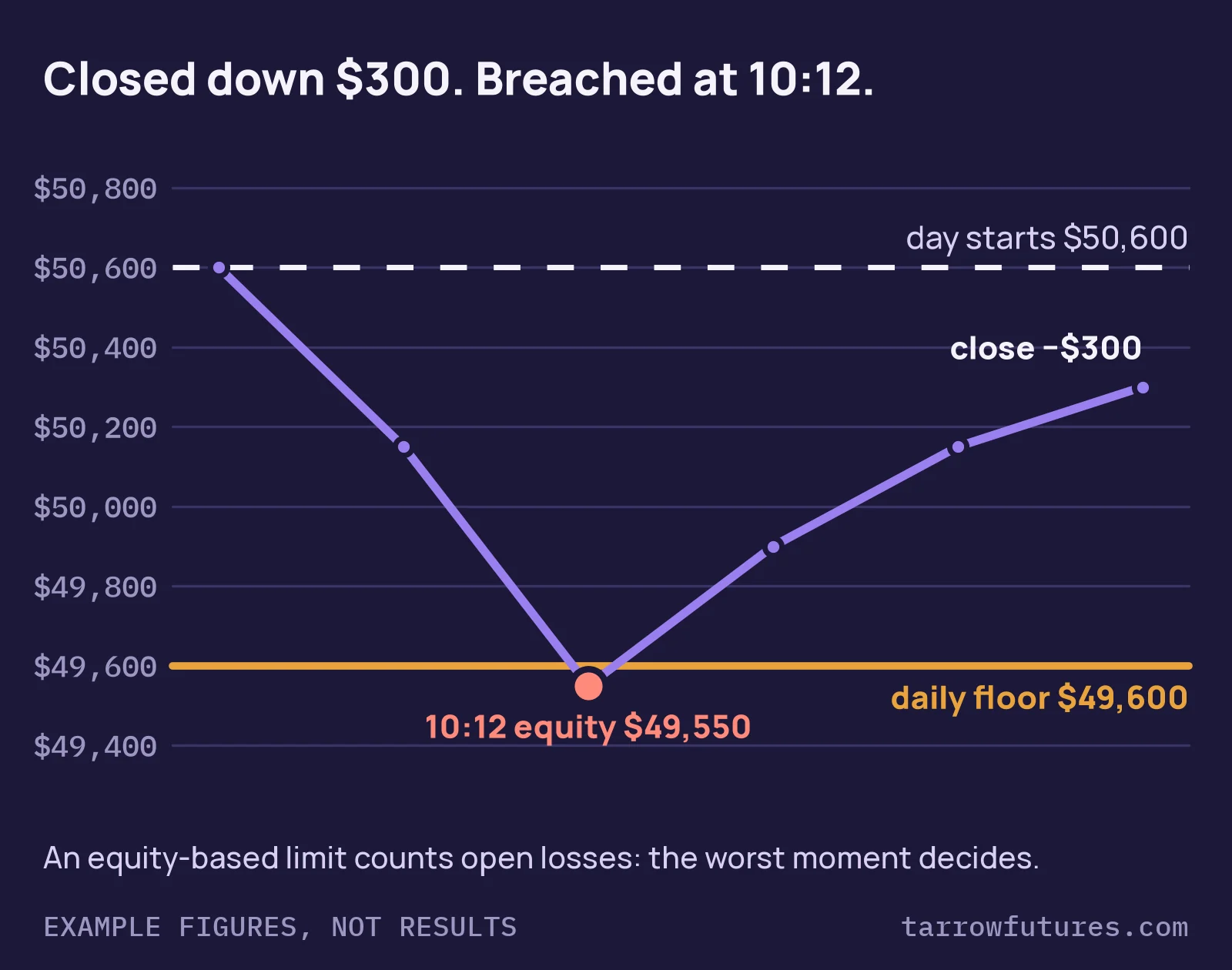
The day starts at $50,600. With a $1,000 daily limit, today's floor is $49,600. At 10:12 an open trade is down $1,050, so equity touches $49,550. The trade recovers and closes down $300.
If the limit is based on equity (open profit and loss included), the breach happened at 10:12, whatever the close. If it is based on balance, only the closed −$300 counts and the day is fine. Same trade, two different outcomes, decided by one word in the rulebook. How the daily limit and the trailing drawdown interact.
The second question is when the day resets. It is often the futures session boundary, not midnight, so a trade late in the afternoon can still count against the old day.
3. The best day was too big
A consistency cap limits how much of the total profit one day can be. On the example plan the cap is 40% and the target is $3,000.
| Number | |
|---|---|
| Best day | $1,800 |
| Total profit | $3,000, target reached |
| Best day as a share of total | 1,800 ÷ 3,000 = 60% |
Largest day the cap allows at $3,000 |
40% × 3,000 = $1,200 |
Total needed for $1,800 to be 40% |
1,800 ÷ 0.40 = $4,500 |
The target is reached, but the evaluation has not passed. Some plans let the trader keep going until total profit reaches $4,500; on others the attempt fails. The consistency rule explained works through both versions.
4. A trade was open inside a news window
Many plans restrict holding positions around scheduled high-impact releases. Say a report is due at 8:30 a.m. ET and the window is 2 minutes either side, 8:28 to 8:32.
A trade opened at 8:20 and still open at 8:29 is inside the window, even if it was planned long before the release and closes at a profit. The penalty depends on the firm: the trade is voided, a warning, or the evaluation ends. Prop firm news trading rules has the release times and the three questions to ask.
Free email courseKeep these numbers to hand: the don't blow your account puts them on one printable page.Get it ↓5. One trade was over the contract limit
On the example plan, the limit is 3 minis until the account is up $1,500.
| Number | |
|---|---|
| Account profit on Thursday | $1,200 |
| Size of Thursday's trade | 5 minis |
| Result of the trade | +$450 |
The trade made money and took the account past $1,500. But at the moment of the trade, profit was $1,200, so the limit was 3, and 5 was over it. This one is often found later, at a review before a pass or a payout, which is why it surprises people. Check the limit at today's profit level before every trade.
6. Size went up after a good day
This one is a sequence, not a rule. It turns the rules above into a breach.
| Day | What happened | Size |
|---|---|---|
1 |
Plan followed, up $600 |
2 MNQ |
2 |
Up $400 early, size raised "because it is working" |
2 → 6 MNQ |
3 |
Red open, a trade to win it back, then another | 6 → 12 MNQ |
MNQ moves $0.50 a tick (CME contract specifications). A 40-tick stop on 2 MNQ costs 40 × $0.50 × 2 = $40. On 12 MNQ it costs 40 × $0.50 × 12 = $240. Against the $1,000 daily limit, that is 4 stops instead of 25.
The breach shows up on day three. The decision that caused it was the size change on day two. How many contracts a prop account can hold works size from the stop and the limits.
Seven lines to find before the first trade
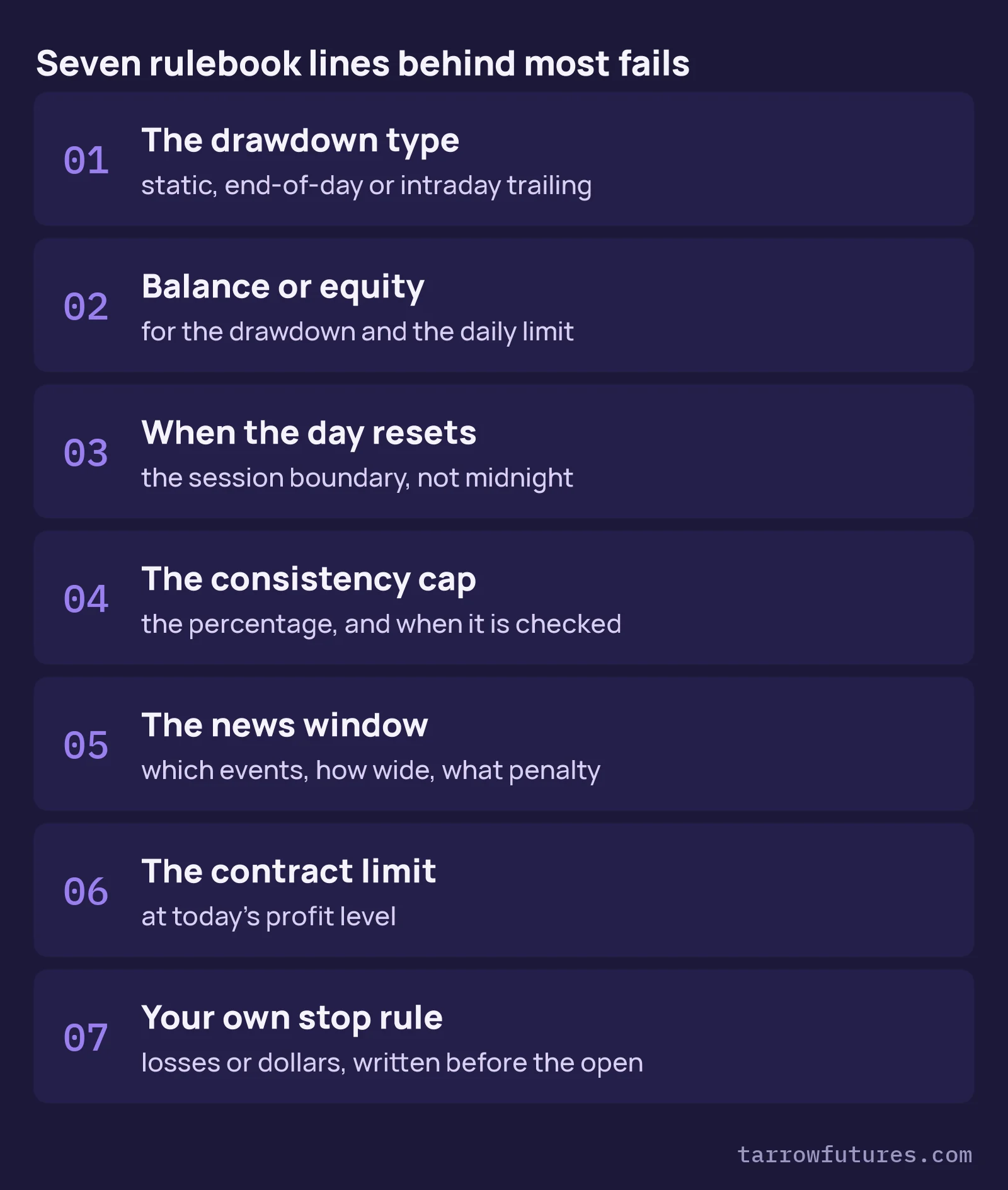
- The drawdown type. Static, end-of-day or intraday trailing, and whether it stops trailing.
- Balance or equity. For the drawdown and for the daily limit.
- When the day resets. Usually the session boundary.
- The consistency cap. The percentage, and whether it is checked at the target, at payout or throughout.
- The news window. Which events, how wide, and the penalty.
- The contract limit. At today's profit level, and how micros count.
- Your own stop rule. A set number of losses or a dollar amount, written before the open.
Six are in the rulebook. The seventh is yours, and it is the only one that stops the sequence in section 6.
Common mistakes
- Treating a profitable day as a safe day. In section 1 the account was up
$1,500before the trade that ended it. - Reading the close, not the worst moment. An equity-based limit counts open losses:
−$1,050open is a breach, though the trade closed−$300. - Stopping at the target. With a
$1,800best day and a40%cap,$3,000is not a pass. - Checking the contract limit once a week. It depends on today's profit, so it can change after one trade.
- Sizing from yesterday's result. Day one's plan was the plan.
The five-day version, by email
The free course Don't Blow Your Account takes one of these rules a day for five days, each worked out in numbers, with the questions to ask your rulebook. Free with your email, below.
Only buy an evaluation with money you can afford to lose in full. The fee is spent whether the evaluation passes or fails.
Diagrams are illustrations drawn by Tarrow Futures, not market data. Worked examples use example figures for a hypothetical plan, selected to show the rules, not typical results and not any firm's rules. MNQ tick value from CME Group contract specifications. Educational only, not financial advice. Trading futures involves substantial risk of loss.
Free email course · free with your email
Don't Blow Your Account
Five short emails, one rule a day that ends evaluations, each worked out in numbers. Day 1 arrives by email in a few minutes, then one a day.
✓ You're in. Day 1 is on its way to your inbox.
Check your inbox in the next few minutes.
Questions
Why do traders fail prop firm evaluations?
An evaluation ends when a rule is broken, so the cause of a fail is a rule. The usual ones are the trailing drawdown, which can follow open profit up and end a trade that was well in profit; a daily loss limit measured on equity, which counts the worst moment of an open trade; a consistency cap on the best day; a news window; a contract limit; and size raised after a good day, which turns the next bad day into a breach.
What percentage of traders fail prop firm evaluations?
We don't quote a figure, because we have no audited, dated source for one. If a firm publishes a pass or fail rate, ask what period it covers, how it counts an attempt, and whether it is for the evaluation alone or for reaching a payout. A rate without those three answers is unverified.
Can you fail a prop firm evaluation while in profit?
Yes. With an intraday trailing drawdown, a trade that runs to $1,500 of open profit on an example $50,000 account lifts a $2,000 floor to $49,500. If the trade then reverses and closes at $49,500, the account reaches the floor and the evaluation ends, though it had been up $1,500 that day.
Does the daily loss limit count open trades?
It depends on the rulebook. An equity-based limit counts open profit and loss, so a trade that is down $1,050 at its worst breaches a $1,000 limit even if it closes down $300. A balance-based limit counts only closed trades. The rulebook says which one applies.
How do you avoid failing a prop firm evaluation?
No method guarantees a pass. What you can control is knowing each rule before the first trade (the drawdown type, balance or equity, when the day resets, the consistency cap, news windows and contract limits) and sizing every trade from today's room, not from yesterday's result.
Educational material only. Not financial, investment or trading advice, and not a recommendation to trade any contract or size. Prop firm rules differ and change; the current rulebook of the firm you use decides. Worked examples use example figures, not results. Futures trading involves substantial risk of loss. Evaluations are paid tests and most people who take one do not pass.