Futures Basics
MNQ vs MES: what's the difference?
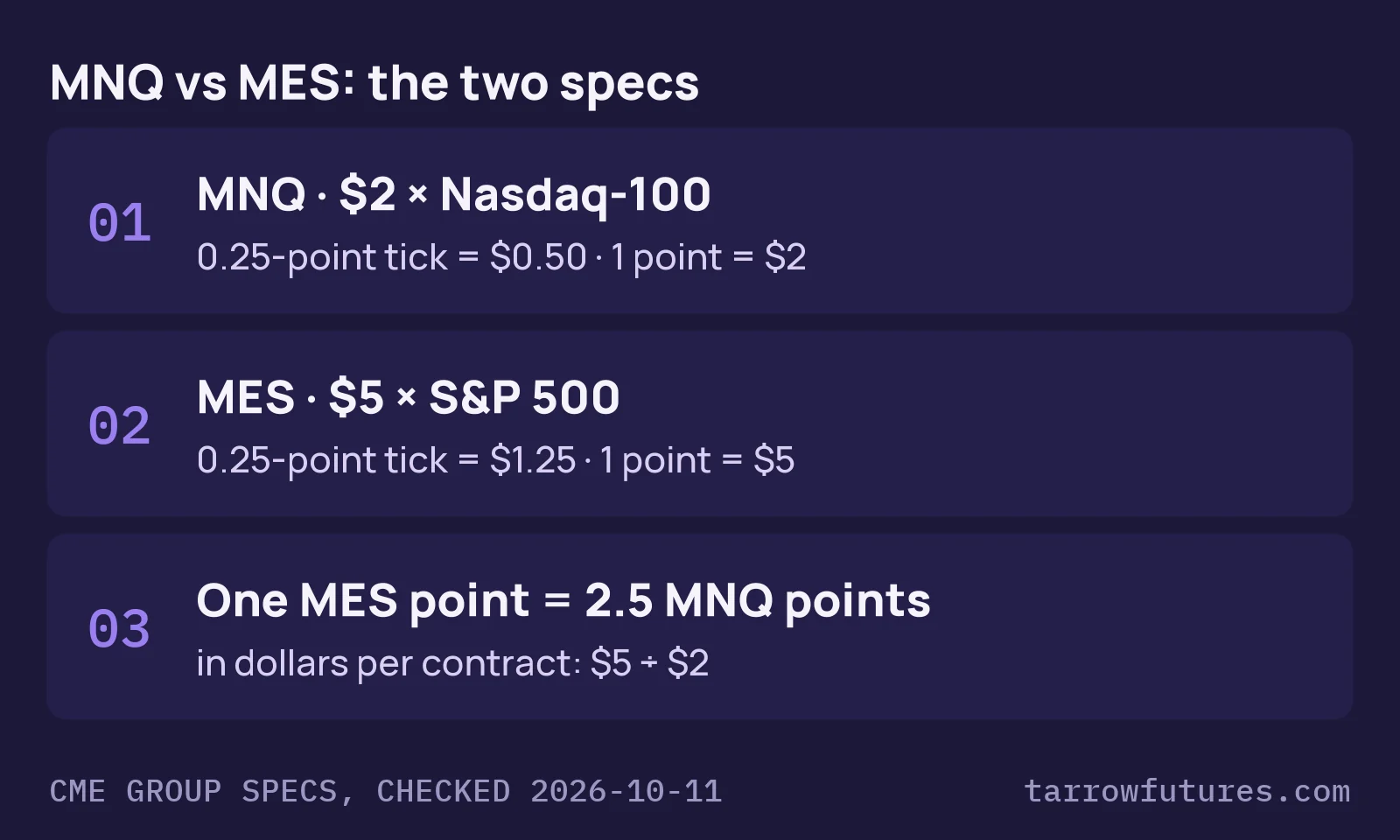
MNQ is the Micro E-mini Nasdaq-100 and MES is the Micro E-mini S&P 500. Both move in ticks of 0.25 index points; one MNQ tick is worth $0.50 and one MES tick $1.25, so a point is $2 on MNQ and $5 on MES (CME Group contract specifications, checked 2026-10-06 and 2026-10-11).
So MES pays more per point, but that doesn't make it the bigger contract. The Nasdaq-100 trades at a much higher number than the S&P 500, so it covers more points in a move of the same size. This post sets the two specs side by side, then works through what that means for a stop, a size and a drawdown. The index levels used below are round example numbers, not quotes: put in the current prices to get today's figures.
Free printable · free with your email
Contract Specs Card
Tick size, tick value and point value for the futures prop traders use most, on one card.
✓ It's yours. The link is on its way to your inbox.
Check your inbox in the next few minutes.
The two specs
From CME Group's contract specification pages for Micro E-mini Nasdaq-100 (checked 2026-10-06 and 2026-10-11) and Micro E-mini S&P 500 (checked 2026-10-11):
| MNQ | MES | |
|---|---|---|
| Index | Nasdaq-100 | S&P 500 |
| Contract unit | $2 × Nasdaq-100 Index |
$5 × S&P 500 Index |
| Minimum price move (tick) | 0.25 index points |
0.25 index points |
| Tick value | 0.25 × $2 = $0.50 |
0.25 × $5 = $1.25 |
| Ticks per point | 4 |
4 |
| Point value | $2 |
$5 |
The tick is the same size on both, so the gap is all in the multiplier: $5 ÷ $2 = 2.5. One MES point carries the dollars of 2.5 MNQ points, and one MES tick the dollars of 2.5 MNQ ticks.
Tick value in dollars
The same dollar amount is a different number of ticks on each contract:
| Dollars, 1 contract | MNQ ticks | MNQ points | MES ticks | MES points |
|---|---|---|---|---|
$10 |
20 |
5 |
8 |
2 |
$50 |
100 |
25 |
40 |
10 |
$100 |
200 |
50 |
80 |
20 |
$500 |
1,000 |
250 |
400 |
100 |
Ticks = dollars ÷ tick value; points = ticks ÷ 4. The free tick value calculator does the same for 12 CME contracts.
Why the smaller point value can be the bigger contract
A contract's size in dollars is its multiplier times the index level. With round example levels of 25,000 for the Nasdaq-100 and 7,000 for the S&P 500:
- 1 MNQ:
$2 × 25,000 = $50,000of index exposure - 1 MES:
$5 × 7,000 = $35,000of index exposure
The same 1% move in each index:
- MNQ:
1%of25,000=250points,250 × $2 = $500 - MES:
1%of7,000=70points,70 × $5 = $350
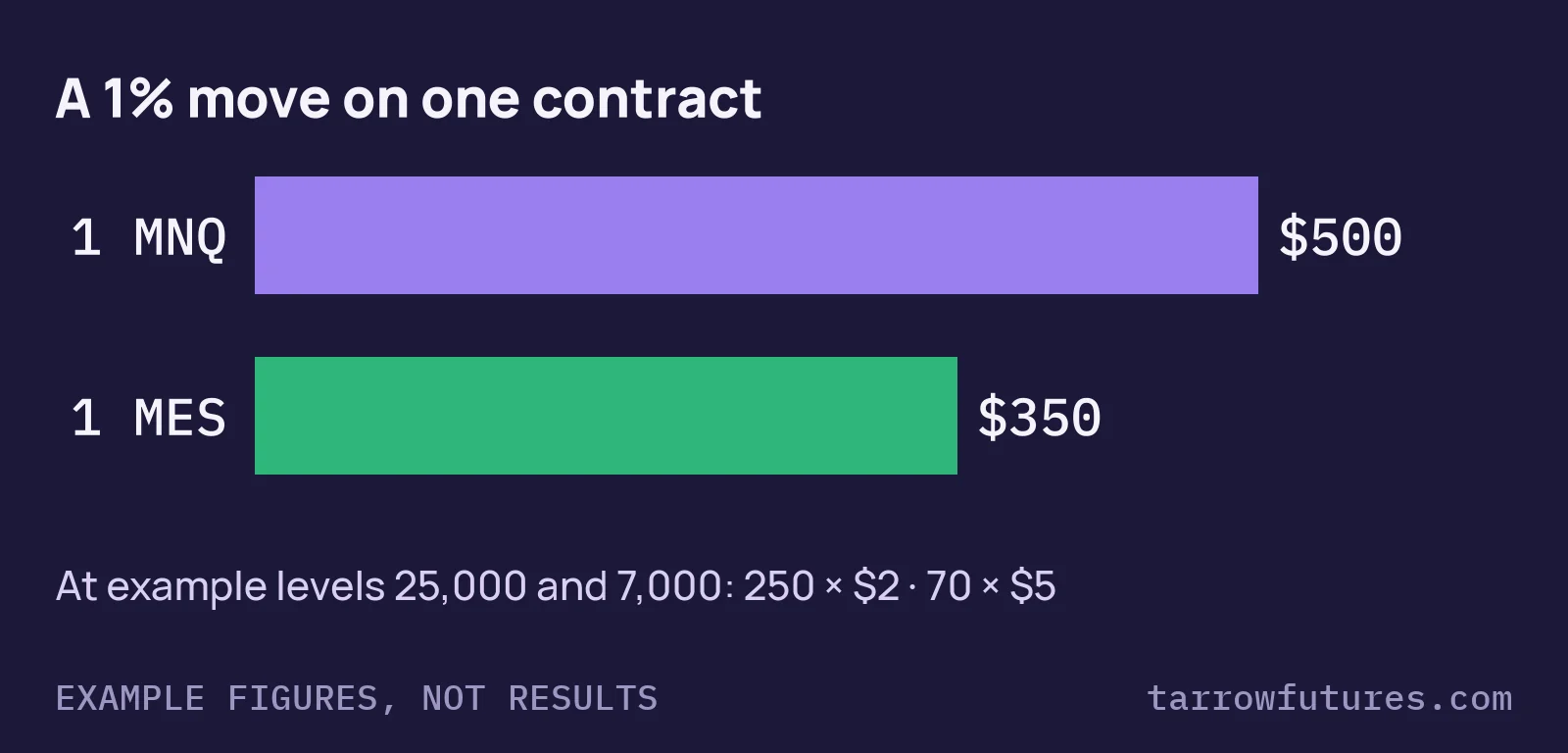
At these levels one MNQ carries more dollars per percent than one MES, even though its point is worth less than half as much. The levels move every day, so redo the two multiplications with the current prices before you compare. And the two indexes don't move by the same percent on the same day, so the comparison is per contract, not a forecast of either one.
The same points, a different stop
A stop copied in points from one contract to the other is a different stop:
- 20 points on 1 MNQ:
20 × $2 = $40, which is0.08%of25,000 - 20 points on 1 MES:
20 × $5 = $100, which is about0.29%of7,000
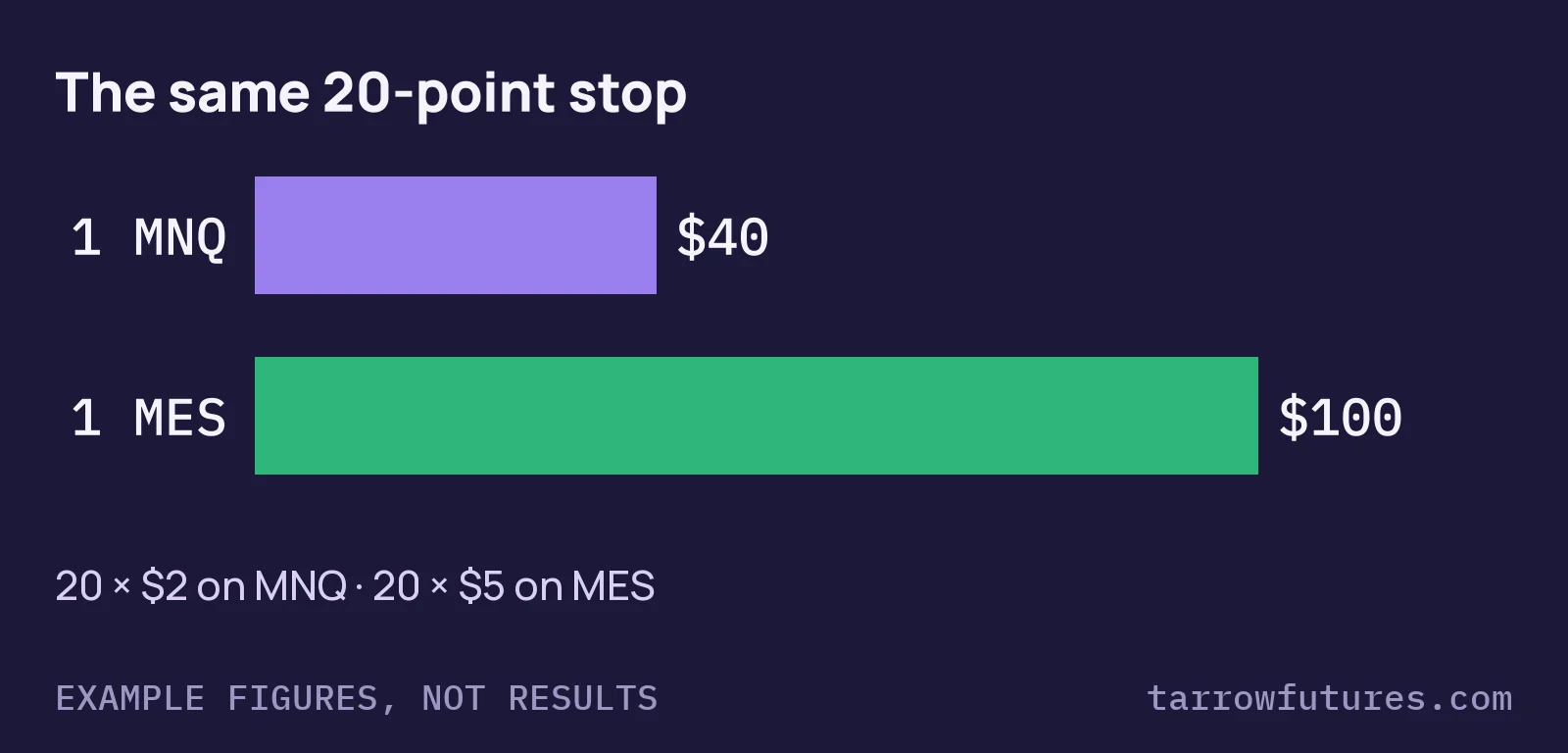
The MES stop costs 2.5 times the dollars and sits more than three times farther away as a share of price. Set the stop on the chart of the contract you trade, then turn it into dollars with that contract's point value.
Sizing each from the same budget
Say you plan to risk $200 on a trade with a stop of 0.2% of price on either contract (example figures):
- MNQ:
0.2%of25,000=50points,50 × $2 = $100a contract, so$200 ÷ $100 = 2MNQ - MES:
0.2%of7,000=14points,14 × $5 = $70a contract, so2MES for$140; a third would be$210, over the budget
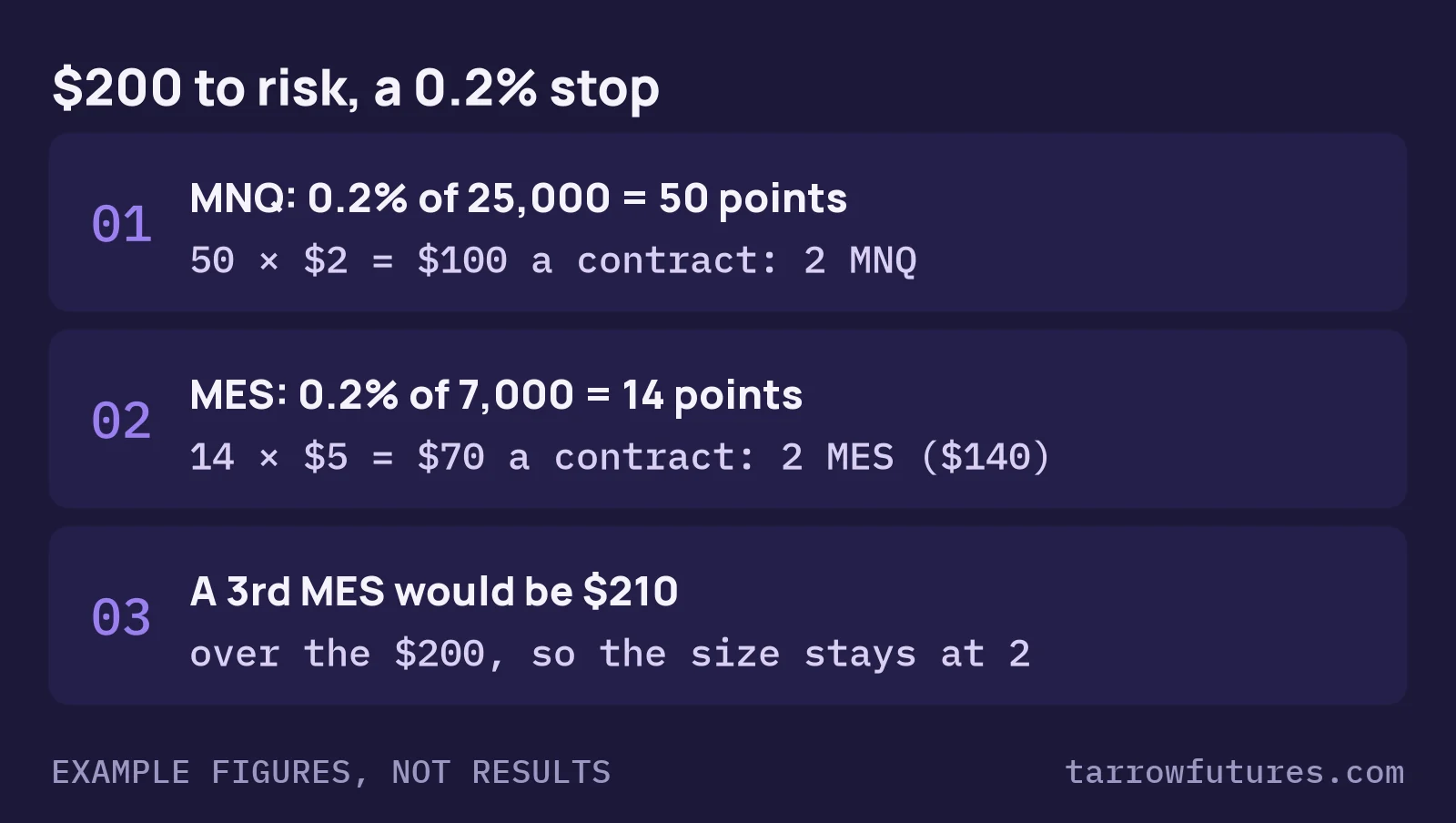
Two contracts on each, but $200 of risk on MNQ and $140 on MES. Round down when the budget doesn't divide evenly. The position size calculator does the division for any stop and budget, and How many contracts should I trade on a prop firm account? covers the method.
Your drawdown, in MNQ and MES points
The shared example: a $2,000 drawdown on its first day, so the room is the full $2,000 (example figures, not results).
- 1 MNQ:
$2,000 ÷ $2 = 1,000points,4%of25,000 - 1 MES:
$2,000 ÷ $5 = 400points, about5.7%of7,000
In points MNQ gives far more room; as a share of price, at these levels, MES gives a little more. On a trailing drawdown the room changes as the floor moves.
What to check in your plan
- Which contracts are allowed. Read the product list; don't assume a plan allows every CME contract.
- How micros count. Many plans count each micro as one contract; some count ten micros as one mini. MNQ and MES each count on their own line. The scaling plan post works through both counting methods.
- Holding both at once. A position in each is two contracts toward the limit, and two stops to add up against the daily limit.
- Fees. Commissions and exchange fees are charged per contract, so two micros are two charges whichever index they are on.
Common mistakes
- Comparing point values only.
$5against$2makes MES look like the bigger contract. Multiply by the index level before deciding. - Copying a stop in points.
20points is a tight stop on the Nasdaq-100 and a wide one on the S&P 500. - Using the wrong tick value.
$1.25on MNQ or$0.50on MES is a2.5-times error in every stop. The two sit next to each other on most platforms. - Confusing MNQ with NQ, or MES with ES. The minis are ten times the micros: NQ is
$5.00a tick and ES$12.50. See MNQ vs NQ and ES and MES tick value.
The tick and point values for all 12 contracts prop traders use most are in the futures tick value chart, and on the free Contract Specs Card below.
Free printable · free with your email
Contract Specs Card
Tick size, tick value and point value for the futures prop traders use most, on one card. We email you the link, so it is one tap away next time.
✓ It's yours. The link is on its way to your inbox.
Check your inbox in the next few minutes.
Questions
What is the difference between MNQ and MES?
The index and the multiplier. MNQ (Micro E-mini Nasdaq-100) is $2 times the Nasdaq-100 index; MES (Micro E-mini S&P 500) is $5 times the S&P 500 index. Both move in ticks of 0.25 index points, so an MNQ tick is $0.50 and an MES tick is $1.25 (CME Group contract specifications, checked 2026-10-06 and 2026-10-11).
What is the MNQ vs MES tick value?
One MNQ tick is $0.50 and one MES tick is $1.25, per contract. One point is 4 ticks, so a point is $2 on MNQ and $5 on MES.
Is MNQ or MES bigger?
Per point, MES is bigger ($5 against $2). Per contract, it depends on the index levels, because the Nasdaq-100 trades at a much higher number than the S&P 500. At example levels of 25,000 and 7,000, one MNQ is $50,000 of index exposure and one MES is $35,000, and a 1% move is $500 on MNQ against $350 on MES. Work it out with the current prices.
Is a 20-point stop the same on MNQ and MES?
No. 20 points is $40 on one MNQ and $100 on one MES, and 20 points is a much smaller share of the Nasdaq-100's price than of the S&P 500's. Set a stop from the chart of the contract you trade, then turn it into dollars with that contract's point value.
Should I trade MNQ or MES in a prop firm account?
That is your decision within your firm's rules; this post does the arithmetic, not a recommendation. Whichever you pick, size from your stop in dollars, and read how your plan counts micros toward its contract limit.
Do MNQ and MES count the same toward a contract limit?
Plans differ. Some count each micro as one contract, whichever index it is on; some count ten micros as one mini. Read the contract-limit line of your plan.
Educational material only. Not financial, investment or trading advice, and not a recommendation to trade any contract or size. Prop firm rules differ and change; the current rulebook of the firm you use decides. Worked examples use example figures, not results. Futures trading involves substantial risk of loss. Evaluations are paid tests and most people who take one do not pass.