Futures Basics
Futures tick value chart: 12 CME contracts, free printable
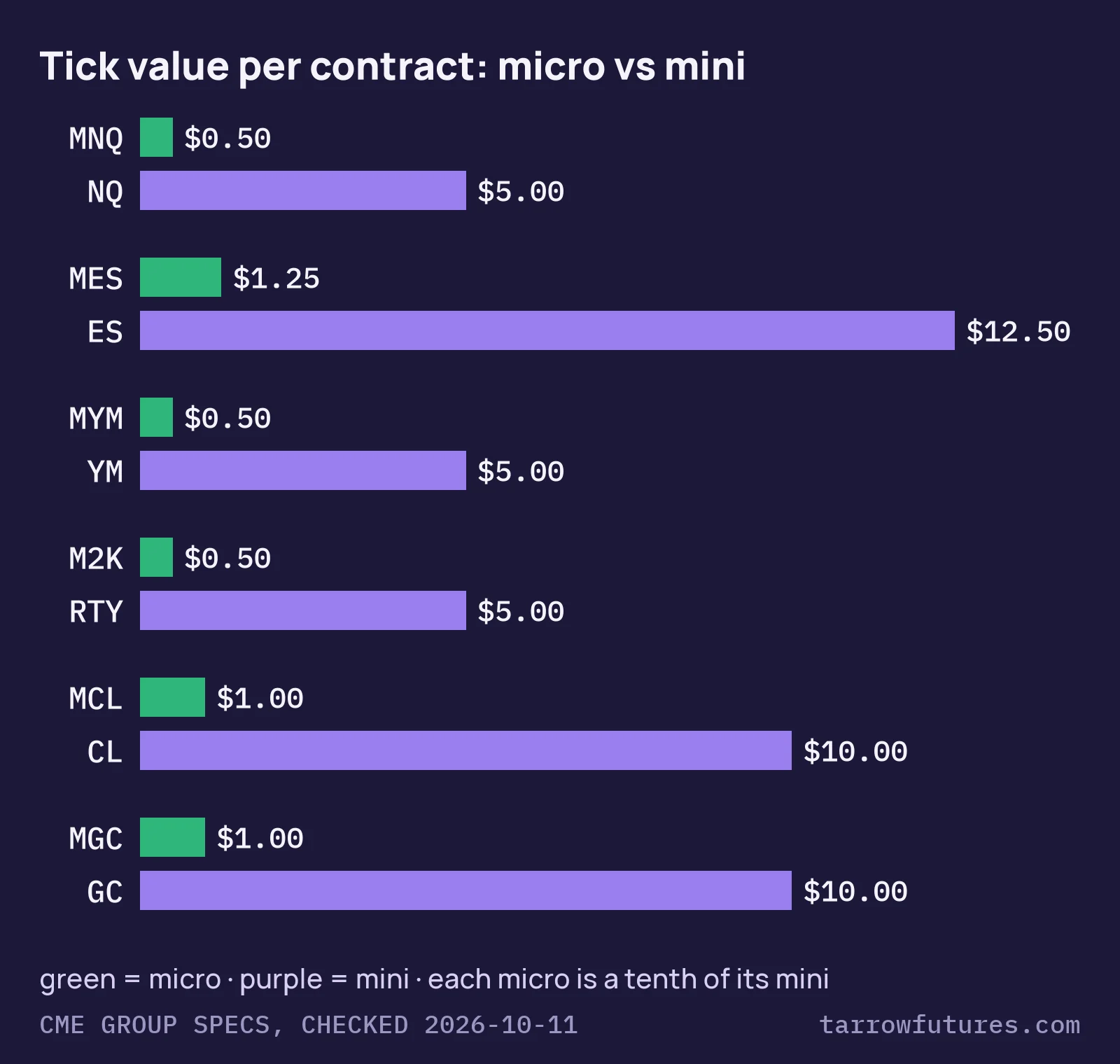
The tick value of a futures contract is its tick size times its multiplier: ES is $12.50 a tick, MES $1.25, NQ $5.00, MNQ $0.50, CL $10.00, MCL $1.00, GC $10.00 and MGC $1.00. The chart below lists all 12 contracts prop traders use most, each number checked against CME Group's own contract specification page on 2026-10-11.
Every stop, size and drawdown sum you work out starts from this number, so it is worth having it exact. The same table is a free printable, linked at the end.
Free printable · free with your email
Contract Specs Card
Tick size, tick value and point value for the futures prop traders use most, on one card.
✓ It's yours. The link is on its way to your inbox.
Check your inbox in the next few minutes.
The tick value chart
Source: CME Group contract specifications, one page per contract (links at the end of this post), checked 2026-10-11. Tick size is the outright minimum price fluctuation. The last column is the dollars per contract for a move of 1.00 in the quoted price: one index point, $1.00 a barrel, or $1.00 an ounce.
| Symbol | Contract | Contract unit | Tick size | Tick value | Ticks per 1.00 | Value of 1.00 |
|---|---|---|---|---|---|---|
| MNQ | Micro E-mini Nasdaq-100 | $2 × index |
0.25 |
$0.50 |
4 |
$2 |
| NQ | E-mini Nasdaq-100 | $20 × index |
0.25 |
$5.00 |
4 |
$20 |
| MES | Micro E-mini S&P 500 | $5 × index |
0.25 |
$1.25 |
4 |
$5 |
| ES | E-mini S&P 500 | $50 × index |
0.25 |
$12.50 |
4 |
$50 |
| MYM | Micro E-mini Dow | $0.50 × index |
1.00 |
$0.50 |
1 |
$0.50 |
| YM | E-mini Dow ($5) | $5 × index |
1.00 |
$5.00 |
1 |
$5 |
| M2K | Micro E-mini Russell 2000 | $5 × index |
0.10 |
$0.50 |
10 |
$5 |
| RTY | E-mini Russell 2000 | $50 × index |
0.10 |
$5.00 |
10 |
$50 |
| MCL | Micro WTI Crude Oil | 100 barrels |
0.01 |
$1.00 |
100 |
$100 |
| CL | Crude Oil (WTI) | 1,000 barrels |
0.01 |
$10.00 |
100 |
$1,000 |
| MGC | Micro Gold | 10 troy ounces |
0.10 |
$1.00 |
10 |
$10 |
| GC | Gold | 100 troy ounces |
0.10 |
$10.00 |
10 |
$100 |
Three things to notice:
- Every micro is one tenth of its mini. Same tick size, a tenth of the multiplier, so a tenth of the tick value.
10MES carry the same dollars per tick as1ES. - "Point" means different things. On the index contracts a point is one index point. On crude and gold the quote is dollars per barrel or per ounce, so a
1.00move is100ticks on crude and10ticks on gold. - The Dow contracts tick in whole points. On YM and MYM one tick and one point are the same thing.
Calendar spreads and some special order types trade in smaller increments than the outright tick. The chart uses the outright tick, which is what a normal buy or sell order fills in.
How to calculate tick value yourself
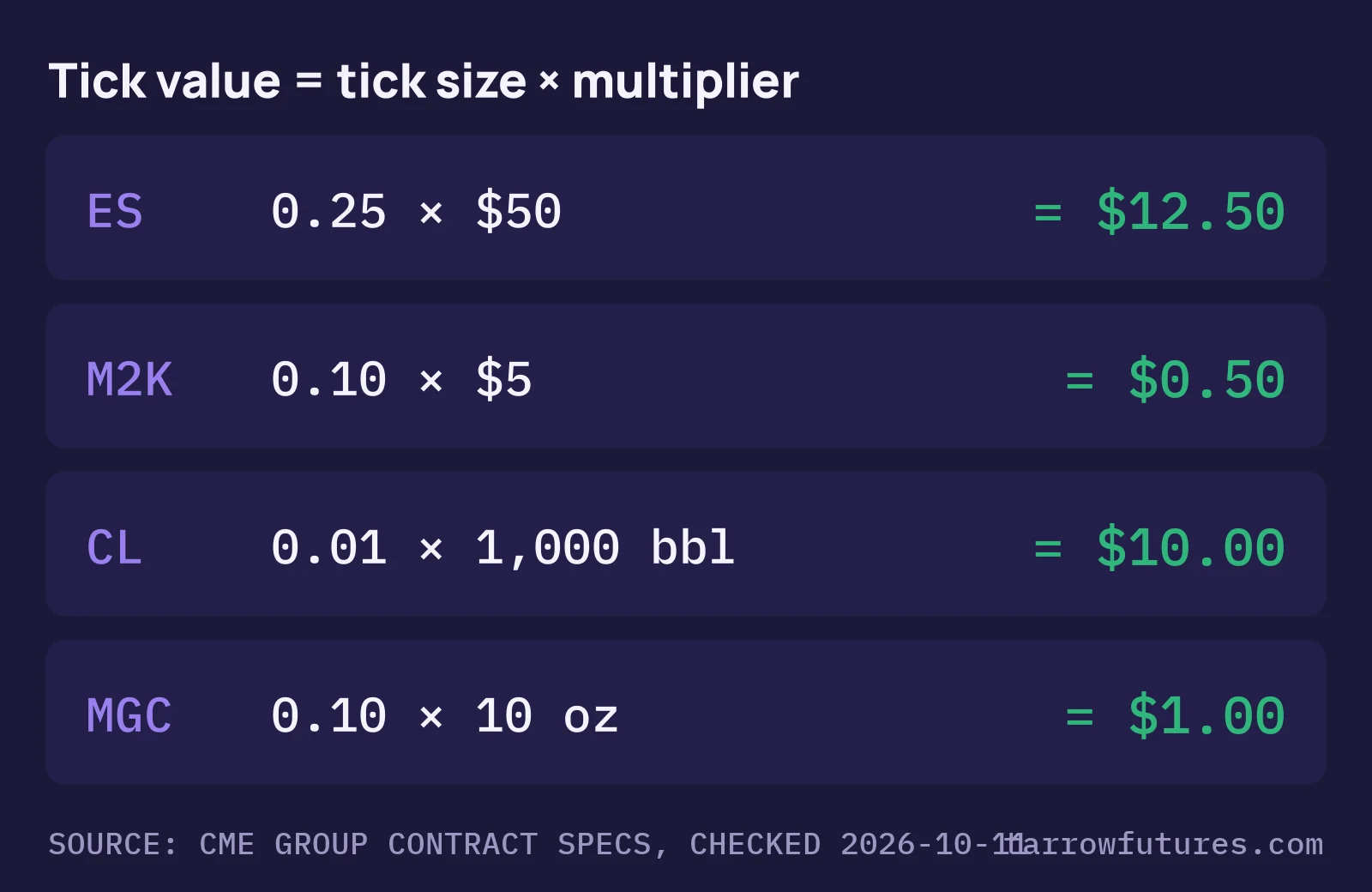
Tick value = tick size × multiplier. Both numbers are on the spec page, so you never have to trust a chart (this one included) without checking.
- ES:
0.25 × $50 = $12.50 - M2K:
0.10 × $5 = $0.50 - CL:
0.01 × 1,000 barrels = $10.00 - MGC:
0.10 × 10 ounces = $1.00
From there, three lines do every conversion:
- Dollars = ticks moved × tick value × contracts
- Ticks = price move ÷ tick size
- Ticks for a dollar amount = dollars ÷ (tick value × contracts)
The tick value calculator does these for any of the 12 contracts. For one contract in depth, What is the MNQ tick value? works through MNQ with conversion tables.
Worked example: equity index (ES and MES)
(example figures, not results)
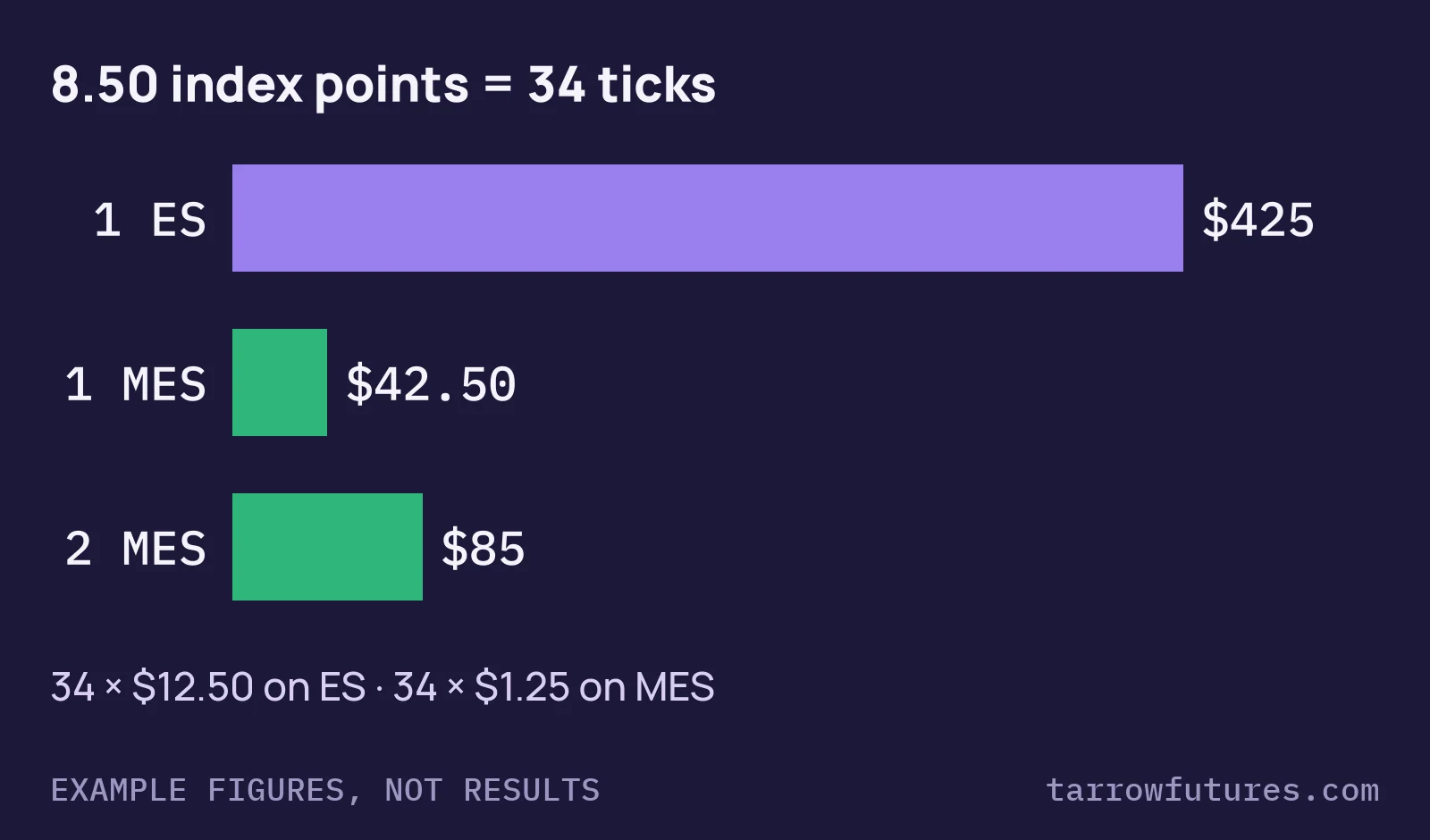
Price moves 8.50 index points.
- Ticks =
8.50 ÷ 0.25 = 34 - 1 ES:
34 × $12.50 = $425 - 1 MES:
34 × $1.25 = $42.50 - 2 MES:
34 × $1.25 × 2 = $85
Backwards from dollars: how many ticks is $500 on ES? $500 ÷ $12.50 = 40 ticks, which is 10 points. On one MES the same $500 is 400 ticks, or 100 points.
A 40-tick stop on 2 MES costs 40 × $1.25 × 2 = $100. The same stop on 1 ES costs $500. That fivefold gap is why the micro is the finer sizing step.
Worked example: energy (CL and MCL)
(example figures, not results)
Crude is quoted in dollars and cents per barrel. Price moves $0.45 a barrel.
- Ticks =
0.45 ÷ 0.01 = 45 - 1 CL:
45 × $10.00 = $450 - 1 MCL:
45 × $1.00 = $45
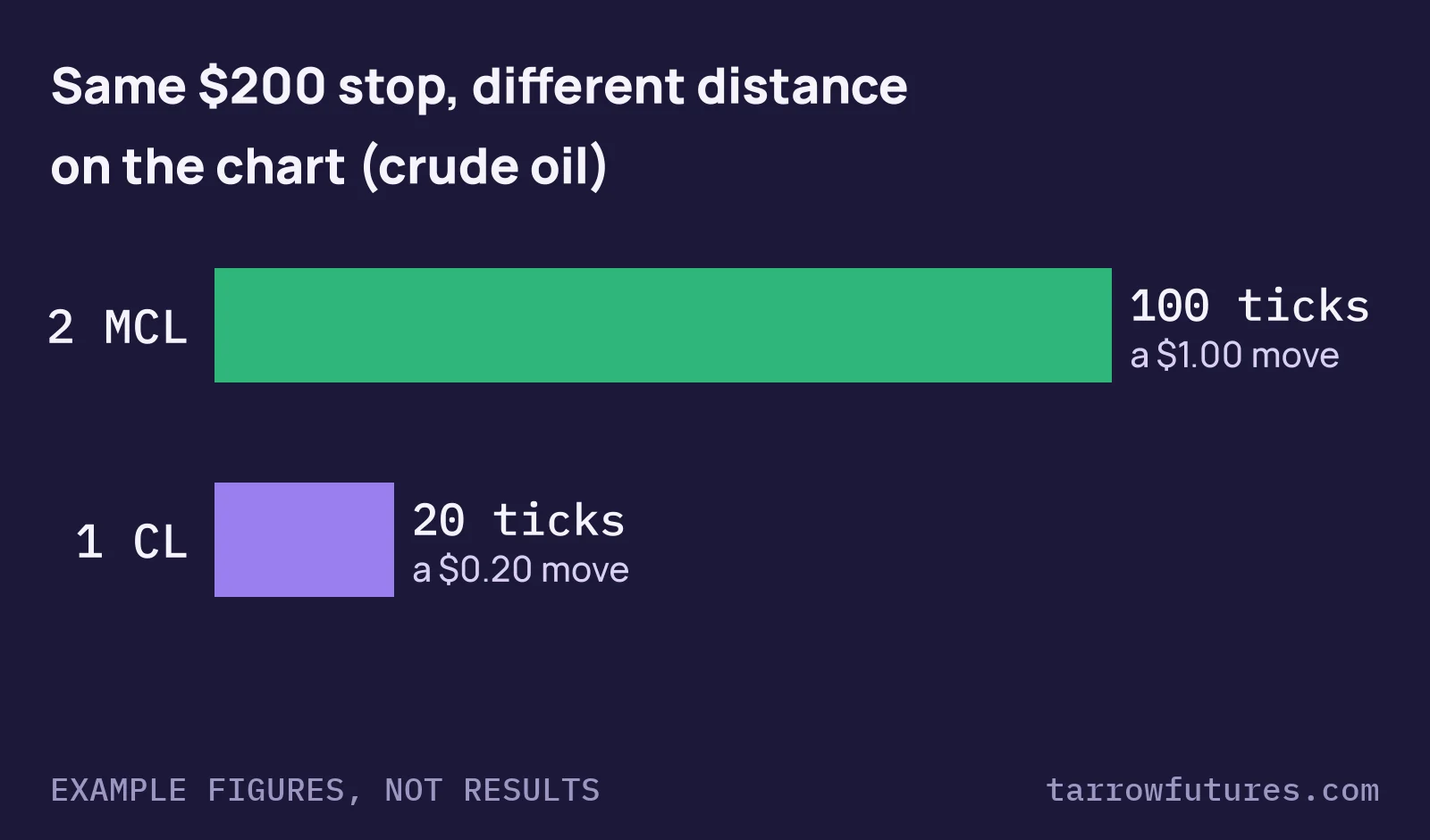
Backwards: a $200 stop on 2 MCL is $200 ÷ ($1.00 × 2) = 100 ticks, a $1.00 move. On 1 CL, $200 is only 20 ticks, a move of $0.20. Same dollars, a fifth of the distance: check the stop on the chart, not just in dollars.
Worked example: metals (GC and MGC)
(example figures, not results)
Gold is quoted in dollars per troy ounce. Price moves $3.50 an ounce.
- Ticks =
3.50 ÷ 0.10 = 35 - 1 GC:
35 × $10.00 = $350 - 1 MGC:
35 × $1.00 = $35 - 3 MGC:
35 × $1.00 × 3 = $105
Backwards: how far can gold move against 1 GC before you lose $500? $500 ÷ $10 = 50 ticks, or $5.00 an ounce. On 1 MGC the same $500 is 500 ticks, or $50.00 an ounce.
Your drawdown, in ticks, for each contract
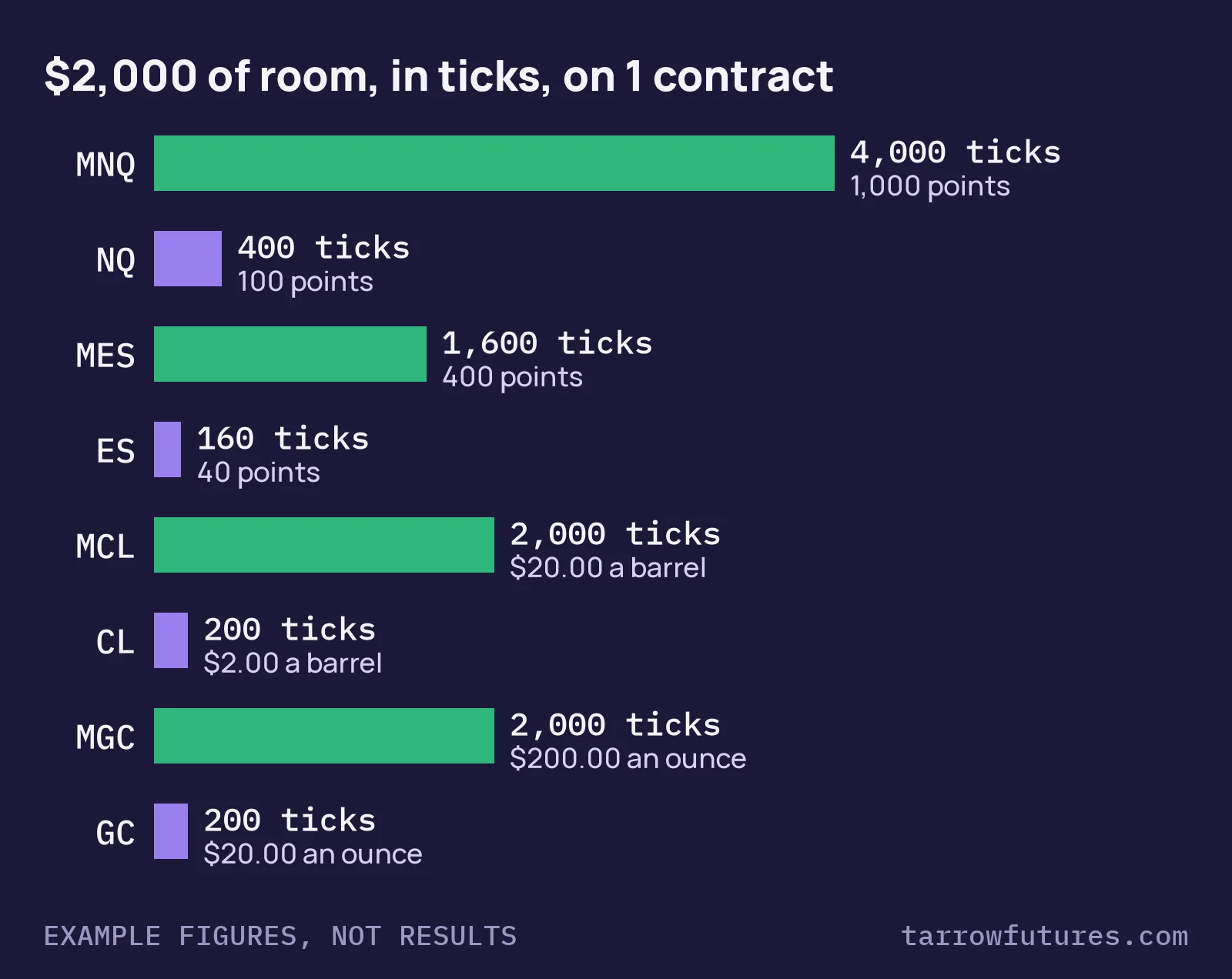
Prop firm limits are written in dollars; the chart is in ticks. Here is the shared example account, $50,000 with a $2,000 drawdown on day one, so the room is the full $2,000 (example figures, not results). Ticks of room per contract = $2,000 ÷ tick value.
| Contract | Tick value | Ticks of room, 1 contract | Price move |
|---|---|---|---|
| MNQ | $0.50 |
4,000 |
1,000 points |
| NQ | $5.00 |
400 |
100 points |
| MES | $1.25 |
1,600 |
400 points |
| ES | $12.50 |
160 |
40 points |
| MCL | $1.00 |
2,000 |
$20.00 a barrel |
| CL | $10.00 |
200 |
$2.00 a barrel |
| MGC | $1.00 |
2,000 |
$200.00 an ounce |
| GC | $10.00 |
200 |
$20.00 an ounce |
Divide by your contract count for the room per position. On a trailing drawdown the $2,000 is not fixed: the floor moves as the account makes new highs, so the room changes. What is a trailing drawdown? explains how, and How many contracts should I trade on a prop firm account? turns room into a contract count.
Common mistakes
- Reading the wrong row. MES and MNQ, or MCL and MGC, sit next to each other on most platforms and have different tick values. Check the symbol before you size.
- Mini value on a micro, or the reverse. That is a tenfold error in every stop and every size.
- Treating points as ticks. A
10-point ES stop is40ticks,$500a contract, not$125. - Assuming a "point" on crude or gold is one tick. A
1.00move is100ticks on CL and10on GC. - Forgetting fees. All the figures here are before commissions and exchange fees, which are charged per contract. On a small target they can take a large share of the gross.
- Trusting any chart without checking. Specs rarely change, but they can. The CME page is the source; this chart and the card are copies of it.
Sources
Each row was read from CME Group's contract specifications page on 2026-10-11 (contract unit and outright minimum price fluctuation): MNQ, NQ, MES, ES, MYM, YM, M2K, RTY, MCL, CL, MGC, GC. Ticks per 1.00, value of 1.00 and the drawdown table are arithmetic from those two figures.
Free printable · free with your email
Contract Specs Card
Tick size, tick value and point value for the futures prop traders use most, on one card. We email you the link, so it is one tap away next time.
✓ It's yours. The link is on its way to your inbox.
Check your inbox in the next few minutes.
Questions
What is the tick value of ES?
$12.50 per contract. ES, the E-mini S&P 500, moves in ticks of 0.25 index points and is $50 times the index, so 0.25 × $50 = $12.50. One point is 4 ticks, or $50 (CME Group contract specifications, checked 2026-10-11).
What is the tick value of MES?
$1.25 per contract. MES, the Micro E-mini S&P 500, has the same 0.25-point tick as ES and a $5 multiplier, so 0.25 × $5 = $1.25. One point is $5, a tenth of ES (CME Group, checked 2026-10-11).
What is the tick value of crude oil (CL) futures?
$10.00 per contract. CL is 1,000 barrels and its tick is $0.01 a barrel, so 0.01 × 1,000 = $10. A $1.00 move is 100 ticks, or $1,000. Micro WTI (MCL) is 100 barrels, so its tick is $1.00 (CME Group, checked 2026-10-11).
What is the tick value of gold (GC) and micro gold (MGC)?
GC is 100 troy ounces with a $0.10 tick, so one tick is $10.00 and a $1.00 move is $100. MGC is 10 troy ounces with the same $0.10 tick, so one tick is $1.00 and a $1.00 move is $10 (CME Group, checked 2026-10-11).
How do you calculate the tick value of a futures contract?
Multiply the tick size by the contract multiplier. Both are on the exchange's contract specification page. ES is 0.25 × $50 = $12.50; CL is 0.01 × 1,000 barrels = $10. Dollars on a trade = ticks moved × tick value × contracts.
Is there a futures tick value chart as a PDF?
Yes. The table on this page is also a free two-page printable, the Contract Specs Card, with the same 12 contracts, micro next to mini, CME Globex hours in ET and CT, and the CME page each number came from.
Is a micro contract always one tenth of the mini?
For the six pairs on this chart, yes: MNQ/NQ, MES/ES, MYM/YM, M2K/RTY, MCL/CL and MGC/GC all have the same tick size and a tenth of the multiplier, so a tenth of the tick value. Check the spec page before assuming it for any other pair.
Educational material only. Not financial, investment or trading advice, and not a recommendation to trade any contract or size. Prop firm rules differ and change; the current rulebook of the firm you use decides. Worked examples use example figures, not results. Futures trading involves substantial risk of loss. Evaluations are paid tests and most people who take one do not pass.