Futures Basics
MNQ vs NQ: same chart, 10x the dollars per tick
MNQ is the micro version of NQ: the same Nasdaq-100 index, the same 0.25-point tick and the same chart, at one tenth of the size. One MNQ tick is worth $0.50 and one NQ tick $5.00, so 10 MNQ move exactly the same dollars per tick as 1 NQ (CME Group contract specifications, checked 2026-10-11).
That one fact decides how finely you can size. Under a $2,000 trailing drawdown, a one-contract step on NQ is a ten-contract step on MNQ. This post sets the two specs side by side, converts between them, and works through what the difference means for size. Every figure is arithmetic from CME's two spec pages; how your firm counts and charges contracts is in its own rulebook.
Free tool · free with your email
Position size calculator
Turn today's loss budget and your stop into a contract count.
✓ It's yours. The link is on its way to your inbox. Open the position size calculator now
See what the position size calculator does firstThe two contracts side by side
From CME Group's contract specification pages for Micro E-mini Nasdaq-100 and E-mini Nasdaq-100, checked 2026-10-11:
| MNQ | NQ | |
|---|---|---|
| Name | Micro E-mini Nasdaq-100 | E-mini Nasdaq-100 |
| Underlying | Nasdaq-100 index | Nasdaq-100 index |
| Contract unit | $2 × index |
$20 × index |
| Tick size | 0.25 index points |
0.25 index points |
| Tick value | 0.25 × $2 = $0.50 |
0.25 × $20 = $5.00 |
| Ticks per point | 4 |
4 |
| Point value | $2 |
$20 |
Everything except the multiplier is the same. The multiplier is ten times larger on NQ, so every dollar figure is ten times larger too.
Does 10 MNQ equal 1 NQ?
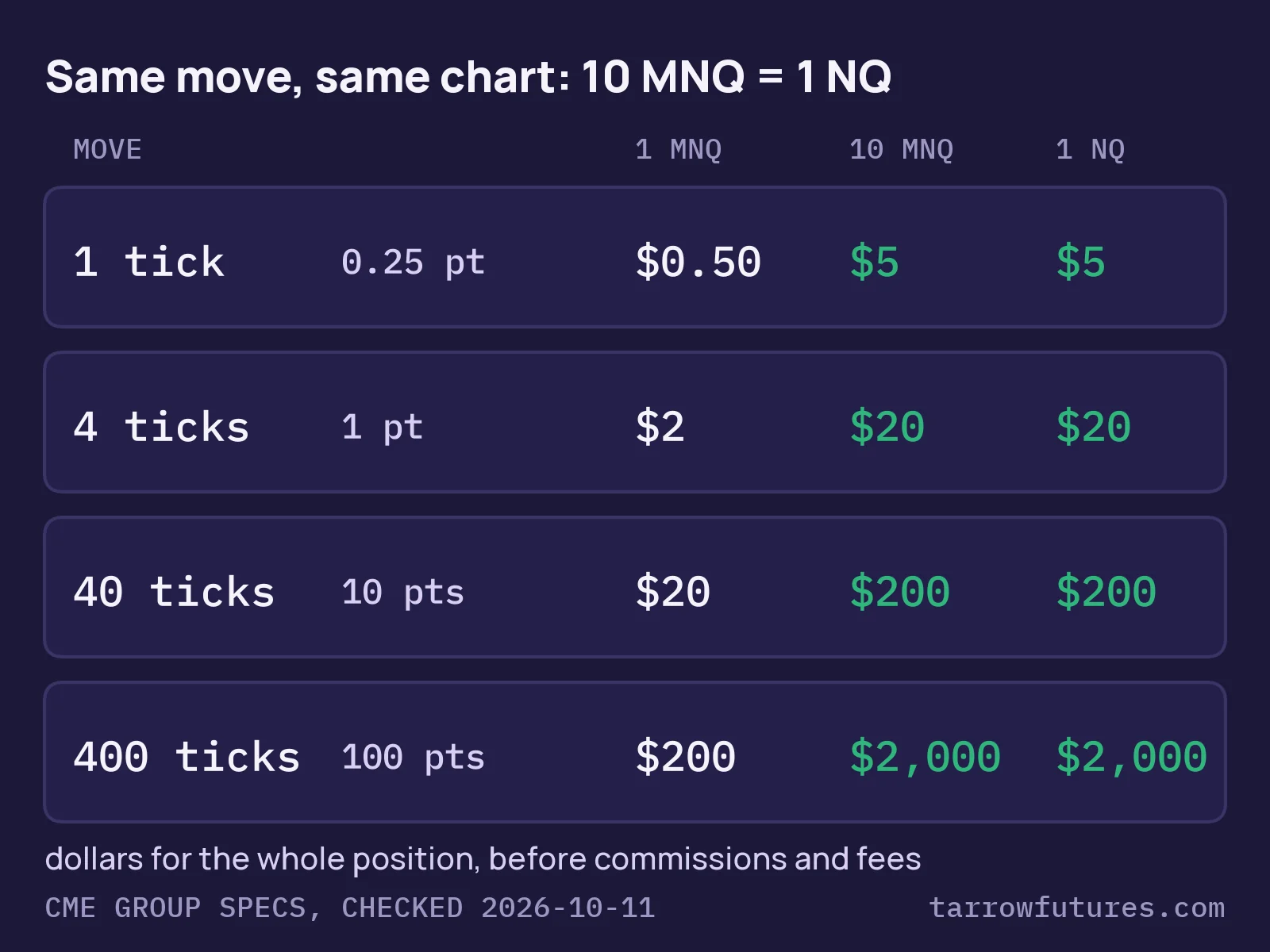
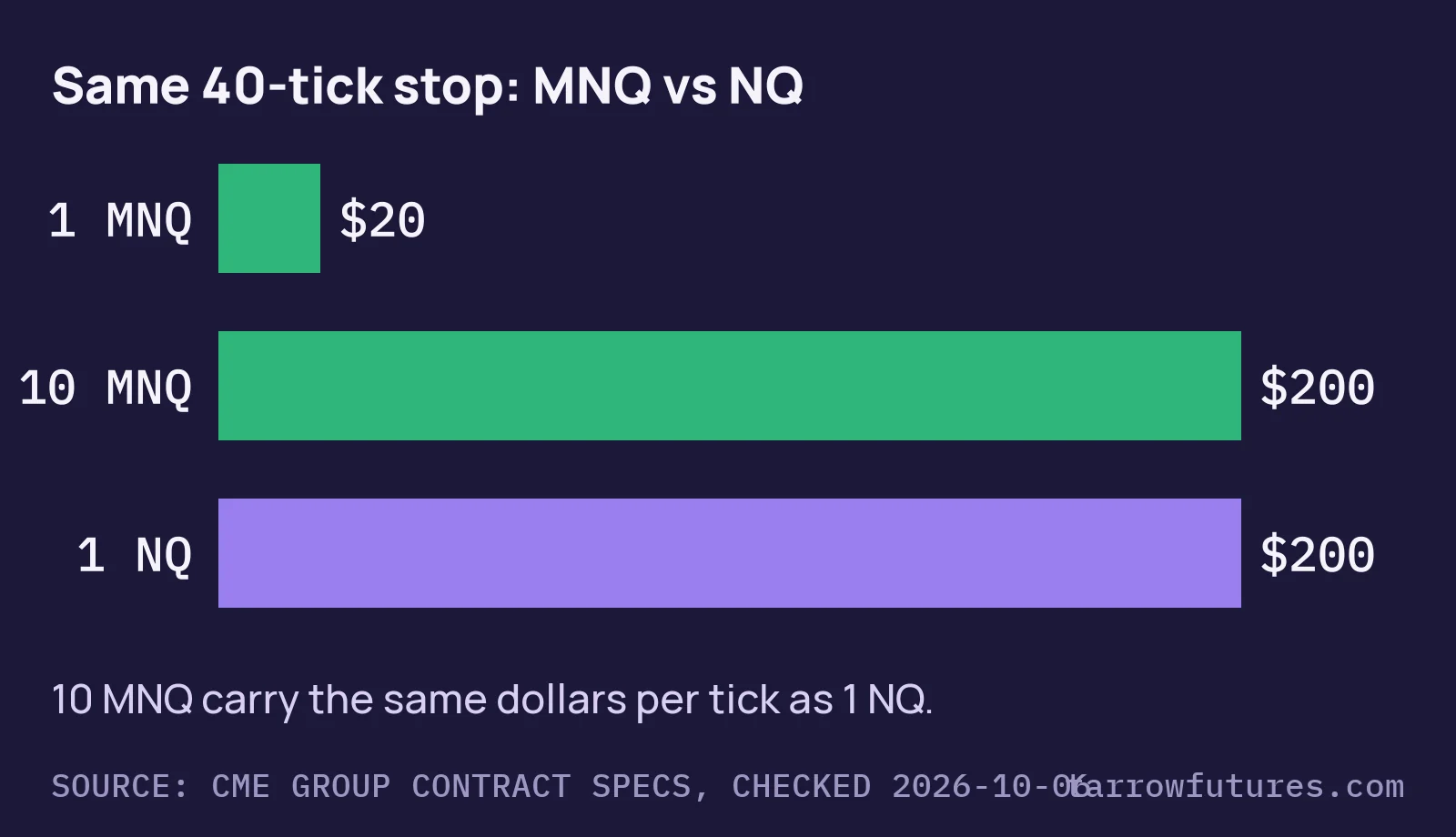
In dollars per tick, yes. The same price move on the same number of points (example figures, before commissions and fees):
| Move | 1 MNQ | 10 MNQ | 1 NQ |
|---|---|---|---|
1 tick (0.25 pt) |
$0.50 |
$5 |
$5 |
1 point (4 ticks) |
$2 |
$20 |
$20 |
10 points (40 ticks) |
$20 |
$200 |
$200 |
100 points (400 ticks) |
$200 |
$2,000 |
$2,000 |
To convert a position: NQ equivalent = MNQ contracts ÷ 10, and MNQ equivalent = NQ contracts × 10. So 5 MNQ carry the dollars of half an NQ, 16 MNQ carry 1.6 NQ, and 2 NQ carry 20 MNQ.
"Equal" stops at dollars per tick. Two things can still differ, and each is set by your firm or broker, not by CME's spec page:
- Fees. Commissions and exchange fees are charged per contract. Ten MNQ are ten charges. Compare ten micro fees with one mini fee on your fee schedule before you assume the two cost the same.
- Contract limits. Plans cap how many contracts you may hold. Check whether yours counts each micro as one contract or as a fraction of a mini.
What 10x means for a $2,000 floor
Room in dollars is the same whichever contract you trade. Room in points is not. With $2,000 of room (example figures, not results):
| Position | Dollars per point | Points of room | Ticks of room |
|---|---|---|---|
| 1 MNQ | $2 |
$2,000 ÷ $2 = 1,000 |
4,000 |
| 2 MNQ | $4 |
500 |
2,000 |
| 5 MNQ | $10 |
200 |
800 |
| 10 MNQ | $20 |
100 |
400 |
| 1 NQ | $20 |
$2,000 ÷ $20 = 100 |
400 |
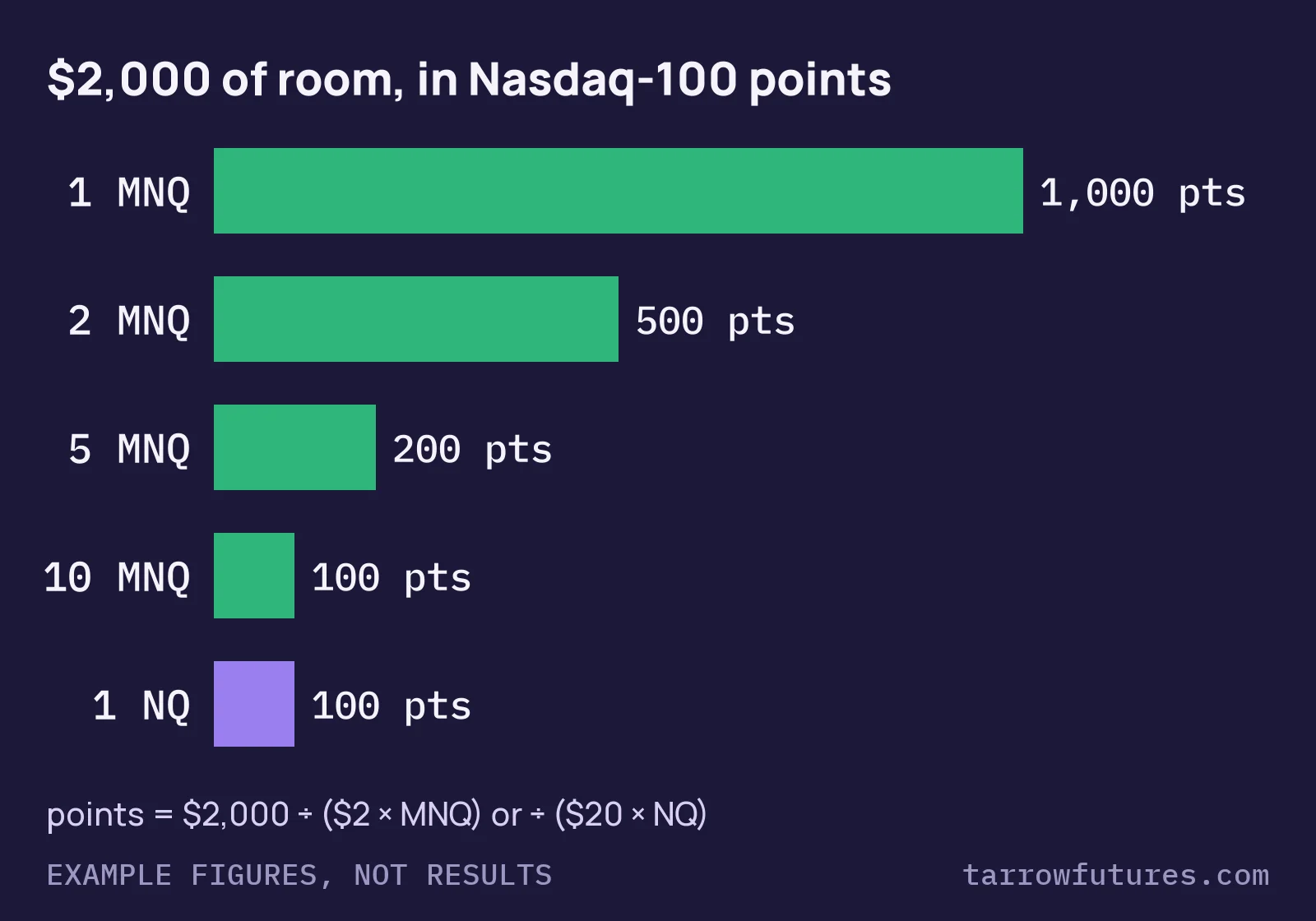
One NQ gives the floor a 100-point move before the account fails. The same 100 points on one MNQ cost $200, a tenth of the room.
Put in stops: a 40-tick (10-point) stop costs 40 × $0.50 = $20 on one MNQ and 40 × $5.00 = $200 on one NQ. $2,000 of room covers $2,000 ÷ $20 = 100 of those stops on one MNQ and $2,000 ÷ $200 = 10 on one NQ.
Micros are the sizing step
Size comes from a loss budget, not from the account balance. How many contracts should I trade on a prop firm account? works the method in full: budget ÷ (cost of one stop × stops you want to survive), rounded down.
Take a $1,000 budget for the day and plan to survive 3 full stops (example figures, not results).
With a 40-tick stop (10 points):
| Contract | One stop, one contract | 3 stops, one contract | Largest size that fits | What 3 stops cost |
|---|---|---|---|---|
| NQ | $200 |
$600 |
$1,000 ÷ $600 = 1.67, so 1 |
$600 |
| MNQ | $20 |
$60 |
$1,000 ÷ $60 = 16.67, so 16 |
$960 |
On NQ the only choices are 1 contract ($600) or 2 ($1,200, over the budget). On MNQ the size can be any whole number up to 16, in $60 steps. Sixteen MNQ is the dollar exposure of 1.6 NQ, a size NQ cannot express.
With a 100-tick stop (25 points):
| Contract | One stop, one contract | 3 stops, one contract | Largest size that fits |
|---|---|---|---|
| NQ | $500 |
$1,500 |
$1,000 ÷ $1,500 = 0.67, so 0 |
| MNQ | $50 |
$150 |
$1,000 ÷ $150 = 6.67, so 6 ($900) |
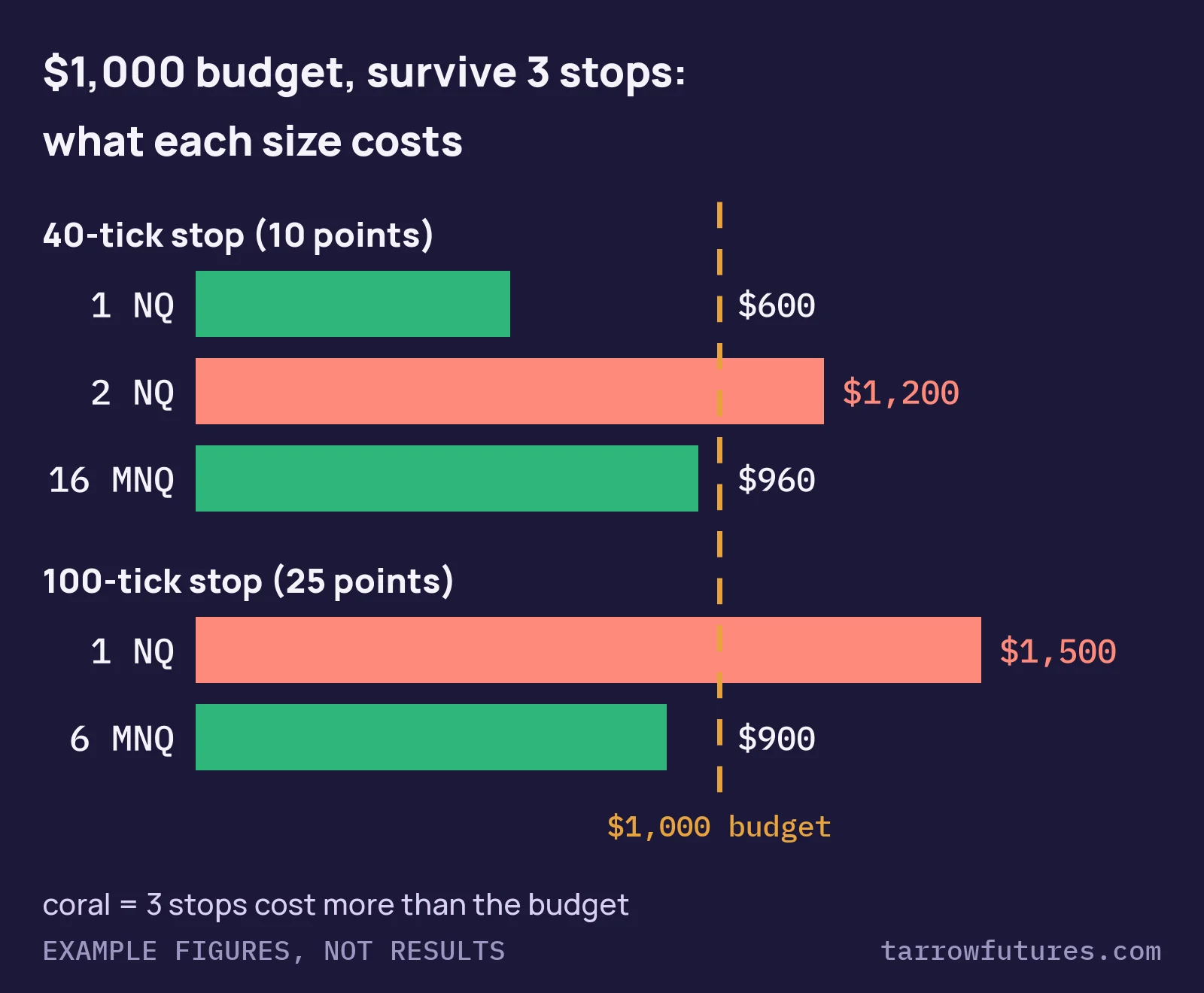
With the wider stop, one NQ does not fit the budget at all; the arithmetic says zero. Six MNQ do. That is the practical difference between the two contracts under a drawdown: not the chart, but the size of the smallest step.
The arithmetic does not say which contract to trade. It says what each one costs at your stop and your budget. The position size calculator below runs it for your own numbers, with MNQ, NQ and the other common contracts.
When one NQ and ten MNQ are interchangeable
If the size you would trade is an exact multiple of ten micros, one NQ carries the same dollars per tick in fewer contracts: 10 MNQ or 1 NQ, 20 MNQ or 2 NQ. Whether that matters comes down to the two things above: your fee schedule and how your plan counts contracts. None of it changes the risk per tick, which is identical.
Below ten micros, or between multiples of ten, there is no NQ equivalent. 7 MNQ has no NQ size.
Common mistakes
- Reading the wrong symbol. MNQ and MES sit side by side on most platforms. MES is the Micro E-mini S&P 500 at
$1.25a tick, a different index and a different value. The futures tick value chart lists both. - Sizing NQ in "micro thinking". A
$20stop on MNQ is a$200stop on NQ at the same distance. Switching contracts without dividing the size by ten multiplies the risk by ten. - Assuming fees scale by ten. They are charged per contract. Check the schedule.
- Counting micros against the contract limit at the wrong rate. The rulebook says how micros count.
- Forgetting the floor in points. One NQ has
100points of room on a fresh$2,000drawdown. Write that number down before you size.
For the MNQ numbers alone, with more conversions and how many ticks $500 is, see What is the MNQ tick value?. The tick value calculator converts ticks, points and dollars for either contract.
Free tool · free with your email
Position size calculator
Turn today's loss budget and your stop into a contract count. We email you the link, so it is one tap away next time.
✓ It's yours. The link is on its way to your inbox. Open the position size calculator now
See what the position size calculator does firstQuestions
Does 10 MNQ equal 1 NQ?
In dollars per tick, yes. MNQ is $0.50 a tick and NQ is $5.00, both on the same 0.25-point tick of the Nasdaq-100 index, so 10 MNQ gain or lose the same dollars as 1 NQ on the same price move (CME Group contract specifications, checked 2026-10-11). Fees, margin and how your plan counts contracts can still differ.
How many MNQ is 1 NQ?
Ten. NQ is $20 times the index and MNQ is $2 times the index, so one NQ carries the dollar exposure of ten MNQ.
What is the difference between MNQ and NQ?
Size. Both are CME futures on the Nasdaq-100 index and move in ticks of 0.25 index points. NQ (E-mini) is $20 × the index, $5.00 a tick and $20 a point. MNQ (Micro E-mini) is $2 × the index, $0.50 a tick and $2 a point.
Is the MNQ chart the same as the NQ chart?
They follow the same index, so the price moves track each other closely, and a 10-point move is 10 points on both. The quoted prices of the two contracts can differ slightly at any moment, so read your own contract's chart for orders.
Is MNQ or NQ better for a prop firm account?
That is your decision within your firm's rules; this post does the arithmetic, not a recommendation. With $2,000 of room, a 40-tick stop costs $20 on one MNQ and $200 on one NQ, so micros let you size in steps of one tenth and fit stops that one NQ cannot.
Do 10 MNQ cost the same in fees as 1 NQ?
Not necessarily. Commissions and exchange fees are charged per contract, so 10 MNQ are ten charges. Compare ten micro fees with one mini fee on your firm's or broker's fee schedule.
Educational material only. Not financial, investment or trading advice, and not a recommendation to trade any contract or size. Prop firm rules differ and change; the current rulebook of the firm you use decides. Worked examples use example figures, not results. Futures trading involves substantial risk of loss. Evaluations are paid tests and most people who take one do not pass.