Futures Basics
What is the NQ tick value?
One NQ tick is worth $5.00 per contract. NQ, the E-mini Nasdaq-100 future, moves in ticks of 0.25 index points, and the contract is $20 times the index, so one point is 4 ticks and is worth $20. Source: CME Group contract specifications for E-mini Nasdaq-100 futures, checked 2026-11-18.
So $500 on one NQ is 100 ticks, or 25 points. The rest of this post is the same multiplication done for the numbers a prop trader needs: a stop, a daily limit and a drawdown.
Free printable · free with your email
Contract Specs Card
Tick size, tick value and point value for the futures prop traders use most, on one card.
✓ It's yours. The link is on its way to your inbox.
Check your inbox in the next few minutes.
The NQ specification
From CME Group's E-mini Nasdaq-100 contract specifications page, checked 2026-11-18:
| NQ | |
|---|---|
| Contract unit | $20 × Nasdaq-100 Index |
| Minimum price move (tick) | 0.25 index points |
| Tick value | 0.25 × $20 = $5.00 |
| Ticks per point | 4 |
| Point value | $20 |
The tick value is the tick size times the multiplier. Remember 0.25 and $20 and you can rebuild everything else. Because the tick is 0.25, NQ prices always end in .00, .25, .50 or .75.
The micro, MNQ, has the same tick at $2 times the index: $0.50 a tick and $2 a point. Its numbers are in What is the MNQ tick value?.
Three lines that do every conversion
- Dollars = ticks ×
$5.00× contracts - Ticks = points ×
4 - Points = dollars ÷ (
$20× contracts)
Ticks, points and dollars
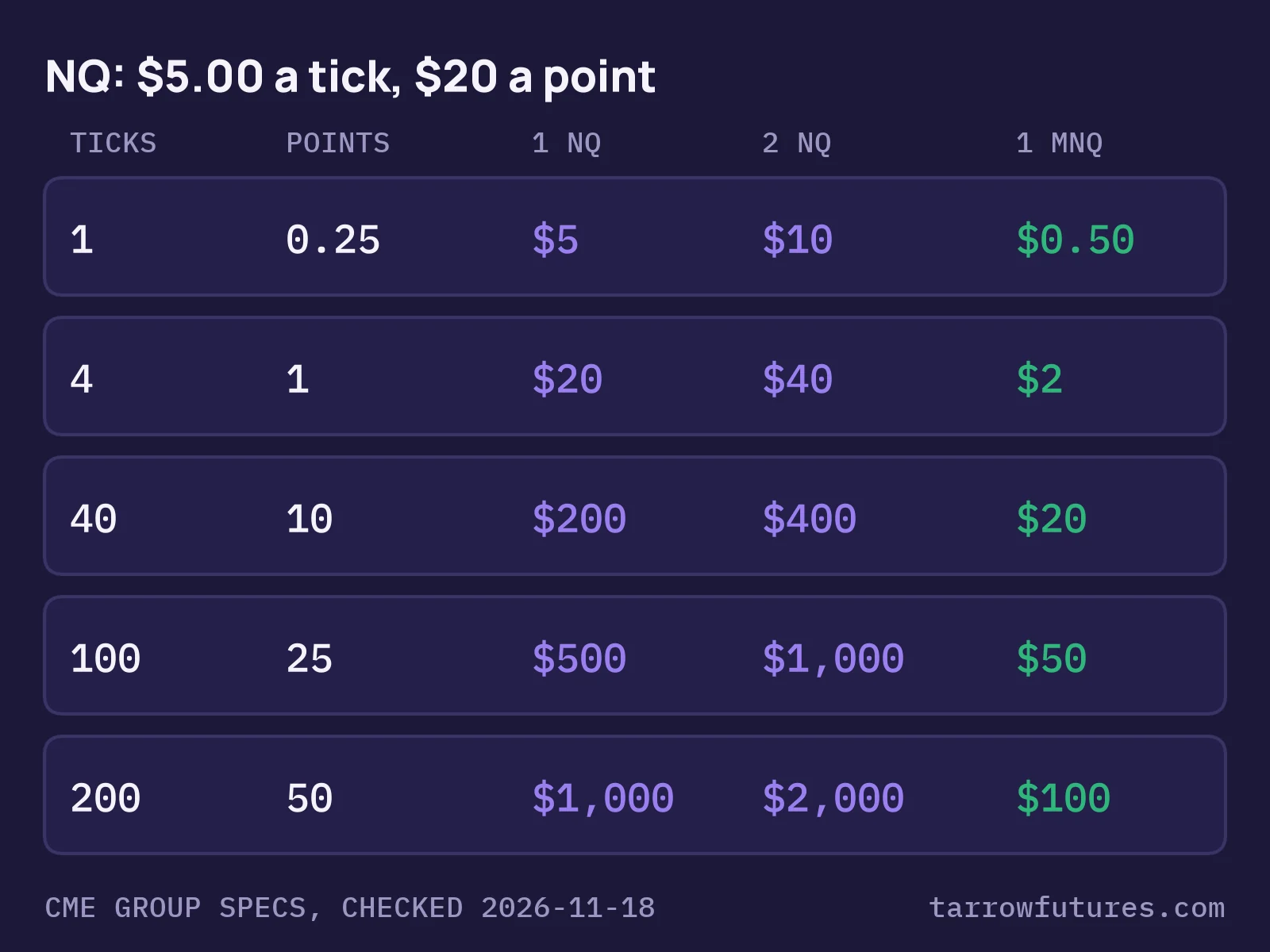
| Ticks | Points | 1 NQ | 2 NQ | 1 MNQ |
|---|---|---|---|---|
1 |
0.25 |
$5 |
$10 |
$0.50 |
4 |
1 |
$20 |
$40 |
$2 |
10 |
2.5 |
$50 |
$100 |
$5 |
40 |
10 |
$200 |
$400 |
$20 |
100 |
25 |
$500 |
$1,000 |
$50 |
200 |
50 |
$1,000 |
$2,000 |
$100 |
Read across any row: 40 ticks is 10 points, $200 on one NQ, $400 on two and $20 on one MNQ.
How many ticks is $500 on NQ?
Work backwards from the dollars:
- 1 NQ:
$500 ÷ $5.00 = 100ticks, which is100 ÷ 4 = 25points - 2 NQ:
$500 ÷ ($5.00 × 2) = 50ticks, or12.5points - 1 MNQ:
$500 ÷ $0.50 = 1,000ticks, or250points - 10 MNQ:
$500 ÷ ($0.50 × 10) = 100ticks, the same as one NQ
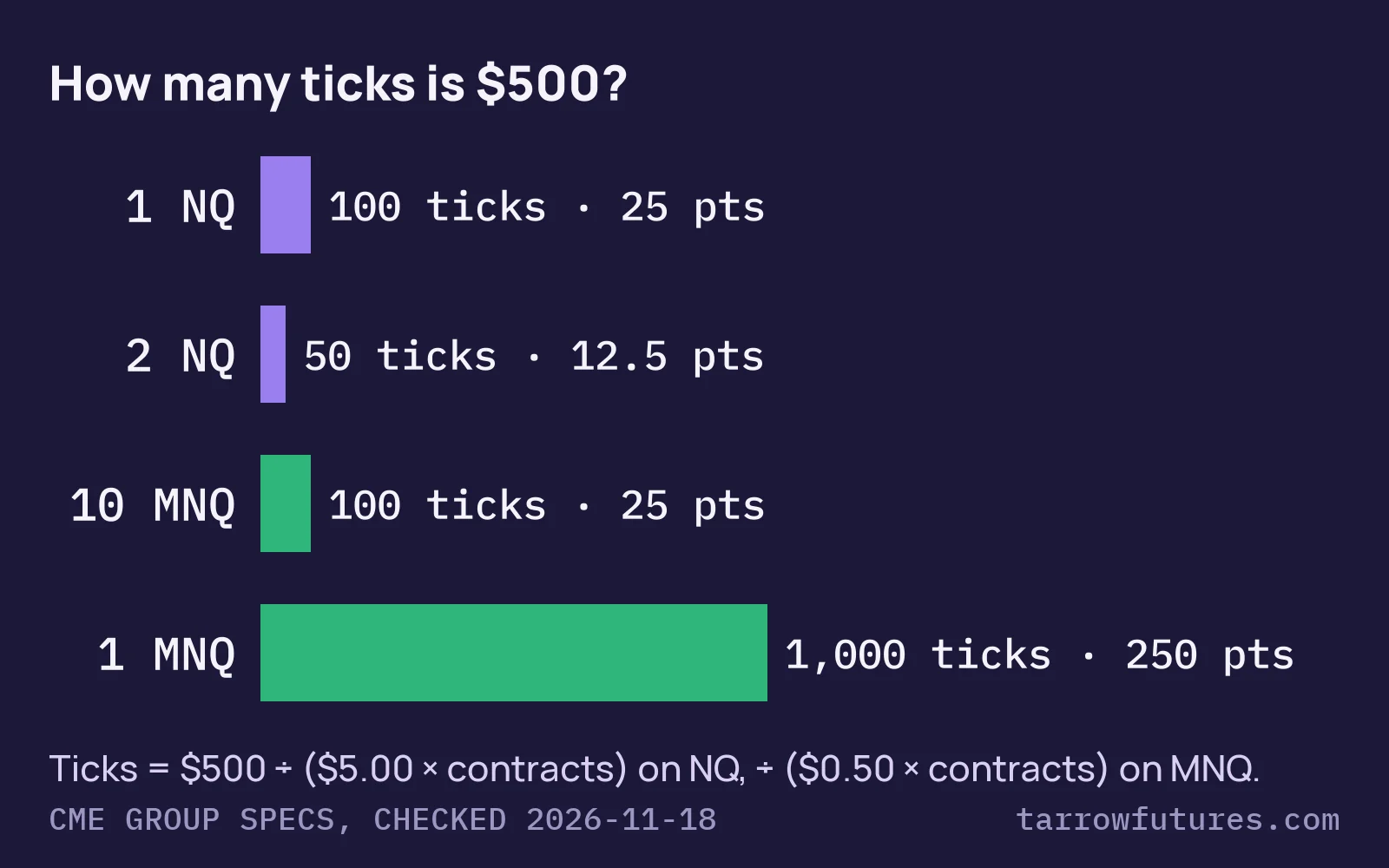
The same method answers "how far can price move before I lose $X?" For $1,000 on one NQ it is $1,000 ÷ $20 = 50 points. That is the step that turns a prop firm's dollar limits into a distance on the chart. The free tick value calculator does it for any of 12 CME contracts.
A worked trade
(example figures, not results)
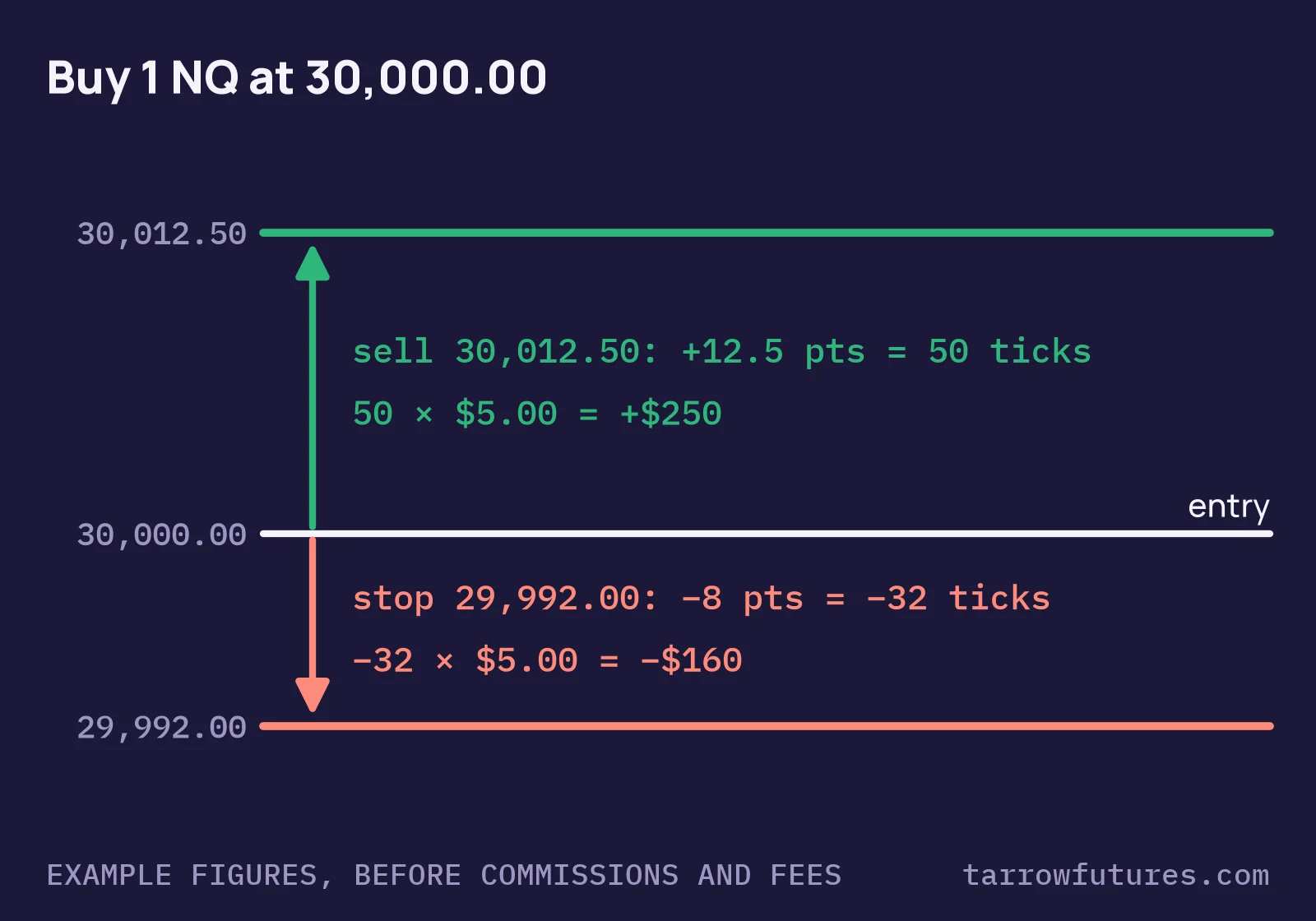
Buy 1 NQ at 30,000.00. Sell at 30,012.50.
- Points =
30,012.50 − 30,000.00 = 12.5 - Ticks =
12.5 × 4 = 50 - P&L =
50 × $5.00 = $250 - Check with points:
12.5 × $20 = $250
The same trade stopped out at 29,992.00 instead:
- Points =
29,992.00 − 30,000.00 = −8 - Ticks =
−8 × 4 = −32 - P&L =
−32 × $5.00 = −$160
On 1 MNQ, the same two outcomes are +$25 and −$16: one tenth. Both results are before commissions and exchange fees, which are charged per contract. Subtract them to get the net figure.
What one NQ does to a small budget
Say you plan to risk $200 on a trade with a 15-point (60-tick) stop (example figures):
- NQ:
60 × $5.00 = $300per contract. One NQ is already over the$200, so no NQ size fits. - MNQ:
60 × $0.50 = $30per contract.$200 ÷ $30 = 6.67, so6MNQ fit, risking$180.
The smallest step NQ allows is $5.00 a tick, so a wide stop can rule it out completely. MNQ vs NQ works through the sizing difference at more stops and budgets, and the position size calculator does the division for your own numbers.
Your drawdown and daily limit, in NQ ticks
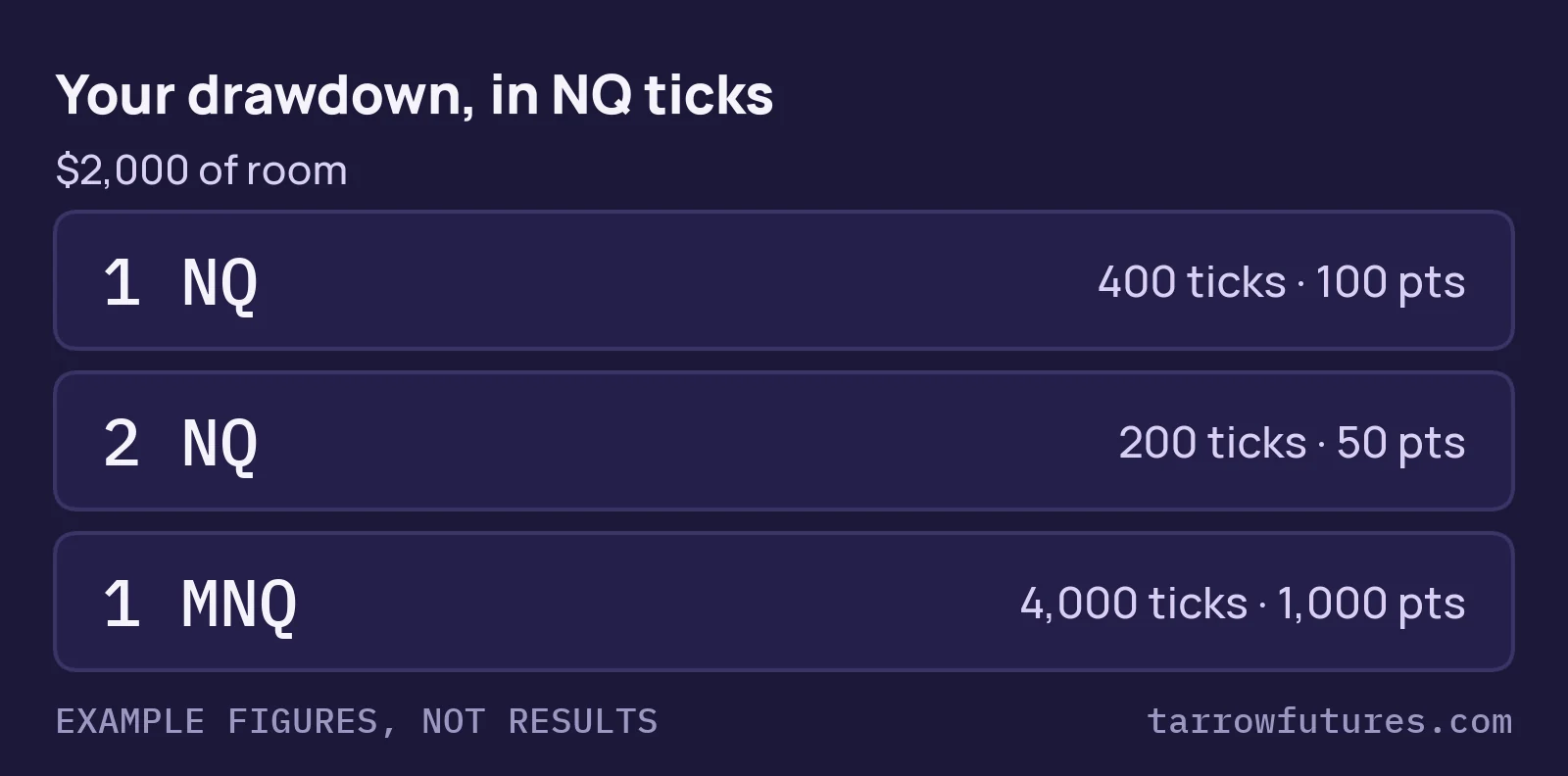
The shared example: a $50,000 account with a $2,000 drawdown and a $1,000 daily loss limit, on its first day, so room is the full $2,000 (example figures, not results).
- 1 NQ:
$2,000 ÷ $5.00 = 400ticks, or100points - 2 NQ:
$2,000 ÷ $10 = 200ticks, or50points - 1 MNQ:
$2,000 ÷ $0.50 = 4,000ticks, or1,000points
The daily limit is smaller: $1,000 on one NQ is 200 ticks, or 50 points. A 60-tick stop on one NQ costs $300, so the daily limit covers 3 full stops ($900) and the drawdown covers 6 ($1,800). Today's budget is the smaller of the two, which Daily loss limit vs trailing drawdown explains. On a trailing drawdown the room changes as the floor moves; see What is a trailing drawdown?.
Common mistakes
- Mixing up ticks and points. A
10-point stop is40ticks. Read as10ticks, it understates the risk four times over:$50instead of$200per NQ. - Using the MNQ value for NQ, or the reverse.
$0.50on a mini or$5.00on a micro is a tenfold error in every stop and size. - Using the ES value for NQ. Both tick in
0.25points, but ES is$12.50a tick and$50a point (CME Group, checked 2026-10-11). The ES and MES tick value post has its tables. - Forgetting to multiply by contracts.
$5.00is per contract.3NQ is$15a tick. - Assuming 10 MNQ cost the same as 1 NQ in fees. Commissions and exchange fees are per contract, so ten micros are ten charges. Compare them on your firm's or broker's fee schedule.
The tick values for all 12 contracts prop traders use most, micros and minis side by side, are in the futures tick value chart.
Free printable · free with your email
Contract Specs Card
Tick size, tick value and point value for the futures prop traders use most, on one card. We email you the link, so it is one tap away next time.
✓ It's yours. The link is on its way to your inbox.
Check your inbox in the next few minutes.
Questions
How much is one NQ tick worth?
$5.00 per contract. The minimum price move on E-mini Nasdaq-100 futures is 0.25 index points, and the contract is $20 times the index, so 0.25 × $20 = $5.00 (CME Group contract specifications, checked 2026-11-18).
How much is 1 point on NQ?
$20 per contract. One point is 4 ticks of $5.00.
How many ticks is $500 on NQ?
On one NQ, $500 ÷ $5.00 = 100 ticks, which is 25 points. On two NQ it is 50 ticks (12.5 points); on one MNQ it is 1,000 ticks (250 points).
How many points is $1,000 on NQ?
50 points on one contract, because $1,000 ÷ $20 a point = 50. That is 200 ticks.
Is the NQ tick value the same as ES?
No. Both move in 0.25-point ticks, but NQ is $20 times the Nasdaq-100 index ($5.00 a tick, $20 a point) and ES is $50 times the S&P 500 index ($12.50 a tick, $50 a point), per CME Group's specifications.
Does the NQ tick value change between contract months?
No. The 0.25-point tick and the $20 multiplier are set in the contract specification and are the same for every listed month. Check CME's spec page if you think a contract has changed.
Educational material only. Not financial, investment or trading advice, and not a recommendation to trade any contract or size. Prop firm rules differ and change; the current rulebook of the firm you use decides. Worked examples use example figures, not results. Futures trading involves substantial risk of loss. Evaluations are paid tests and most people who take one do not pass.