Prop Firm Rules
What is a scaling plan in a prop firm?
A prop firm scaling plan is a contract limit that rises in steps as your profit grows, and can fall again after a losing day. It tells you the most contracts the rules allow today, not how many you should trade.
New accounts start with a low cap. Pass a set profit level, usually measured on the end-of-day balance, and the cap goes up a step; fall back below it and the cap comes down. This post works one example plan through a short run of days, shows how micros change the count, and lists the lines to find in a rulebook. Every figure is an example, not a result, and no particular firm's plan is described.
Free tool · free with your email
Position size calculator
Turn today's loss budget and your stop into a contract count.
✓ It's yours. The link is on its way to your inbox. Open the position size calculator now
See what the position size calculator does firstThe example plan
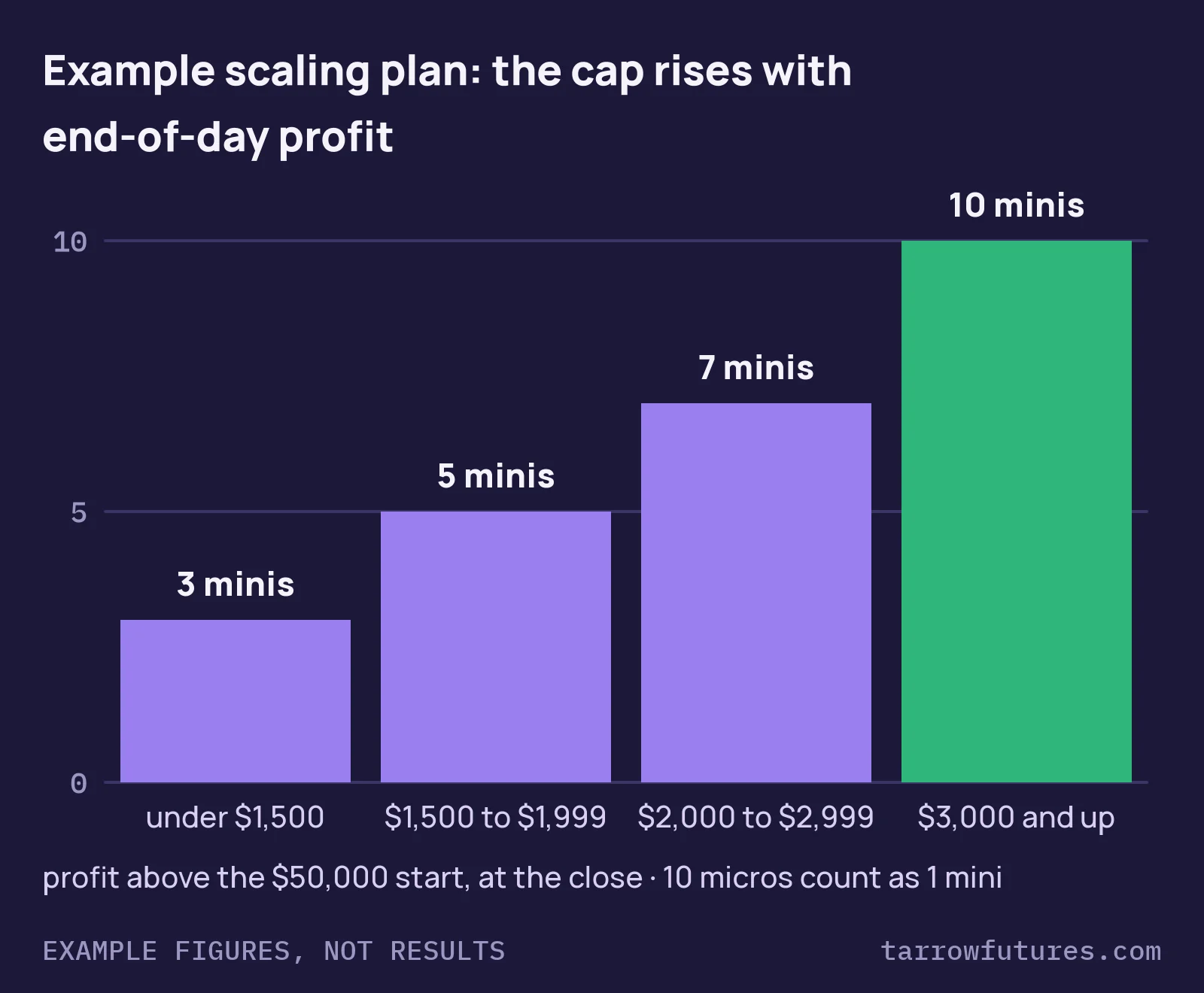
A hypothetical $50,000 account (example figures, no particular firm):
Profit above $50,000, at the close |
Most contracts next day |
|---|---|
under $1,500 |
3 minis |
$1,500 to $1,999 |
5 minis |
$2,000 to $2,999 |
7 minis |
$3,000 and up |
10 minis |
In this plan, ten micros count as one mini, so 3 minis also means 30 MNQ. The tier is set by the balance at the end of the trading day and applies from the next session. A balance below $50,000 counts as under $1,500, so the first tier is also the floor tier.
A worked run of days
Start at $50,000, on the first tier: 3 minis.
- Day 1 closes at
$50,800. Profit$800is under$1,500, so tomorrow's cap is still3minis. - Day 2 trades up to
$51,900during the session and closes at$51,600. The$1,900peak doesn't count in this plan; the$1,600close does.$1,600is in the$1,500to$1,999band, so tomorrow's cap is5minis. - Day 3 loses
$500and closes at$51,100. Profit$1,100is under$1,500again, so the cap drops back to3minis for day 4.
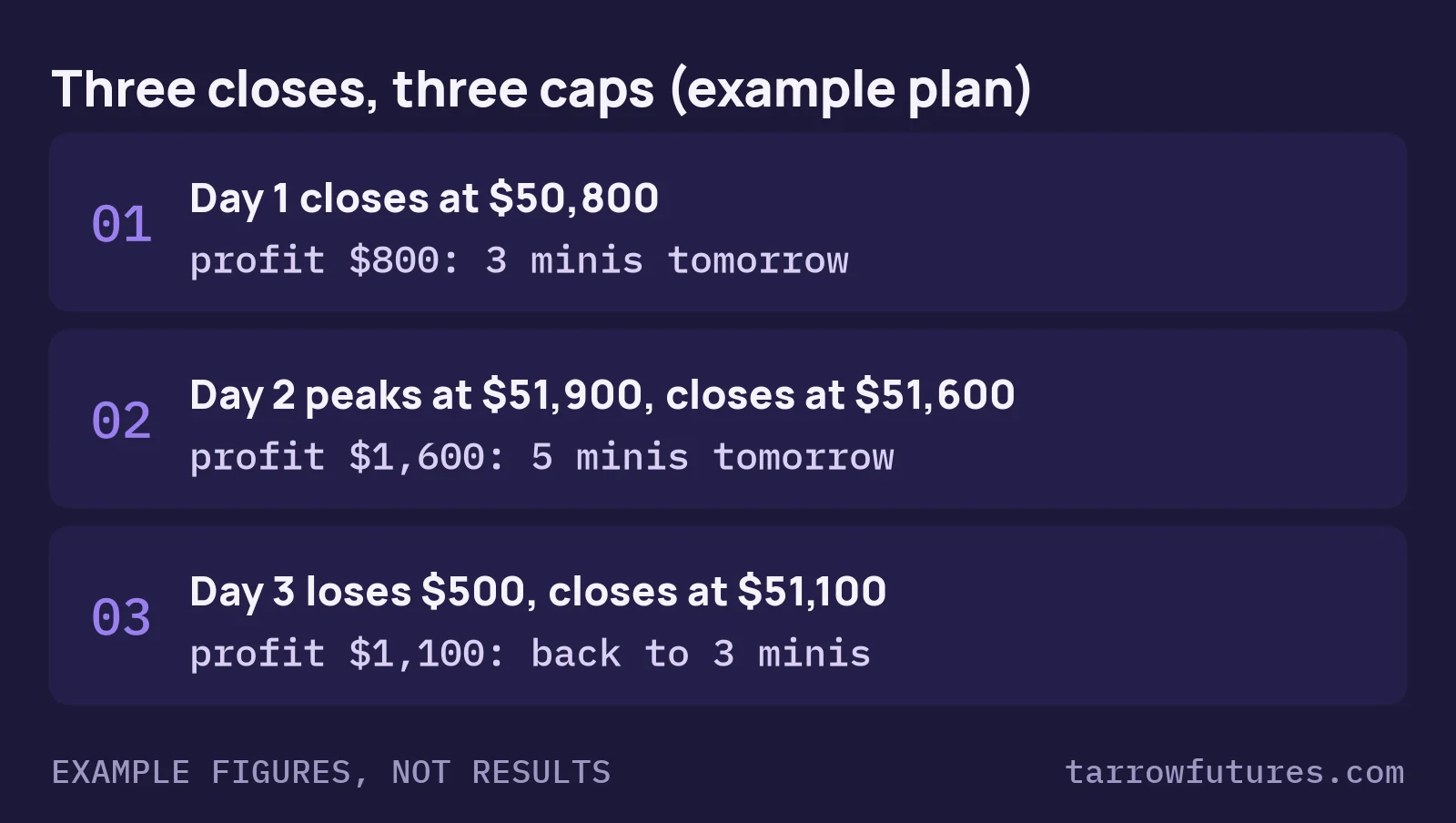
Two things follow. First, a tier you reach during the session doesn't raise your cap that day in a plan like this one; it waits for the close. Second, the step down is as automatic as the step up. A trader who sized for 5 minis on day 3 has to be back at 3 on day 4, before the first order.
Read your own plan for the timing. Some check the tier on the end-of-day balance, some on the intraday balance, and some only step up and never down. Those are three different rules with the same name.
How micros change the count
The cap is written in contracts, and the rulebook decides what a contract is. The two readings you will see:
- Ten micros count as one mini. A
3contract cap allows3NQ, or30MNQ, or a mix such as2NQ and10MNQ. - Each micro counts as one contract. A
3contract cap allows3NQ or3MNQ.
The difference is tenfold. A trader who reads the first rule into a plan that uses the second can be over the cap with 4 MNQ. Find the exact sentence, and if it isn't clear, ask the firm in writing before you size a trade. The MNQ vs NQ post covers why the same chart moves ten times the dollars on the mini.
Size from the stop, then check the cap
The scaling tier is a ceiling. Your size still comes from your stop and the loss you can afford on this trade, as in the contracts post. An example on day 3, with a 5 mini cap:
- Budget for the trade:
$500. - Stop:
40points on MNQ, which moves$2a point, so40 × $2 = $80a contract. $500 ÷ $80 = 6.25, rounded down: the budget fits6MNQ.- Cap:
5minis, which is50MNQ when ten micros count as one mini.6is under it, so the trade is6MNQ.
The same 40 point stop on NQ is 40 × $20 = $800 a contract, more than the whole $500 budget, so it fits 0 NQ whatever the cap says.
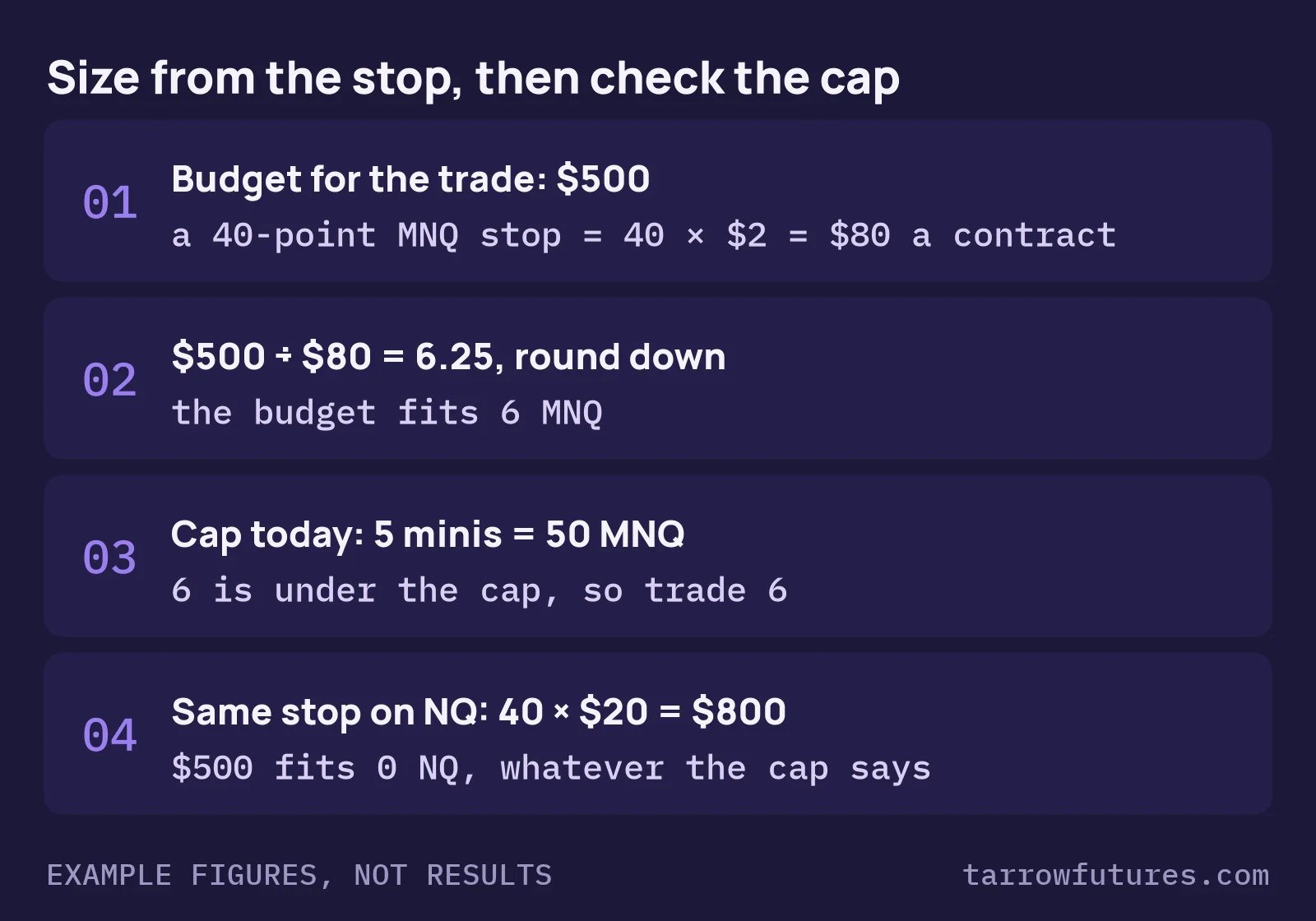
In this example the cap doesn't bind at all; the budget does. The cap starts to matter when a trader sizes from the tier instead ("I'm allowed 5, so I'll trade 5"). Five NQ on the same 40 point stop risks 5 × $800 = $4,000, which is twice a $2,000 drawdown on an example $50,000 plan.
Where scaling plans catch traders
- Adding to a position. The cap covers everything open at once. Holding
3minis and adding1is4, over a3mini cap, even if each order on its own was small. - The day after a loss. The cap fell overnight, but the order template on the platform still says the old size.
- Mixing contracts.
2NQ and15MNQ is3.5minis under the ten-to-one rule, over a3mini cap. - Reading the wrong stage. An evaluation limit and the limit for the stage after it can be different numbers. Check which table applies to the account in front of you.
- Trusting the platform to stop you. Some platforms reject an order over the cap. Others accept it and the rulebook counts it as a violation. Find out which before the order, not after.
The rulebook lines to find
Before you buy, find these lines in the contract limit section (the rulebook post covers the other nine sections):
- Which stage it covers: the evaluation, the next stage, or both.
- The tiers: the profit levels and the cap at each one.
- When the tier is checked: end-of-day balance, intraday balance, or once a week.
- Whether it steps down after a loss, and when.
- How micros count: ten to one, or one to one.
- What happens on a breach: order rejected, position closed, or a rule violation.
If any of the six isn't written down, ask the firm and keep the answer.
Common mistakes
- Treating the tier as a target. It is the most the rules allow. Size from the stop.
- Counting the intraday peak. In an end-of-day plan, only the close moves you up a tier.
- Forgetting it steps down. A losing day can take a tier away before the next open.
- Assuming micros count ten to one. Some plans count every micro as a contract.
- Checking the cap once a day. Check it before every order, including adds.
Work out your own size
The position size calculator takes your stop, your contract and your budget for the trade, and shows how many contracts fit and how many full stops your daily limit and drawdown hold. Compare that number with today's cap and trade the smaller. It is free with your email, below.
Diagrams on this page are drawn by Tarrow Futures from made-up inputs; they are not market data or trade results. Figures are before commissions and slippage. MNQ and NQ point values: CME Group contract specifications.
Free tool · free with your email
Position size calculator
Turn today's loss budget and your stop into a contract count. We email you the link, so it is one tap away next time.
✓ It's yours. The link is on its way to your inbox. Open the position size calculator now
See what the position size calculator does firstQuestions
What is a scaling plan in a prop firm?
A contract limit that depends on your profit. A new account starts with a low maximum number of contracts, and the maximum rises in steps as the balance passes set profit levels. In many plans the level is checked on the end-of-day balance, and a losing day can drop you back a step.
Does a scaling plan apply during the evaluation?
It depends on the plan. Some apply a scaling plan only after the evaluation, some apply it in the evaluation too, and some have a single fixed contract limit instead. The rulebook's contract limit section says which stage it covers.
How do micros count in a scaling plan?
Plans count them in one of two ways: ten micros as one mini, or each micro as one contract. Under a 3-contract cap, the first reading allows 30 MNQ and the second allows 3 MNQ. Find the exact sentence in the rulebook before you size a trade.
What happens if I trade more contracts than the scaling plan allows?
It depends on the plan and the platform. An order over the cap may be rejected, the extra contracts may be closed, or the trade may count as a rule violation. Read what the rulebook says happens on a breach, and check the cap before every order, not only the first one of the day.
Should I trade the maximum my scaling tier allows?
No. The tier is the most the rules allow, not a size. Size each trade from your stop and the loss you can afford today, then take the smaller of that number and the cap.
Educational material only. Not financial, investment or trading advice, and not a recommendation to trade any contract or size. Prop firm rules differ and change; the current rulebook of the firm you use decides. Worked examples use example figures, not results. Futures trading involves substantial risk of loss. Evaluations are paid tests and most people who take one do not pass.