Home / Blog / Strategy Testing & Automation
Strategy Testing & Automation
What is a break and retest strategy?
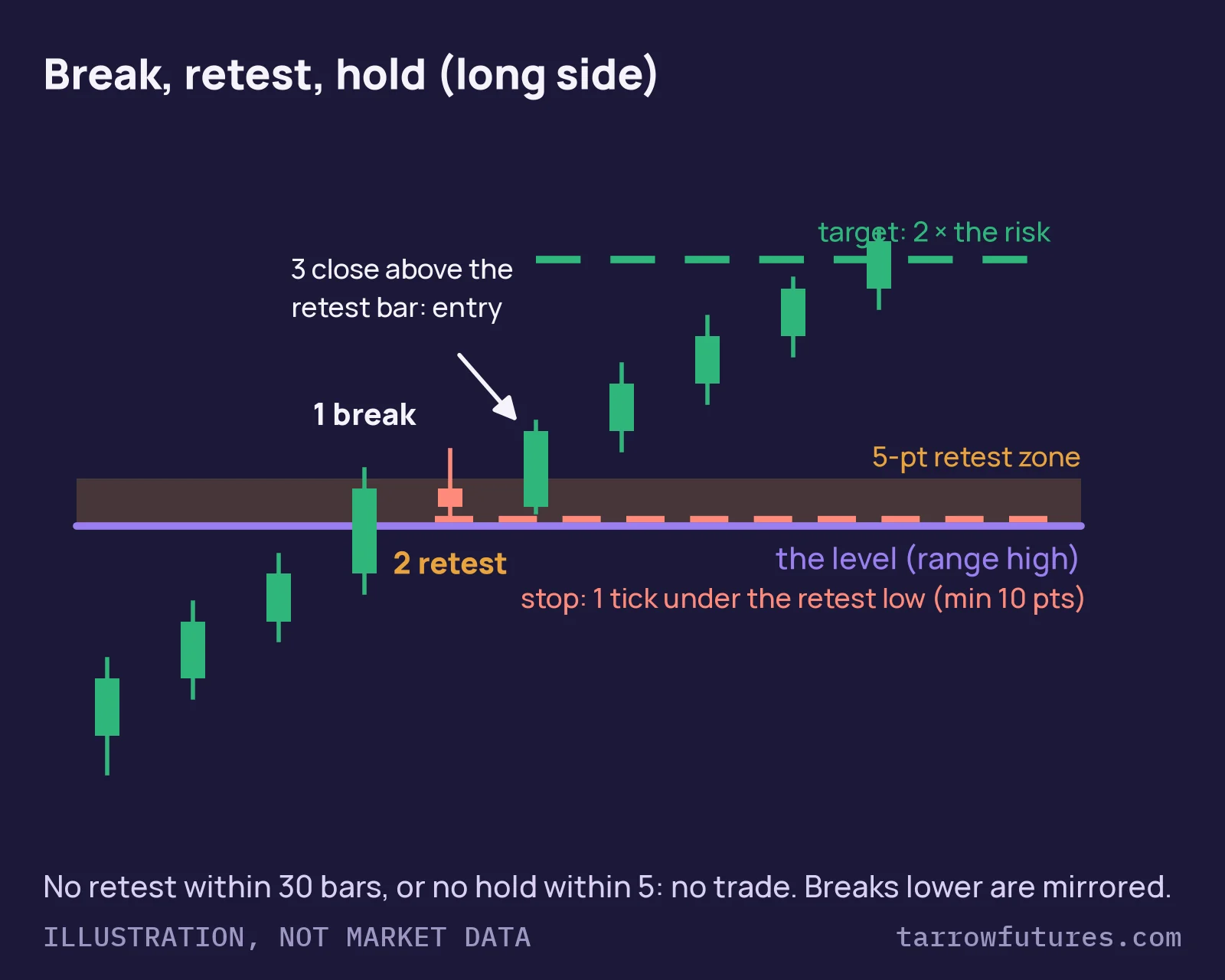
A break and retest strategy waits for price to close through a level, come back to test it from the other side, and hold, then trades in the direction of the break with the stop just past the retest. The logic: a level that was resistance before the break should act as support after it (and the reverse below).
It is the patient version of the opening range breakout. The breakout enters on the break and takes a wide stop; the retest waits for a second look and a tighter stop, and accepts that the second look often never comes. Below: the three edges every retest rule needs, the rules as numbers, three real MNQ sessions (a target, a stop and a day with no trade), and how it fits a trailing drawdown.
Free strategy breakdown · free with your email
Break and retest breakdown
The rule card with exact retest edges, a target, a stop and a no-trade day on real MNQ sessions.
✓ It's yours. The link is on its way to your inbox. Open the break and retest breakdown now
Read the free overview firstThe three edges a retest rule must define
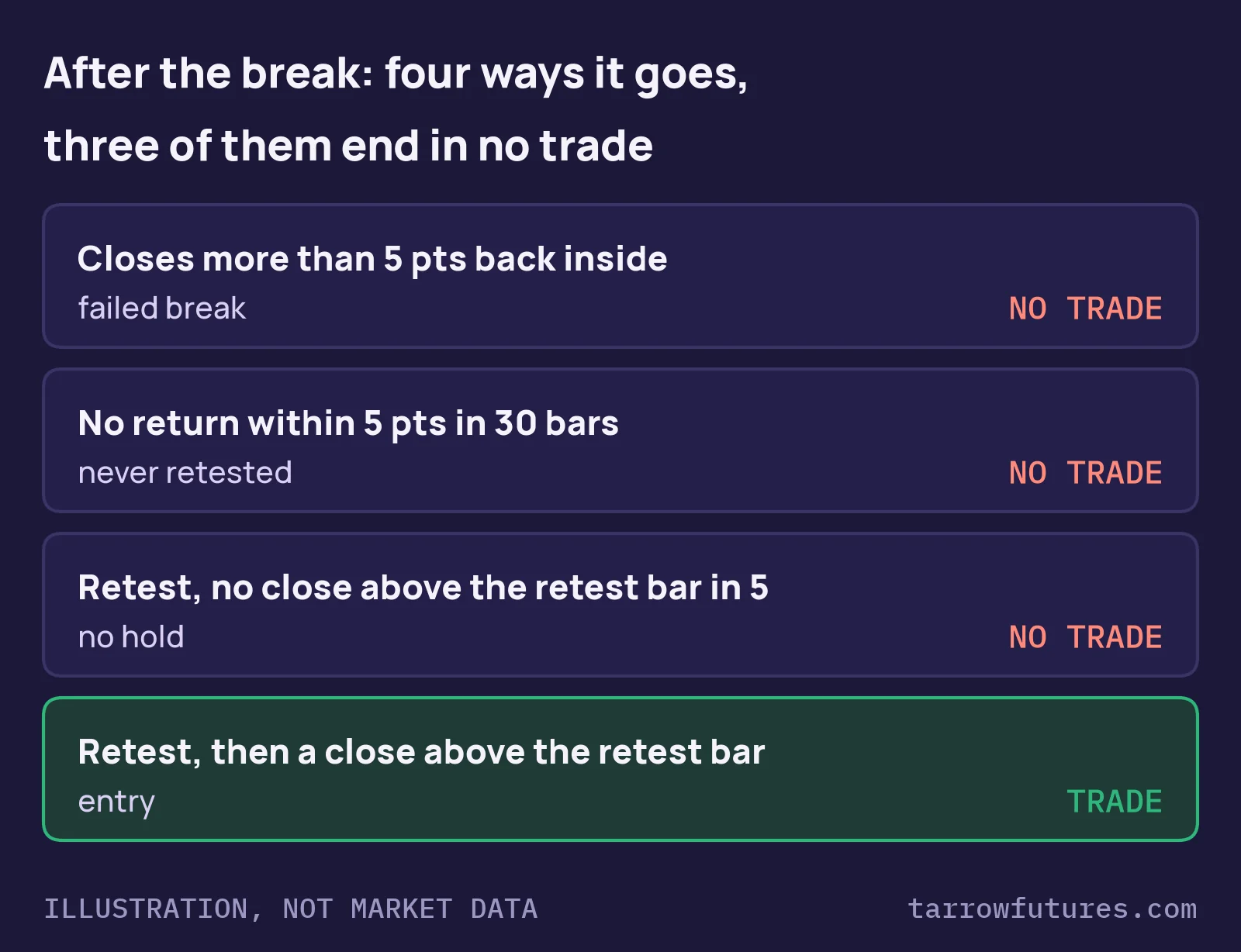
- How close counts? Our example: within
5points (20ticks) of the broken level. - How long do you wait? Our example:
30one-minute bars after the break, then the setup expires. - What if price never returns? No trade. And a close more than
5points back inside the range cancels the setup (a failed break).
Without those numbers, "retest" can be found on any chart after the fact.
The rules, as a checklist
On 1-minute MNQ bars:
- Level: the 30-minute opening range, the high and low from
9:30to9:59ET (a common choice). - Break: the first close outside it, between
10:00and11:30ET. - Retest: back to within
5points of the level within30bars, with no close more than5points back inside. - Entry: within
5bars of the retest, the first close beyond the retest bar's extreme in the break direction. - Stop: one tick past the retest's extreme, at least
10points. Target:2 ×the risk. Flat by15:50. - Cap: one trade a day, or none.
This is taught as a worked example of the rules; that is not evidence it is profitable.
A session where the rules worked
Past session, selected to show the rules, not a typical result. MNQ1!, 1-minute, 2 September 2026; chart: TradingView snapshot, levels and labels marked by Tarrow Futures. MNQ is $2 a point (CME Group contract specs).
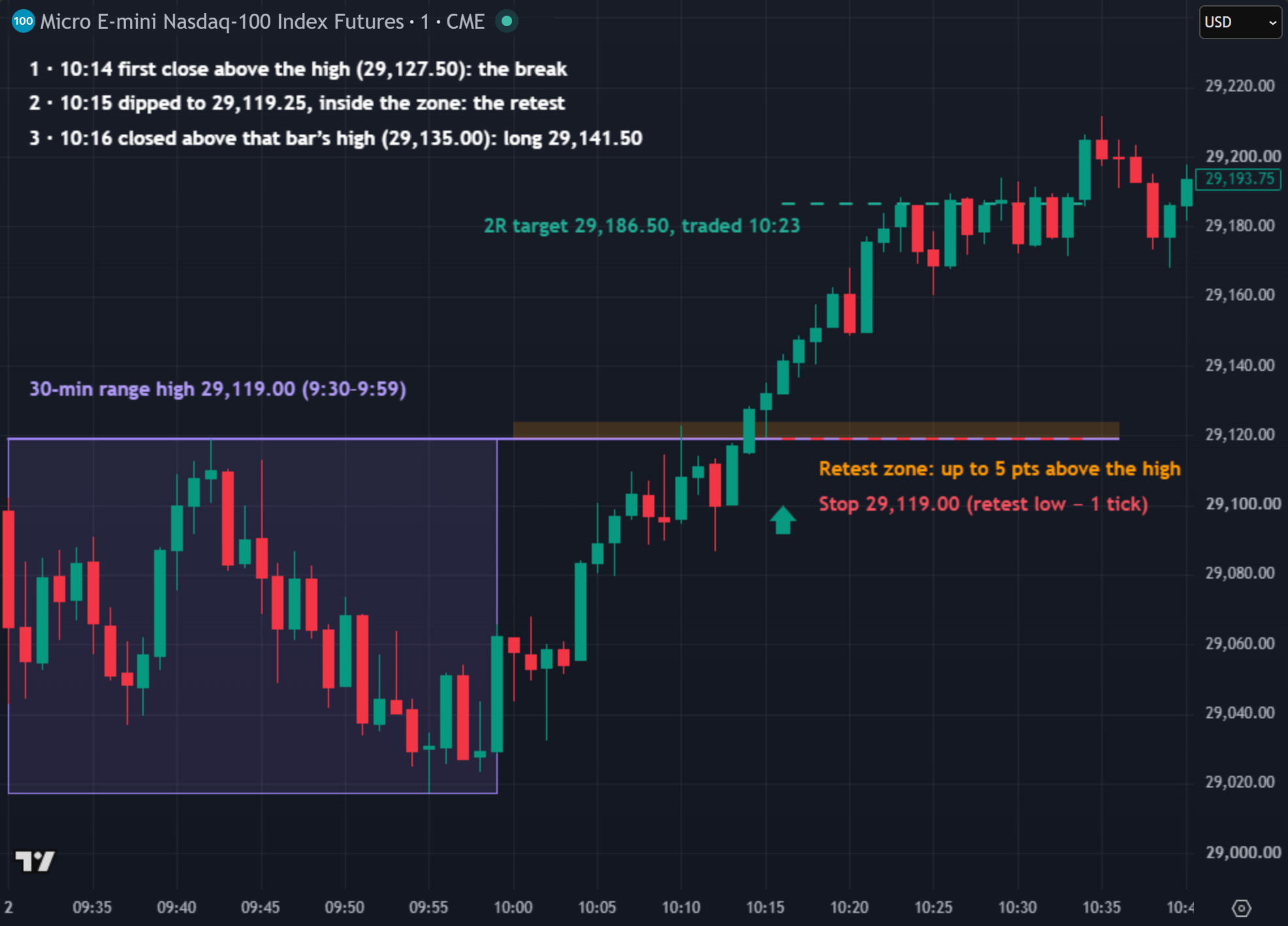
| Step | Value |
|---|---|
| Range high (9:30–9:59) | 29,119.00 |
| Break / retest / entry | close above at 10:14 (29,127.50), back to 29,119.25 at 10:15, long at 10:16, 29,141.50 |
| Stop | 29,119.00, 22.5 pts → 4 MNQ at a $200 example budget with a 2-pt cost allowance ($180 at risk) |
| Outcome | Hypothetical: 2R target 29,186.50 traded at 10:23, 45 × $2 × 4 = +$360 before costs |
A session where the same rules failed
Past session, selected to show the rules, not a typical result. MNQ1!, 1-minute, 2 October 2026; chart: TradingView snapshot, levels and labels marked by Tarrow Futures.
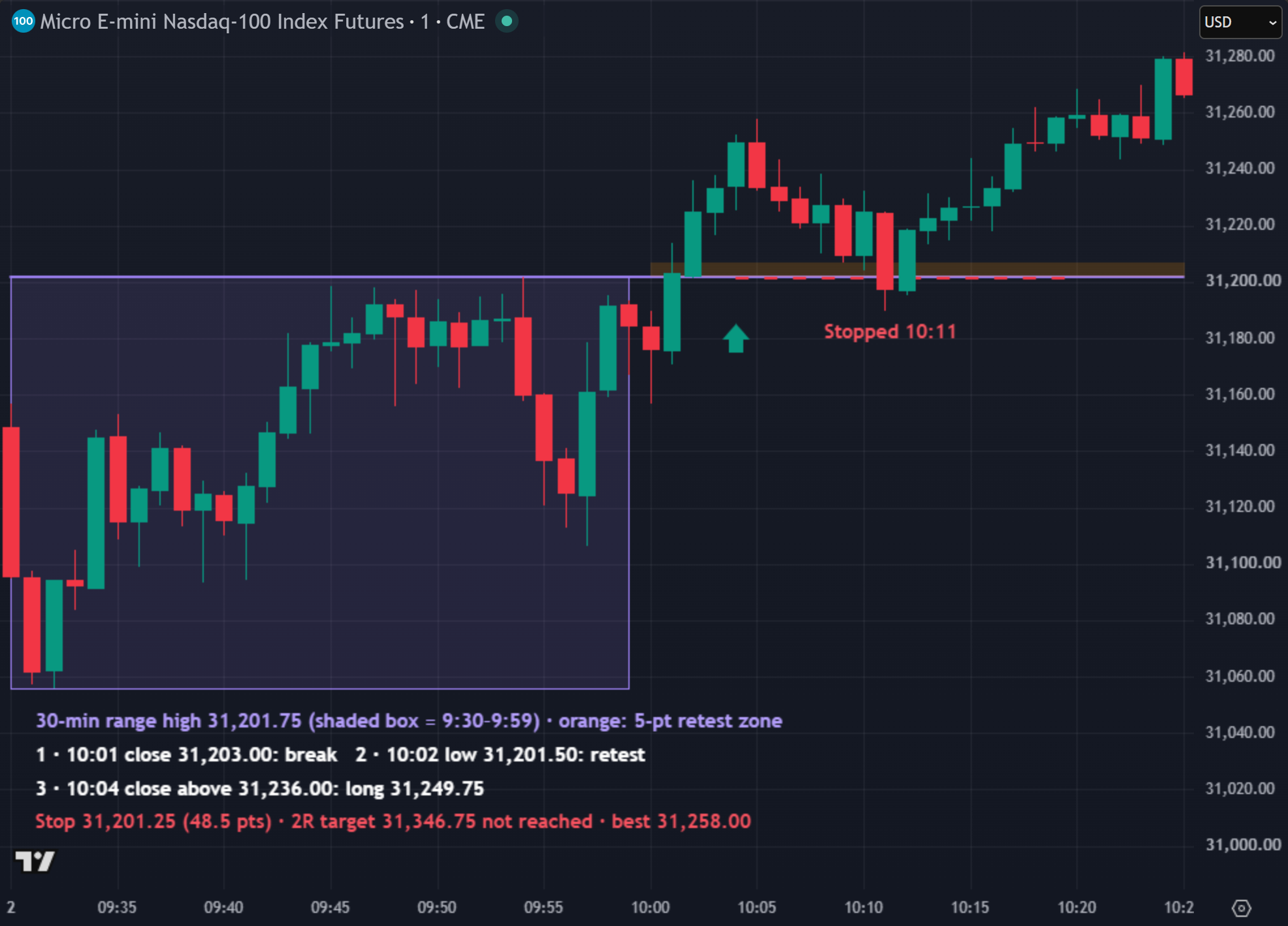
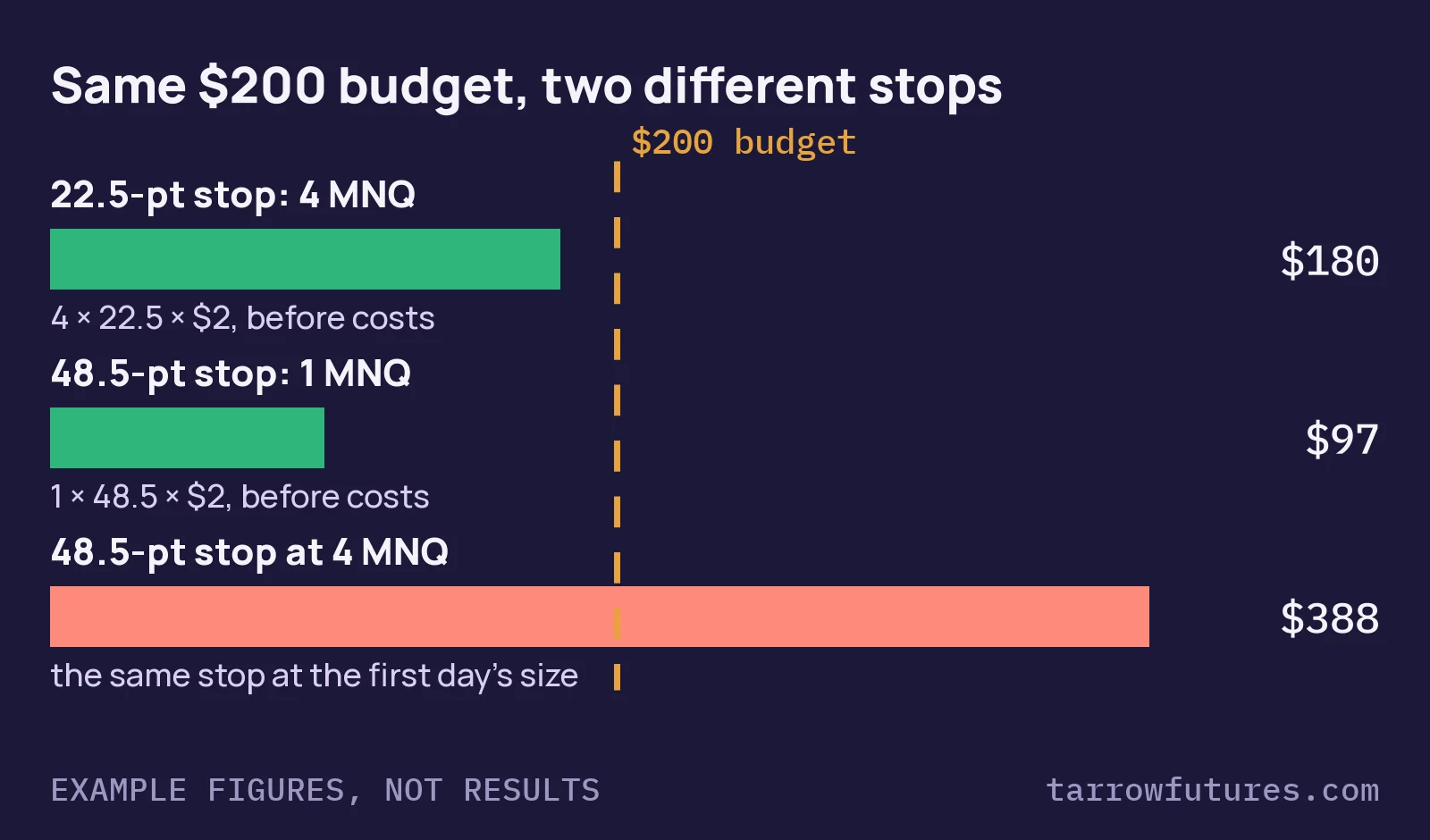
Break above the range high of 31,201.75 at 10:01, retest at 10:02, long at 10:04 (31,249.75), stop 31,201.25: 48.5 points, so 1 MNQ at the same budget. Hypothetical: the best price after entry was 31,258.00, then the stop traded at 10:11, −$97 before costs. At the first session's size of 4, the same stop would have cost $388. The stop sets the size, every time. And one trade a day means no re-entry when price climbed back above the level later that morning. We don't offer a filter that separates holding retests from failing ones; test any filter before trusting it.
A session where the rules did nothing
Past session, selected to show the rules, not a typical result. MNQ1!, 1-minute, 18 September 2026; chart: TradingView snapshot, levels and labels marked by Tarrow Futures.
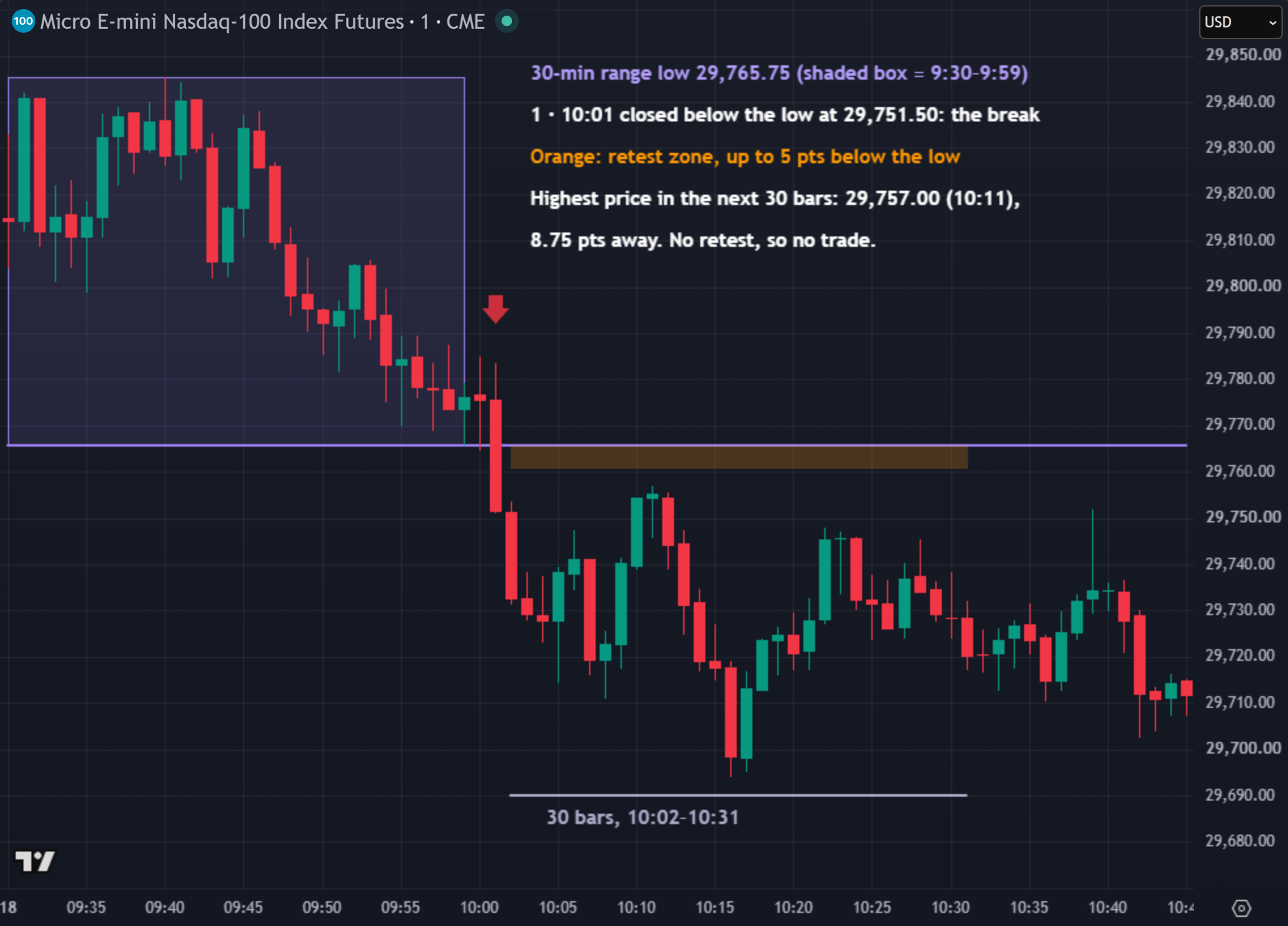
The range low of 29,765.75 broke on the 10:01 close (29,751.50). In the next 30 bars the highest price was 29,757.00, 8.75 points away: close, but not within 5. No trade. That is the strategy working as written, and it is the moment most traders break it by chasing.
Hypothetical results. The outcomes above are what the written rules would have done on selected past sessions, before commissions and slippage; they are not trades anyone placed. CFTC Rule 4.41: hypothetical or simulated performance results have certain limitations. Unlike an actual performance record, simulated results do not represent actual trading. Also, since the trades have not been executed, the results may have under- or over-compensated for the impact, if any, of certain market factors, such as lack of liquidity. Simulated trading programs in general are also subject to the fact that they are designed with the benefit of hindsight. No representation is being made that any account will or is likely to achieve profit or losses similar to those shown.
How it fits prop firm rules
- Daily loss limit. One trade at a
$200example budget is a$200worst day by rule, a fifth of a$1,000example limit. Size from the stop with the position size calculator. - Trailing drawdown.
$2,000 ÷ $200 = 10full stops in a row, fewer once the floor trails up. Under an intraday trailing drawdown, a trade that gets most of the way to 2R and reverses costs twice: at4MNQ,+$320open then a−$180stop shrinks the room by$500. - Consistency. Under a 50% rule (example), a
$360best day needs$720of total profit; check yours with the consistency rule checker.
Common mistakes
- No distance for "retest". Any pullback becomes a retest after the fact. Pick a number.
- No time limit. A level touched two hours later is a new setup, not a retest.
- Chasing the break that didn't come back. The no-trade day is part of the rules.
- Same size for every stop. A retest stop can be twice as wide one day as the next. Size each trade from its own stop.
For how this compares with other day trading strategies under the same prop rules, see futures trading strategies ranked by difficulty.
Test it before you trade it
Fix the level and the three edges before you look at results, judge any other level on sessions you did not use to choose it, count the no-trade days, include costs, then forward-test on a simulator. Our free guide, Build It, Break It, Then Trade It, shows how.
The full break and retest breakdown has the rule card, all three real MNQ sessions step by step and the prop-rule arithmetic. It is free with your email, below.
Charts are TradingView snapshots of past sessions; the levels and labels on them were added by Tarrow Futures. Trade outcomes shown are hypothetical; see the CFTC Rule 4.41 notice after the examples above. Diagrams labelled as illustrations are drawn by Tarrow Futures and are not market data.
Free strategy breakdown · free with your email
Break and retest breakdown
The rule card with exact retest edges, a target, a stop and a no-trade day on real MNQ sessions. We email you the link, so it is one tap away next time.
✓ It's yours. The link is on its way to your inbox. Open the break and retest breakdown now
Read the free overview firstQuestions
What is a break and retest?
Price closes through a level, comes back to test that level from the other side, and holds. A break and retest strategy enters on that hold, in the direction of the original break, with the stop just past the retest.
How close does price have to come for a retest?
There is no standard; you have to choose a number and write it down. Our worked example counts a retest when price comes back to within 5 points (20 ticks) of the broken level on MNQ, and cancels the setup if a bar closes more than 5 points back inside.
What if price never comes back to retest the level?
Then there is no trade. Set a time limit (our example uses 30 one-minute bars) and let the setup expire. Chasing the break is a different strategy with a wider stop.
What is the win rate of a break and retest strategy?
There is no single figure; it depends on the level, the retest rules, the market, the period and costs, so we don't quote one. Our version is taught as a worked example of the rules; that is not evidence it is profitable. Test your own exact rules, with costs, on many sessions.
Is break and retest better than a breakout?
Not proven either way. A retest entry usually has a smaller stop than a breakout entry, but it skips every break that never comes back. Which trade-off suits you is something to test with costs, not assume.
Educational material only. Not financial, investment or trading advice, and not a recommendation to trade any contract or size. Prop firm rules differ and change; the current rulebook of the firm you use decides. Worked examples use example figures, not results. Futures trading involves substantial risk of loss. Evaluations are paid tests and most people who take one do not pass.